Publications and Resources
Toda has published numerous Policy Briefs and Reports, as well as books and journals, over the last twenty years. See below for the publications in each thematic area. Guidelines for authors can be found here.
See the full list of Policy Briefs and Reports or view Policy Briefs and Reports by Research Theme:

Peace and Security in Northeast Asia
A Third Cold War
Report No.288 - March, 2026 • By Barry Buzan
This report argues that in 2025 the Second Cold War which followed a period of cold peace was succeeded by a Third. The Second Cold War was different from the First in being less about ideology and having close economic interdependence between China and the West. This Third Cold War has both a radically different pattern of alignments and an ideological shift to the values and aspirations of the far right and looks potentially quite durable. In other words, the condition of cold war remained continuous, but the architecture and aims of it changed dramatically.

Social Media, Technology and Peacebuilding
Escaping the Multipolar Trap in Global Climate Negotiations: A Deliberative Negotiation Technology and Simpol-Based Simulation
Report No.287 - March, 2026 • By Ernest Thiessen, John Bunzl, and Leland Beaumont
This report examines how deliberative technologies can restructure climate negotiation architecture to enable multi-issue, mutually beneficial agreements that can be simultaneously implemented without undermining relative competitiveness. Using a Smartsettle Infinity simulation of an alternative global climate negotiation architecture, the report demonstrates how private preference modelling, structured trade-offs, and optimisation algorithms can generate Pareto-superior policy packages at the global scale. The contribution lies in illustrating a deliberative decision-support architecture capable of identifying coordinated, politically viable outcome packages under realistic strategic constraints. The findings point toward new pathways for coupling deliberative negotiation technology with citizen-driven political mobilisation to strengthen global climate governance.
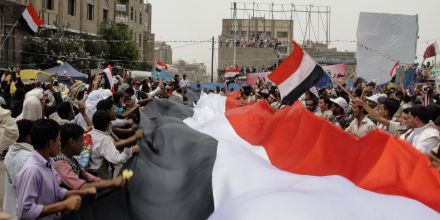
Yemen: An Aborted Democratic Dream
Report No.286 - March, 2026 • By Nabil Al-Bukairi
This report analyses the challenges in Yemen which has for fourteen years suffered from the problem of aborted democratization. This is aggravated by acute and continuous state failure. After a discussion of state fragility since the popular uprising of 2011, the report outlines what is needed in Yemen. This includes a process of national reconciliation without which no democratization will be ever possible, to revive the National Dialogue begun in 2013-14, a strategy of stabilization, and a development and social justice vision to prevent further state collapse.

A New Syria in a ‘New Middle East’: Challenges and Opportunities for Democratization
Report No.285 - March, 2026 • By Larbi Sadiki and Layla Saleh
This report seeks to chart the political transition and the prospects for pluralist, if not democratic, rule in a situation that remains very much in flux since the fall of the Assad regime in Syria in December 2024. Profound changes in Syria, spearheaded by President (of the Transitional Phase) Ahmed Al-Sharaa and his government, unfold in a setting where issues of security and basic territorial sovereignty remain highly volatile, shaped by regional and international dynamics. Following analysis of the political transition, the civic space and pressing security issues, a set of recommendations suggests ways that civil society and international stakeholders can work towards greater inclusiveness and popular participation.

Lebanon’s Democratization: The Impasse of Political Parties Reform
Report No.284 - March, 2026 • By Dania Koleilat Khatib and Amine Bashir
This report focuses on the impasse of legal and political reform in Lebanon, with special reference to political parties. It examines some of the chief challenges Lebanon’s political parties face in a fragile and sectarian political system. In particular, how do the obstacles to reforming political parties limit the prospect of genuine democratization? It addresses how these obstacles historically played out in three different arenas: a) within the country’s existing sectarian political parties, b) within parliament, and c) within the legal profession. It concludes with a policy approach that is key for brokering forms of representation and distribution of power that have the potential to state–society relations more inclusively and democratically.
Books (1996-2017)
Toda Peace Institute's Publications: Complimentary copies of our publications are available where noted.
Journals (1996-2017)
Peace & Policy: Since 1996, Peace & Policy has become a significant journal of opinion on global peace and policy issues.