Why Cultural Security is Key for Climate Security: Insights from the Pacific and the Maldives
Claudia Fry, Zahiya Saeed, Malakai Waqa-Kaitani, Anna Gero and Carol Farbotko
September 29, 2026
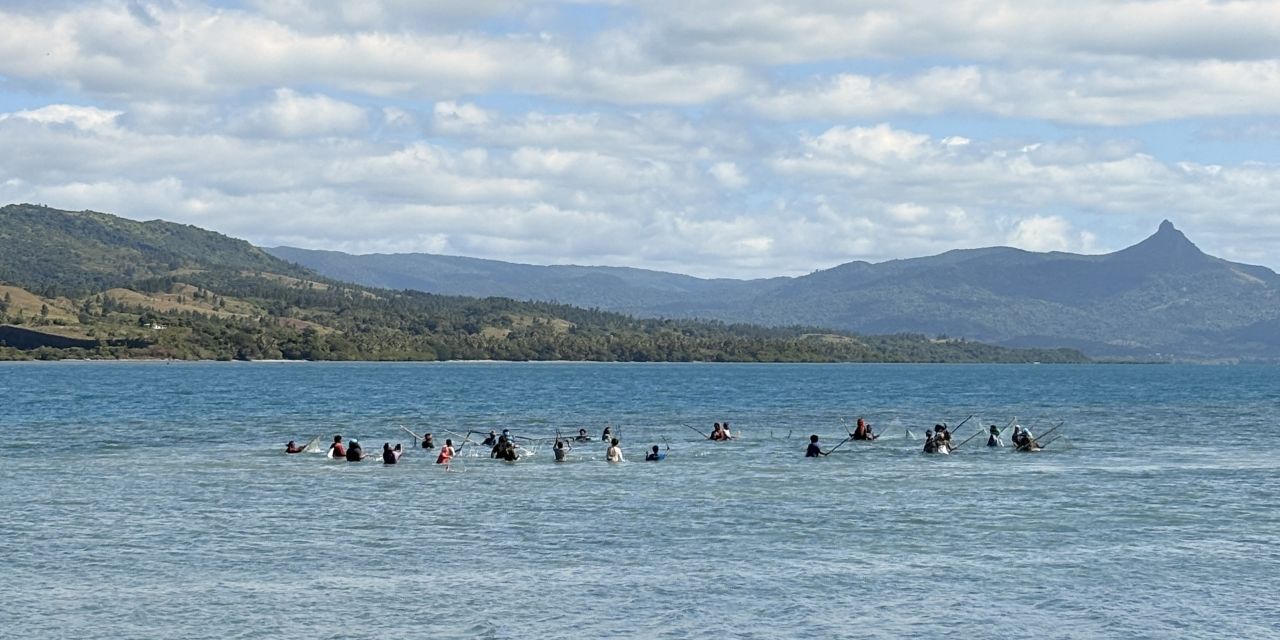
Image: Supplied
This paper draws from the knowledges and experiences of communities across Fiji and the Maldives to highlight that the most enduring forms of climate security are those already embedded in cultural practices. Cultural security thus helps reframe climate security and adaptation from ‘fixing risk’ and ‘reducing vulnerability’ to maintaining meaningful ways of being under increasingly uncertain conditions. As illustrated across Fiji and the Maldives, cultural security provides critical peacebuilding mechanisms by strengthening social cohesion, supporting conflict resolution, and enabling collective responses to climate change. Most importantly, cultural security reminds us to build on the already existing strategies, systems. and knowledge that have long guided communities and continues to do so into uncertain futures.
Contents
- Situating cultural security within climate security
- Engaging with cultural security in practice: Community stories from Fiji and the Maldives
- Opportunities to embed cultural security as an element of adaptation and climate security
- Towards cultural security in policy and practice
Situating cultural security within climate security
In recent years, climate security has gained increasing traction in policy attempts to address the cross-sectoral impacts of climate change (Waiwai 2026). Climate security is an emerging space with its own politics (e.g.
McDonald 2018), and its definitions and policy pathways are contested. However, the core pillars of climate security are generally considered to be:
- Human security
- Climate adaptation and resilience
- Conflict prevention and peace
- State security and protection of sovereignty
- Human mobility management
- Economic and financial stability
- Geopolitical and strategic security
- Effective governance and justice
Cultural security (see Box 1) expands conventional security frameworks (Tarawa and Bryar 2026) by centring people and communities, emphasising the maintenance and restoration of cultural identity, social cohesion, and meaningful people–place relationships in the face of profound environmental and societal change.
Drawing from Pasifika thought-leaders (Vaai 2019; Koya Vaka’uta et al. 2022; Naupa 2023), cultural security emphasises cosmo‑centric and relational worldviews, where power includes responsibility to protect relations to land and sea.
Box 1: Cultural Security
Cultural Security refers to the protection and strengthening of the relationships, identities, governance systems, knowledge traditions and spiritual values through which communities maintain wellbeing, continuity, and resilience in the face of environmental and social change.
Core elements of cultural security include (Boege 2023):
- Customary governance and conflict resolution
- Intergenerational transfer of traditional knowledge
- People–place relationships
- Social inclusion and protection
- Cultural innovation and adaptation
- Rituals and ceremonies
While cultural security shares important concerns with human security, the two concepts are not synonymous. Human security has traditionally focused on protecting individuals from threats to their lives, livelihoods, health, and wellbeing. Cultural security is fundamentally relational, putting the protection of the relations between people, land, sea, sky, ancestors, and future generations at the fore.
This perspective is based on the recognition that climate change is experienced through its impacts on relations; sea-level rise and ocean degradation, for example, disrupt relations to land and fishing grounds and with that also disrupt the cultural elements connected to these. This could include the inability to fulfil cultural obligations in the sea or the loss of connections to ancestors as gravesites are flooded during king tides (Fry and Waqa-Kaitani 2026). Here, cultural security adds that responses to the climate crisis may themselves generate insecurity when cultural dimensions are ignored, where, for example, climate related planned relocation exacerbates already ongoing disruptions to land and ocean-based relationships (Raisele et al. 2025). When externally imposed donor-centric technocratic adaptation approaches disregard local cosmologies (Ocharan et al. 2021), outcomes can include the erosion of culturally grounded mechanisms of social cohesion and security (Acharya 2025), the undermining of collective efforts (McNeeley and Lazrus 2014), disruption of traditional norms of reciprocity (Nabobo-Baba 2008) and worsened psycho-social wellbeing (Raisele et al. 2025).
Cultural security recognises that these social, cultural, spiritual, and ecological relationships are central to what makes life meaningful and sustains collective identity. In many Pacific and Indigenous contexts, cultural and social practices serve to maintain and restore these relationships. Indeed, concepts of relational and ontological security emphasise that for many communities, the interconnectedness between people, land, ocean, and the spiritual world is central to identity, stability, continuity, and meaning in one’s life (Campbell 2019; Farbotko 2019; Tiatia-Seath et al. 2020; Raisele et al. 2025).
Climate-related peace and security concerns therefore extend beyond immediate physical and material threats to include the erosion of social cohesion and collective ways of living, growing tensions over access to land and ocean resources, conflicts between displaced and host communities, and declines in individual and collective wellbeing. Threats to ancestral lands, customary governance systems, cultural practices, and people–place relationships are therefore not only threats to wellbeing, but to the foundations of peace and security itself.
Indeed, a cultural security perspective understands peace not simply as the absence of conflict, but through the quality, strength, and harmony of relationships sustained through cultural institutions. Cultural security therefore provides a foundation for understanding the climate–peace nexus (Bryar and Tarawa 2026).
These perspectives are not new but build on knowledge transmitted over generations across local and Indigenous communities, some of which are described in the next section of this paper. However, contemporary adaptation governance continues to be shaped by technocratic assumptions that marginalise these long-established ways of knowing and responding to change. The dominant, technocratic adaptation machinery (Eriksen et al. 2021) continues to operate according to a particular logic. This machinery, comprising financial systems, institutions, operating/implementing systems, and metrics used to define success, commonly prioritises technocratic expertise grounded in Western and Eurocentric worldviews. Alternative adaptation imaginaries (Olazabal et al. 2024) are constrained and Indigenous and local strategies continue to be sidelined as climate security policy narrowly focuses on maintaining geopolitical stability and economic development trajectories (Waiwai 2026). Interventions that overlook cultural security may therefore inadvertently exacerbate existing tensions and generate further peace and security implications. Cultural security offers an opportunity to dismantle and rebuild the adaptation machine, to centre cultural knowledge and practices as critical for climate security.
Existing climate security frameworks such as the Pacific’s Boe Declaration increasingly recognise culture as integral to peace, resilience, and regional stability. There is opportunity here to add to this discussion by highlighting some of the specific ways in which cultural systems offer solutions and strategies for navigating climate security related challenges.
In doing so, we emphasise an important reframing in terms of how climate security is understood; a cultural security framework moves beyond notions of deficit, dependency, and vulnerabilities of communities, towards recognising and building upon the strengths, knowledge, capacities, and strategies that already exist within communities. In other words, we highlight the central contribution of cultural systems to sustaining peace and climate security. Importantly, cultural security contributes to peacebuilding through strengthening customary governance, conflict resolution, social cohesion, collective decision-making, and restorative practices that support adaptation. Cultural security therefore provides a foundation for a Pacific climate–peace nexus (Bryar and Tarawa 2026).
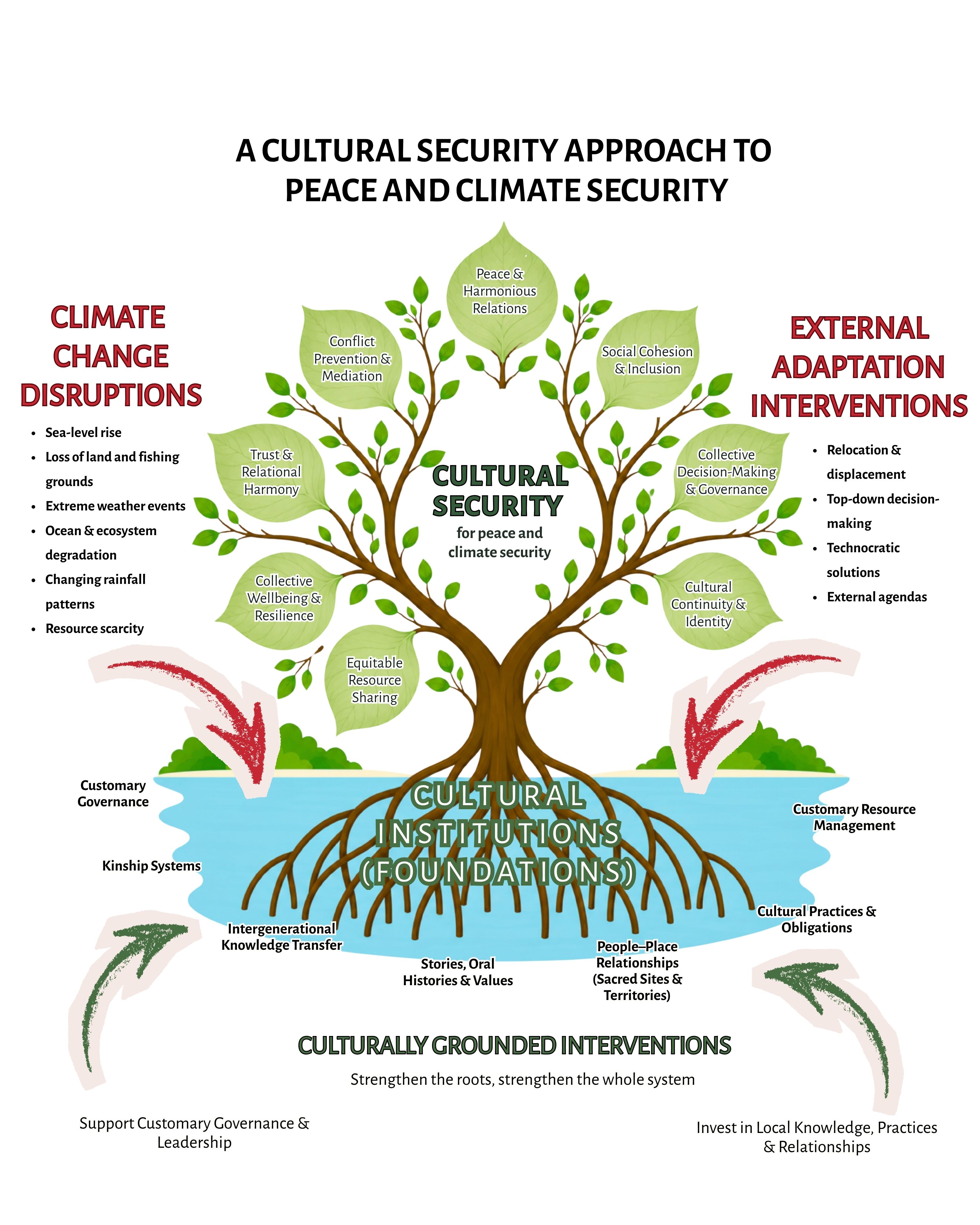
Figure 1 illustrates these multidimensional interconnections through the metaphor of a mangrove. The image highlights how culturally grounded interventions that recognise, strengthen, and value cultural institutions, represented by the roots and foundations of communities, support and reinforce broader dimensions of peace and security. These outcomes, represented by the leaves, are sustained by strong cultural institutions that enhance communities’ capacity to navigate disruptions associated with climate change and other destabilising external factors.
In the figure, the impact of climate change on cultural institutions is represented by the red arrow on the left. Here, disruptions such as sea-level rise and ocean degradation, which can lead to the loss of land and fishing grounds, indirectly affect cultural institutions that are inseparable from relationships to land and sea. Similarly, the red arrow on the right illustrates how external adaptation interventions may disrupt cultural institutions, for example by disconnecting people from place, disrupting intergenerational knowledge transmission, or undermining customary governance systems through top-down decision-making. In both cases, these disruptions have broader implications for cultural security.
In the following section, we engage with community experiences from Fiji and Maldives to identify place-specific examples of cultural security, including culturally grounded community-based practices and strategies that build climate security. These examples highlight the core aspects of cultural security (Box 1) and are followed by proposed opportunities to more effectively embed cultural security as a foundation to climate security.
These emerge from strands of our research and lived experiences of working with communities across the Pacific and the Maldives. We extend our deepest gratitude to the communities who have welcomed us to spend time in their communities. We recognise community members as the holders of the knowledge and stories shared in this paper. The authors have been granted permission by community leaders to share stories and knowledge presented here.
The narratives from Fiji emerge from in-depth, culturally grounded, and decolonial research, drawing on research methods, knowledge systems, values, ethics, and protocols of the Vanua. The second author is a Maldivian researcher whose perspectives on governance, gender and climate adaptation are informed by her lived experience in the Maldives, previous work with NGOs, and extensive fieldwork engaging with local councils, providing an in-depth understanding of the cultural, political, and institutional contexts through which Maldivian communities experience and respond to climate change. The third author is an Indigenous Fijian researcher who shares kinship links to the case study communities in Fiji. This brings a wealth of culturally grounded knowledge of Vanua, customary governance and kinship in place. The first, fourth and fifth authors are non-Pacific islanders working in the Pacific. Acknowledging that our own itulagi, ‘side of the heavens’, is limited and partial (Vaai 2025), shaped by training within Western academic systems, we are committed to processes of unlearning and relearning from Pasifika knowledge systems.
Engaging with cultural security in practice: Community stories from Fiji and the Maldives
EXAMPLES FROM FIJI
In Fijian iTaukei (Indigenous) contexts, customary governance remains one of the key mechanisms to fostering climate security through multiple mechanisms, including but not limited to: the allocation of resources, the fostering of social cohesion and inclusion, conflict resolution and reconciliation, the organising of collective work, decision-making about risk and habitability, preservation of sacred places, and transferring of knowledge across generations.
For example, governance systems of the Vanua serve to maintain social cohesion, achieved through the collective responsibility of different clans in the Vanua (land) who all hold specific roles. In traditional Fijian governance systems these include: the chief (turaga), steward chief (sau turaga), warrior (bati), fisherfolk (gonedau), born carpenters (mata i sau) and the priest (bete). These roles function together to maintain stability and peace, and the protocols embedded in these structures provide mechanisms for conflict prevention, mediation, and restorative justice. For instance, if there are two conflicting parties, the community may draw on matanigasau, a traditional reconciliation protocol whereby two conflicting parties come together to resolve their problems, thus offering practical solutions to managing disputes and fostering peace within the community.
These roles also become important as communities organise themselves in responding to climate-induced disasters, as seen in the aftermath of Tropical Cyclone Winston in 2016. The rebuilding of the houses that were destroyed was led by the clan of the mata isau (born carpenters). The clan of the gonedau (fisherfolks) would go out to fish, while women and other members of the communities would work according to their traditional roles and responsibility, reinforcing collective labour in disaster recovery.
In addition, the indigenous Fijian concept of solesolevaki (working together to achieve a common goal) is reinforced and sustained when these traditional roles are functioning well, providing a mechanism to foster social cohesion, inclusion, and peace. Collective work brings community members together to undertake activities such as preparing food, weaving mats, and planting crops. The cornerstone of solesolevaki is having strong kinship relations, respecting the values of the Vanua and being grounded in the roles that defines their traditional statuses. Solesolevaki thus reinforces social cohesion and social inclusion, as community members collectively contribute to social, economic, and cultural life, making it an important peacebuilding practice. In bringing together community members of various ages to carry out traditional work such as weaving mats or fish nets, solesolevaki also provides a space for intergenerational knowledge transfers. This in turn strengthens collective and cultural identity and builds social cohesion.
Importantly, when communities choose to stay, cultural security can support strategies to adapt in place.
These traditional roles and practices remain central for communities in responding to climate change, where cultural and collective continuity is put at the centre for how climate security is understood and enacted. For example, the fisherfolk tribe of Nukui, located in the province of Rewa on the island of Viti Levu in Fiji, refused the Fijian government’s advice to relocate to ensure that their traditional roles, grounded in their customary fishing grounds (qoliqoli), are not disrupted. Here, cultural continuity is maintained when community members have fulfilled their role of presenting their catch to the paramount chief in the Rewa province during traditional ceremonies. Staying in place ensures continued access to fishing grounds and thus ensures the protection of ritual and ceremony which create belonging, trust, and forge collective identity—all central to building resilience. Staying in place further allows community members to pass on these place-based rituals to their children, reinforcing intergenerational knowledge transfers. Experiences from Nukui show how customary governance systems are central to decision-making for culturally grounded adaptation pathways, prioritising the safeguarding of places and relationships through which communities sustain belonging, trust and collective identity—foundations of cultural security.
In another example from Fiji, the residents of Vunisavisavi, located in the Caukadrove province of Vanua Levu, highlighted that cultural security means obeying the ancestral ordinance to guard the ancestral home foundation or Tui Cakau-Yavu Lalagavesi. This ancient site is where the first Tui Cakau in the province of Cakaudrove was installed. It contains the mana (power) wielded by their chief and serves as evidence of the relationship they have with dakuwaqa, their ancestral shark god. These physical and cultural sites are symbolic of people–place relationships that reflect the inseparable connections people have to sacred sites where their identities are found. However, it also highlights the centrality of ritual and ceremony for cultural security, where these elements create belonging, trust, identity, and continuity. Indeed, guarding the Tui Cakau Yavu-lalagavesi is an act of ritualising the sites in maintaining the connection with their ancestor god. These cultural sites are active when it is guarded and respected and can also be the source of mana and power for their chief and the Vanua. Elders of Vunisavisavi for example, highlighted that abandoning these sites would mean the loss of spirituality for the Vanua and thus have direct implications on lived sense of security.
Indeed, several communities across Fiji are choosing to remain rather than relocate, reflecting a prioritisation of cultural continuity amongst communities. Importantly, when communities choose to stay, cultural security can support strategies to adapt in place.
This can be seen in the community of Qoma island, located off the eastern coast of Viti Levu, within Tailevu Province. Whilst the government suggested they should relocate further uphill in mainland Viti Levu (Fry et al. 2025), the community chooses to draw on cultural elements to adapt in place. Importantly, knowledge systems themselves function as adaptive infrastructure here, where community members draw on their inherited knowledge of reading the wind, current, tide and stars to identify ideal fishing spots or to anticipate the arrival of storms (Fry and Waqa-Kaitani 2026). Moreover, Qoma islanders overcome the limited opportunities to grow crops on their island by using farmland on Viti Levu. They are able to access this land through stories passed down from elders to the younger generation about their connection to this land (Fry and Waqa-Kaitani 2026). In addition, through their traditional role as gonedau (fisherfolk) they can access extensive areas of reef to fish on, where kin-based governance systems of customary fishing grounds promote ocean stewardship and a sharing of ocean resources. As reefs become degraded, this system allows islanders access and mobility across greater areas of reefs, beyond the formal boundaries of their fishing grounds (Fry and Waqa-Kaitani 2026). This highlights how customary governance systems work to regulate marine resources through principles of care and solidarity, sustained through story-telling.
Stories are therefore not simply cultural heritage; they actively sustain access to food systems on land and at sea, while reinforcing the relationships and obligations through which these systems are governed.
Importantly, as tensions may arise through climate related resource scarcity, these customary governance systems and stories reaffirm obligations of care thus offering critical peacebuilding mechanisms, fostering food security and resource distribution through relational systems.
EXAMPLES FROM THE MALDIVES
The Maldives offers two separate but complementary narratives of cultural security in relation to climate adaptation, one rooted in longstanding intergenerational ecological knowledge of tuna fishing, the other in the institutional innovation of a wetland governance project. Together, they reveal how cultural security is enacted through lived relations between people and place.
In the Maldives, tuna is not simply food. It is the foundation of island life, where roughly a third of the total population is involved in fishing in some way. The practice of catching tuna one fish at a time by hand, using a pole and line, has been documented in the Maldives since at least the ninth century CE. Over the past thousand years, this culturally grounded practice has kept reef fishing light, ensuring resilience of coral reefs and buffering them against climate-related disturbances such as mass coral bleaching events.
Generations of direct observation by pole-and-line fishers, transmitted orally, has produced this local ecological knowledge. It includes an understanding of how tuna abundance shifts between the eastern and western sides of the archipelago across monsoon seasons, how sea surface temperatures and currents influence fish behaviour, and the ability to read environmental signals that modern instruments are yet to capture with the same precision.
Yet this knowledge system is under threat. As ocean temperatures rise and tuna migration patterns shift, fishing knowledge developed over centuries is becoming unreliable, carrying the risk of eroding not only practice but cultural identity.
At the same time, communities are responding to these challenges through actively innovating their tradition, showing that intergenerational knowledge transfer shaped through people–place relationships are not static but constantly evolving to support climate adaptation. For example, Maldivian fishers have integrated new vessel technologies, adapted fishing routes in response to shifting tuna migration patterns, and incorporated data from fish aggregating devices into knowledge systems that were previously observation-based. Rather than abandoning the cultural knowledge that underpins this practice, fisheries are integrating local ecological knowledge into formal fisheries science and excluding foreign vessels to retain community control, thus protecting rather than displacing traditional practices. This demonstrates how communities are actively engaging in cultural innovation and adapting on one’s own terms. The adaptation machine does not have clear metrics for such innovation, but a cultural security framework can capture its significance.
The Protect Maabaidhoo Koaru Project in Laamu Atoll offers a complementary example of cultural innovation. The Koaru is a wetland and mangrove complex on the northern side of Maabaidhoo island. This is one of only four mangrove ecosystems in the Maldives and provides freshwater lens protection, coastal flood buffering, erosion control, and fish nursery functions. Maabaidhoo is a culturally distinct community with its own dialect of Dhivehi, and the Koaru itself holds deep cultural significance where Maldivian mangroves and wetlands are woven into Dhivehi folklore. For example, mangroves are featured in proverbs, cautionary tales, and oral traditions that tell of ancestral relationships to land and water. For the community of Maabaidhoo, the Koaru is a site of meaning that links people to place and ancestors. These are precisely the people–place relationships that the adaptation machine continues to render invisible.
Rather than building a parallel project committee, the project drew on these traditions to give an existing, community-recognised institution real authority, enacting social inclusion through cultural continuity rather than external design.
What distinguished the project from standard conservation programming was its governance: the island’s Women’s Development Committee (WDC) held formal decision-making and implementation authority over the project, working alongside the island council. Typically, WDCs occupy a marginal position with advisory rather than decision-making authority and limited resources. The Koaru project reversed this by making the WDC the lead institution for ecosystem management. This was more than adding women to an existing structure. The project gave authority to an institution that already carried local legitimacy, grounded in two traditions. The first is women’s customary stewardship of island land and inshore resources: while men worked at sea, women managed home gardens, coir production from husks retted in wetland pits, and the gathering of wetland resources, making the Koaru part of women’s everyday economic and social life. The second is the island women’s committee itself, a community institution that organised women’s collective work on islands from the 1980s, long before its formalisation as the WDC under the Decentralisation Act (2010). Rather than building a parallel project committee, the project drew on these traditions to give an existing, community-recognised institution real authority, enacting social inclusion through cultural continuity rather than external design.
In addition, rather than imposing standardised conservation frameworks, the project included Dhivehi species names, community understanding of the wetland’s hydrological functions, and cultural narratives of the Koaru. The project’s community awareness activities created spaces for intergenerational knowledge transfer where community members could understand the Koaru‘s ecological functions on their own terms and pass on the knowledge connecting them to this place. In this sense, the Koaru project refused the separation typically imposed between ecological and cultural life. Instead, adaptation and cultural identity are recognised as inseparable, enacted through cultural innovation of governance systems where women held the authority to make that inseparability work in practice.
In the Maldives, these examples show cultural governance function as climate governance in itself, not simply a cultural backdrop to formal decision-making. Pole-and-line tuna fishing regulates access to marine resources through locally held knowledge of tuna migration, monsoon timing, and reef health, restraining harvest pressure and allowing communities to manage a shared resource without external enforcement. The Maabaidhoo Koaru project performs a comparable governance function: the WDC’s authority over the wetland involves allocating responsibility for its upkeep, resolving competing claims over its use, organising community labour for restoration and monitoring, and protecting a site that is simultaneously a coastal buffer and a place of ancestral and folkloric significance. Both cases embed decisions that climate policy would otherwise treat as technical—resource allocation, dispute resolution, and site protection—within governance systems that also carry out intergenerational knowledge transfer, ensuring that the practices needed to manage a changing coastline are handed down rather than lost. Recognising these as governance functions, not cultural add-ons, strengthens the case for channelling formal authority and resourcing toward the institutions already performing this work.
Opportunities to embed cultural security as an element of adaptation and climate security
Narratives from Fiji and Maldives show that cultural security expands what climate security can be imagined to do, grounding frameworks in the lived realities and knowledge systems of communities. Below, we present three overlapping opportunities that provide practical pathways for embedding cultural security within adaptation and climate security.
OPPORTUNITY 1: ENGAGING WITH PLURAL IMAGINARIES
Adaptation needs to treat cultural security as a legitimate adaptation objective, not a co‑benefit. Taking a cultural security lens encourages us to move from:
- Universality → engage with place‑based meaning
- Non‑pluralism → centring Indigenous and relational knowledge
- Linear adaptation → recognising continuity, ceremony, rhythm, iteration
Community experiences in Nukui village, Fiji, highlight how non-plural and linear adaptation interventions, based on universality, may overlook locally defined resilience. Here, culturally grounded resilience can be found in the name of the village itself: Nukui literally translates to ‘strong wave currents’. According to the people, even though being vulnerable to sea-level rise and inundation, the location of the village at the mouth of the Rewa River, the widest river in Fiji, is strategic. These currents continuously build and rebuild sand banks along their coastline. The ancestral naming of the village thus reflects a place-based understanding of resilience building on local and relational knowledge of the movement of water and sand. This highlights the importance of a cultural security approach, capturing place–based meaning rather than imposing universal frameworks.
Similarly, experiences from Vunisavisavi reflect a collective prioritisation of cultural heritage, ancestral land, and continuity of way of life over physical safety alone (Raisele et al. 2025). This highlights that adaptation is not solely future-oriented, individual-focused, or linear. Instead, adaptation involves continuity, collectivism, ceremony, rhythm, and iteration, engaging with the past to guide the future. Approaches to integrate cultural security in climate adaptation efforts need to incorporate these place-based notions of temporality, understanding adaptation as a cyclical process grounded in maintaining relationships with ancestors and ensuring intergenerational continuity. Adaptation interventions should therefore be designed alongside knowledge holders and elders, ensuring cultural knowledge systems are not treated as consultation inputs but as embedded within community systems of governance, learning, and adaptation.
OPPORTUNITY 2: REDEFINING SUCCESS
Dominant approaches to measuring the success of adaptation and climate security are shaped by Western technocratic worldviews. These are operationalised through monitoring, evaluation, research, and learning (MERL) systems that prioritise quantifiable, standardised indicators, rather than locally grounded understandings of success and change (Gero 2026).
Community narratives presented in this paper illustrate how success is conceptualised differently when cultural security is centred. In Nukui and Vunisavisavi, success is not defined through relocation or risk minimisation alone, but through the continuity of people–place relationships, the maintenance of customary governance structures, and the protection of ancestral sites. Similarly, on Qoma island, adaptation success is evident in the strengthening of intergenerational knowledge systems and kinship-based access to land and marine resources, enabling communities to remain in place despite environmental change. In the Maldives Koaru project, success extends beyond ecological restoration outcomes to include the institutionalisation of women’s leadership, the use of culturally grounded ecological knowledge, and the reinforcement of community–environment relationships.
These examples suggest that relational dimensions such as kinship, reciprocity, cultural continuity and collective wellbeing are central to community-defined measures of success, where climate security is about sustaining meaningful ways of being, knowing, and relating under conditions of change.
A cultural security lens provides an opportunity to expand beyond solely quantitative indicators towards pluralistic approaches that recognise storytelling, oral histories, and lived experience as necessary forms of evidence. It also encourages engagement with alternative criteria that better reflect lived realities, which may include:
- Continuity and strengthening of people–place relationships, including access to ancestral lands and seas.
- Maintenance of customary governance systems, including conflict resolution and decision-making processes.
- Intergenerational knowledge transmission, including the ability to pass on cultural practices.
- Strengthened kinship networks and collective action, supporting social cohesion and security systems.
- Cultural and ontological security, including sense of identity and belonging across generations.
- Agency and authority of cultural knowledge holders in adaptation planning, implementation, and evaluation.
OPPORTUNITY 3: RESHAPING THE ADAPTATION MACHINE
A cultural security perspective urges that Indigenous knowledges are not squeezed into dominant systems of power, but instead that dominant, often Western, systems of power are unsettled and reshaped. Whilst the adaptation machine remains a powerful force, Indigenous and non-Western scholars and activists are carving out spaces to decolonise development, security, and climate change, offering critical insights to this reprogramming process. As an example, the Pasifika Communities University (PCU) based in Suva, Fiji, is advancing education and research shaped by Pasifika philosophies and sciences, fostering decolonised, whole-of-life learning. In this way, institutions such as PCU are not only seeking to reprogram the adaptation machine but to reimagine and rebuild it, creating policy approaches to security and climate change grounded in the philosophies and spiritualities of Pasifika communities.
This process calls for the active engagement of anyone partaking in the adaptation machine: it involves a critical examination of oneself, doing the work of decolonising our own minds. Professor and reverend Upolu Lumā Vaai calls for an acknowledgement and clarification of our own ‘side of the heavens’, recognising that every perspective is limited, partial, and context based. Such recognition is a foundational step in rebuilding the adaptation machine to one grounded in multiple knowledge systems.
Cultural security is a reminder that process and relationships are as important as outcomes. By honouring responsibilities grounded in ethical relations, it is possible to begin to question whose knowledge is included or excluded, to address power imbalances, and challenge the assumptions that underpin dominant understandings of success. In doing so, the presumed universality of policy approaches is directly contested, bringing forward place-based meanings, and re-centring Indigenous and relational forms of knowledge.
PCU thus adds to a longstanding and growing movement across the Pacific to build institutions where traditional knowledge and contemporary science shape decision-making together. Aqorau (2024), for example, argues that traditional governance systems remain living institutions that contribute to climate resilience, environmental stewardship, sustainable development, and community wellbeing and should thus be genuinely incorporated into policy and practice. These calls highlight the need for a broader shift in power dynamics that shape governance. Reshaping the adaptation machine requires more than incorporating cultural knowledge into existing Western, state-centric systems; it requires creating space for traditional leaders, customary governance systems, and community knowledge holders to shape adaptation on their own terms. Here, climate security frameworks must move from having a primarily deficit and vulnerability approach to instead work through knowledge, strengths, practices, and governance systems that already exist within communities. This shifts authority away from external ‘experts’ and towards the communities whose knowledge and relationships are foundational to sustaining security.
Reshaping the adaptation machine thus requires creating spaces where cultural knowledge holders can influence and shape agenda setting, decision making, and evaluation processes. This includes supporting community-led dialogue, recognising Indigenous and local knowledge as evidence in policy processes, and strengthening regional conversations on how cultural knowledge is valued, protected, and transmitted within climate adaptation. Such approaches can help prevent adaptation interventions from inadvertently marginalising culturally grounded knowledge systems.
Towards cultural security in policy and practice
In this paper, we have drawn from the knowledges and experiences of communities across Fiji and the Maldives to highlight that the most enduring forms of climate security are those already embedded in cultural practices. Cultural security thus helps reframe climate security and adaptation from ‘fixing risk’ and ‘reducing vulnerability’ to maintaining meaningful ways of being under increasingly uncertain conditions. As illustrated across Fiji and the Maldives, cultural security provides critical peacebuilding mechanisms by strengthening social cohesion, supporting conflict resolution, and enabling collective responses to climate change. Most importantly, cultural security reminds us to build on the already existing strategies, systems, and knowledge that have long guided communities and continues to do so into uncertain futures.
These insights show that the adaptation machine can be rebuilt. It asks of climate security policy not only to recognise the role of culture but to redistribute authority toward knowledge holders and to redefine goals and measures of success on the terms of communities. Cultural security offers both the reason and the architecture for doing so. Practical intervention points to support policy makers and practitioners to reshape the adaptation machine include:
- Design – questioning whose knowledge defines the problem and is prioritised and/or marginalised.
- Governance – questioning whose authority and timeframes are dominant, and reshaping these to correct underlying imbalances.
- Evaluation – questioning what counts as success, and what evidence and measures are valued in evaluation processes.
Together, these offer tangible steps to dismantle the adaptation machine and rebuild it to serve the priorities, needs and visions of communities themselves.
Climate security will be possible not when communities become better adapted to climate change, but when climate-related responses strengthen the cultural relationships that enable communities to flourish despite change. Cultural security is therefore not an additional component of climate security. Rather, it provides the ethical foundation, governance architecture, and relational pathways through which climate security is enacted.
REFERENCES
Acharya, S. 2025. “Unintended consequences: The erosion of traditional collective action and social capital by externally imposed climate adaptation programs.” Environmental Science & Policy 171, 104167. https://doi.org/10.1016/j.envsci.2025.104167
Aqorau, T. 2024. “Navigating Pacific Futures: Intersecting Traditional Knowledge with Contemporary Challenges for Sustainable Development (Discussion Paper 2024/6).” Department of Pacific Affairs, The Australian National University, Canberra, Australia. https://doi.org/10.25911/C76J-TG49
Bryar, T., and J. Tarawa. 2026. “A Pacific Climate-Peace Nexus.” Toda Peace Institute Policy Brief No. 310. https://toda.org/publications/policy -briefs-and-reports/a-pacific-climate-peace-nexus/ (accessed 17/8/26)
Boege, V. 2023. “The Pacific and its Peoples in a Changing Climate: Pasifika Wisdom and Relational Security – Workshop Report.” Toda Peace Institute Policy Brief No. 175. https://toda.org/wp-content/uploads/2025/11/t-pb-175_summary -report-canberra_boege.pdf (accessed 15/7/26)
Campbell, J. 2019. “Climate Change, Migration and Land in Oceania.” Policy Brief No. 37.
Toda Peace Institute. https://toda.org/publications/policy -briefs-and-reports/climate-change-migration-and-land-in-oceania/ (accessed 15/7/26)
Eriksen, S., E.L.F. Schipper, M. Scoville-Simonds, et al. 2021. “Adaptation interventions and their effect on vulnerability in developing countries: Help, hindrance or irrelevance?” World Development 141, 105383. https://doi.org/10.1016/j.worlddev.2020.105383
Farbotko, C. 2019. “Climate change displacement: Towards ontological security.”
In Dealing with climate change on small islands: Towards effective and sustainable adaptation?, edited by C. Klöck and M. Fink, 251–266. Göttingen: Göttingen University Press. https://doi.org/10.17875/gup2019-1219
Fry, C., G. Gini, and A. Piggott-McKellar. 2025. “Slow versus sudden: tailoring planned relocation to different hazard types.” Forced Migration Review. https://www.fmreview.org/climate-choices/fry-gini-piggott-mckellar/ (accessed 15/7/26)
Fry, C., and M. Waqa-Kaitani. 2026. “Kai Wai: Enacting Resilience and Negotiating Governance of Voluntary (Im)mobility in Oceanic Worlds.” Geoforum.104843,ISSN 0016-7185. https://doi.org/10.1016/j.geoforum.2026.104843
Gero, A., 2026. “Epistemic justice in climate adaptation: How worldviews shape measures of success in the Blue Pacific.” Environmental Science & Policy 181, 104419. https://doi.org/10.1016/j.envsci.2026.104419
Koya Vaka’uta, C.F., L. Vaka’uta, and R. Lagi. 2022. “Reflections from Oceania on Indigenous Epistemology, the Ocean and Sustainability.” In Tidalectics: Imagining an Oceanic Worldview Through Art and Science, edited by S. Hessler.
Cambridge, MA & London: TBA21‑Academy and MIT Press.
McDonald, M. 2018. “The Climate Change–Security Nexus: A Critical Security Studies Perspective.” Policy Brief No. 19, Toda Peace Institute. https://toda.org/publications/policy -briefs-and-reports/climate-change-in-pacific-island-countries-a-review/ (accessed 15/7/26)
McNeeley, S.M., and H. Lazrus. 2014. “The cultural theory of risk for climate change adaptation.” Weather, Climate, and Society 6, 506–519. https://doi.org/10.1175/WCAS-D-13-00027.1
Nabobo-Baba, U. 2008. “Decolonising Framings in Pacific Research: Indigenous Fijian Vanua Research Framework as an Organic Response.” AlterNative 4, 140–154. https://doi.org/10.1177/117718010800400210
Naupa, A. 2023. “Cultural security in the Pacific: Why it matters for regional security.” The Lowy Institute. https://www.lowyinstitute.org/the-interpreter/cultural-security -pacific-why -it-matters-regional-security (accessed 15.7.26)
Ocharan, J., V. Petrova, and I. Guijt. 2021. “The urgency for epistemic and political climate justice.” In Knowledge For The Anthropocene. Edward Elgar Publishing. https://doi.org/10.4337/9781800884298.00027
Olazabal, M., A.T. Amorim-Maia, C. Alda-Vidal, and S. Goodwin. 2024. “What is limiting how we imagine climate change adaptation?” Current Opinion in Environmental Sustainability 71, 101476. https://doi.org/10.1016/j.cosust.2024.101476
Raisele, K., M. Waqa, and R. Lagi. 2025. “Climate Crisis and Indigenous Well-Being: Ancestral Land, Psychological & Ontological Impact, and Resilience in Fijian Communities.” Journal of Indigenous Social Development 13 (1): 15–39. https://doi.org/10.55016/ojs/jisd.v13i1.79230.
Tarawa, J., and T. Bryar. 2026. “Climate security in a warming Pacific: framing the threat [WWW Document].” Pacific Security College. https://pacificsecurity .net/blog/climate-security -in-a-warming-pacific-framing-the-threat/ (accessed 15/7/26)
Tiatia-Seath, J., T. Tupou, and I. Fookes. 2020. “Climate Change, Mental Health, and Well-Being for Pacific Peoples: A Literature Review.” The Contemporary Pacific 32 (2), 400–430. https://www.jstor.org/stable/27126692
Vaai, U.L. 2019. “‘We Are Therefore We Live’: Pacific Eco-Relational Spirituality and Changing the Climate Change Story.” Policy Brief No. 56, Toda Peace Institute. https://toda.org/publications/policy -briefs-and-reports/we-are-therefore-we-live-pacific-eco-relational-spirituality -and-changing-the-climate-change-story / (accessed 15/7/26)
Vaai, U. L. 2025. “Climate change in Pasifika: Relational itulagi.” Toda Peace Institute. Report No. 212. https://toda.org/wp-content/uploads/files/resources/policy -briefs/tr-212_climate-change-in-pasifika-relational-itulagi_vaai.pdf
Waiwai, M.S. 2026. “Security beyond defence: why Vanuatu should have a national climate security plan.” Pacific Security College. https://pacificsecurity .net/blog/security -beyond-defence-why -vanuatu-should-have-a-national-climate-security – plan/ (accessed 15/7/26)

The Author

Claudia Fry
Claudia Fry is a PhD researcher with University of Exeter, based in Suva, Fiji,

Zahiya Saeed
Zahiya Saeed is a PhD researcher at Griffith University, Australia, whose work explores climate change adaptation, decentralisation, and gender-inclusive governance in the Maldives.

Malakai Waqa-Kaitani
Malakai Waqa-Kaitani is an Educator with the School of Law and Social Sciences, Social Work, and policy program at the University of the South Pacific.

Anna Gero
Anna Gero is a climate change adaptation researcher and current PhD candidate focused on plural worldviews and inclusive approaches to navigating complex environmental challenges.

Carol Farbotko
Carol Farbotko is a cultural geographer who conducts research on Pacific places, mobilities and cultures in a changing climate. She is currently Australian Research Council Future Fellow at the Griffith Centre for Social and Cultural Research, leading a four-year project on Indigenous Solutions to Global Challenges in the Pacific. Prior to joining Griffith University, she worked at the Australian government’s research organisation, CSIRO, and completed her PhD at the University of Tasmania. Carol’s research focuses on climate mobilities and immobilities as an empirical phenomenon, and as political and policy discourse. She undertakes co-production of knowledge with Pacific communities based in Indigenous knowledge systems and cultural protocols, together with critical discourse analysis of climate mobility in knowledge, the media, and governance, at local, national, regional and international scales.
Toda Peace Institute
The Toda Peace Institute is an independent, nonpartisan institute committed to advancing a more just and peaceful world through policy-oriented peace research and practice. The Institute commissions evidence-based research, convenes multi-track and multi-disciplinary problem-solving workshops and seminars, and promotes dialogue across ethnic, cultural, religious and political divides. It catalyses practical, policy-oriented conversations between theoretical experts, practitioners, policymakers and civil society leaders in order to discern innovative and creative solutions to the major problems confronting the world in the twenty-first century (see www.toda.org for more information).
Contact Us
Toda Peace Institute
Samon Eleven Bldg. 5thFloor
3-1 Samon-cho, Shinjuku-ku, Tokyo 160-0017, Japan
Email: contact@toda.org