Climate Change and Conflict
Toda Peace Institute Public Conversations
The Toda Peace Institute is an independent, nonpartisan institute committed to advancing a more just and peaceful world through policy-oriented peace research and practice. Founded in 1996, the institute catalyses practical, policy-oriented conversations between theoretical experts, practitioners, policymakers and civil society leaders to discern innovative and creative solutions to the major problems confronting the world in the twenty-first century. These conversations, presentations and seminars are part of that endeavour. The views and opinions expressed on this channel are those of the speakers and do not necessarily reflect the views or positions of the Toda Peace Institute.

Dr. Mohammad Assem Mayar | Climate and Conflict Sensitivity in Post-Conflict Reconstruction
September 30, 2025
A discussion with Dr.-Ing. Mohammad Assem Mayar, a leading expert on climate, conflict and post conflict recovery, whose research and field experience in Afghanistan, in Syria and in Iraq offer vital insights for practitioners and policy makers worldwide. In conversation with Janani Vivekananda, he discusses the dual challenge of rebuilding in the face of both recurring violence and intensifying climate impacts as countries emerge from conflict. Dr Mayar's recent paper can be found here: Afghanistan’s Climate Crisis: A Call for Decentralised and Inclusive Finance https://toda.org/publications/policy-briefs-and-reports/climate-change-and-conflict/afghanistans-climate-crisis-a-call-for-decentralised-and-inclusive-finance/

Ambika Vishwanath: Climate, Peace and Security Resonance & Relevance for India
September 22, 2025
A discussion with Ambika Vishwanath, the Director of the Kubernein Initiative in India. Ambika is a renowned expert on foreign policy, water security and peace building with deep expertise across South Asia and beyond. In conversation with Janani Vivekananda, she discusses the value and practical potential of trilateral policy exchange, and broader policy exchange on the topic of climate, peace, and security, bringing in India which to date has not played a big part in the climate, peace and security discourse.

Dr. Merewalesi Yee: People-centred and dignity-driven approaches to climate relocation
June 27, 2025
In this conversation, Dr Merewalesi Yee discusses her doctoral research with Prof. Kevin Clements, Director of Toda Peace Institute, and Dr Carol Farbotko from Griffiths University. In particular, they focus on planned relocation, non-economic loss and damage, disaster risk reduction and place belongingness, and the impact of climate change on Fijian communities.
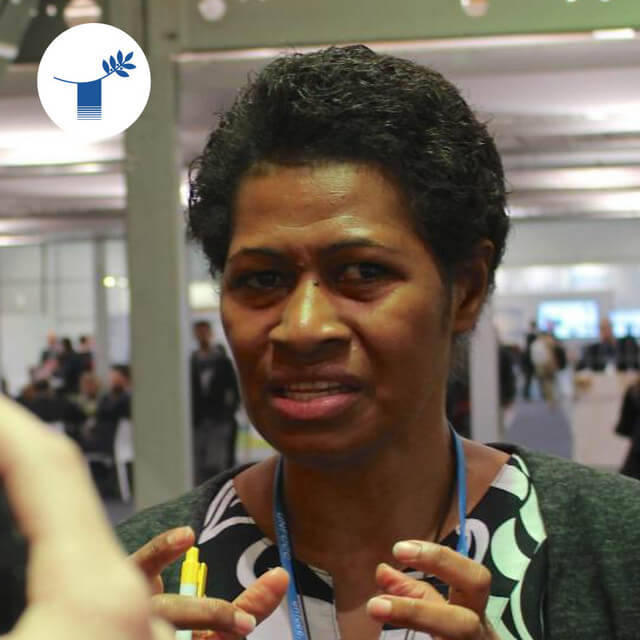
Frances Namoumou: Ecological stewardship and climate justice
June 27, 2025
A discussion with Frances Namoumou, ecumenical coordinator for the ecological stewardship and climate justice program of the Pacific Conference of Churches. In conversation with Kevin Clements and Volker Boege, they discuss the work of Pacific Conference of Churches at a local and regional level in meeting the needs of those most affected by climate change.

Paulo Baleinakorodawa & Alex Azarov: Local context and international contacts
June 27, 2025
Paulo Baleinakorodawa and Alex Azarov have developed a thriving climate peace partnership between their respective NGOs, Transcend Oceania and Conciliation Resources, working in the Pacific, and Fiji in particular.
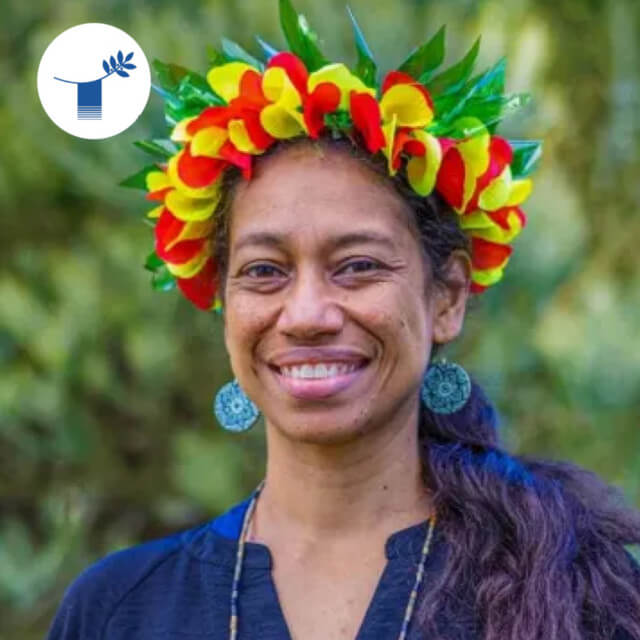
Katerina Teaiwa: Climate Change, Cultural Vulnerability and Social Resilience – The Case of Banaba
June 27, 2025
Professor Katerina Teaiwa is a Pacific scholar, artist and teacher of Banaban, I-Kiribati and African American heritage. For 80 years, the island of Banaba was mined for phosphate by Australia, Aotearoa New Zealand and the United Kingdom. Mining devastated the landscape and, after World War Two, the whole population was moved to what is now Rabi Island in the northern part of Fiji. Professor Teaiwa explains the narratives around displacement of the population, and the way that inhabitability of the island and extraction impacted not just the landscape and the environment, but the culture, the language, the sense of identity, land rights, protocols, genealogies of the Banaban people. This very personal connection and experience forms the basis of much of her academic research which is shared in ways that include exhibitions, art and dance.
Dr. Carol Farbotko: Inevitable uninhabitability? Indigenous solutions to global challenges
June 27, 2025
A discussion with Carol Farbotko from Griffith University on her project that aims to understand what indigenous solutions to global challenges look like, with a particular focus on climate change in atoll countries like Tuvalu. With Kevin Clements and Volker Boege, the conversation explores the narrative of inevitable uninhabitability, habitability thresholds, and the impact of adaptation measures on the ability to stay put. To what extent are Pacific experience and philosophies informing decisions by policy makers and development partners, and how can climate change knowledge be decolonized?

Pacific Climate Justice Activists in Diaspora Communities
June 27, 2025
A discussion with young Pacific climate activists Sulu-Danielle Joseph, Iemaima Vaai and Bedi Racule, who have grown up in diaspora communities. They discuss the impact of growing up away from the Pacific communities they call home, and their advocacy work for the Pacific as activists, particularly in relation to the effects of climate change. They are in conversation with Kevin Clements and Volker Boege.
Professor Kazuo Matsushita: Net zero, energy security and Japan’s role in the Pacific
June 27, 2025
A discussion with Emeritus Professor Kazuo Matsushita, and Toda’s Kevin Clements and Volker Boege. They discuss the interlinkages between the triple global crises of climate change, pollution and biodiversity loss, and calls for a social shift to non-fossil fuel civilization. They talk in detail about the vision for a zero carbon Japan; what that means on personal, regulatory and policy levels; and the position of the Japanese government.

James Bhagwan: Integrating Faith-based and Secular Approaches to Climate Change in the Pacific
June 27, 2025
A discussion with James Bhagwan (Pacific Conference of Churches),and Toda’s Kevin Clements and Volker Boege. They discuss the role that Pacific churches have been playing in raising awareness of the impact of climate change in the region. The spiritual worldview of Pacific people is deeply influenced by the indigenous culture, and a sense of connection with land, the environment, the ocean and their Christian faith. Rev. Bhagwan explains the importance of ‘reweaving the ecological mat’ as a Pacific articulation of the reweaving of the sacred thread that binds ecology, economics, and relationships with one another and the natural world.
Upolu Luma Vaai: Developing a Pacific Ecorelational Approach to Climate Change
June 27, 2025
A discussion with Upolu Luma Vaai (Pacific Theological College) and Toda’s Kevin Clements and Volker Boege. They discuss the core principles of Pacific ecorelationality and their implications for climate change policies in the Pacific region, advocating for a ‘holistic gaze’ that overcomes anthropocentric understandings of climate change and climate policy. He explains the “Reweaving the Ecological Mat” project, an initiative which is a self-determination strategy aimed at weaving a Pasifika story of hope about genuinely Pasifika approaches to climate change, development, ecology and peace.

Ralph Regenvanu: Our Ocean Call – Pacific Regionalism and Deep Sea Mining
June 27, 2025
A discussion with Hon. Ralph Regenvanu (Vanuatu) and Toda’s Kevin Clements and Volker Boege. They discuss the campaign to unite Pacific Island nations against deep sea mining. In conversation with Kevin Clements and Volker Boege, he backgrounds the issue of deep sea mining in the Pacific and describes efforts to utilise the strength of Pacific regionalism via the newly formed Pacific Parliamentarians Alliance on Deep Sea Mining. Through their founding statement, Our Ocean Call, the alliance articulates a common responsibility and moral obligation for the protection of the ocean for future generations.