
Where to for the Pacific’s Ocean of Peace?
Sep 2026 - News
This article was first published by the East Asia Forum on 31 August 2026 │ Author: Sandra Tarte, University of the South Pacific The Pacific Islands Forum annual leaders’ summit (30 August - 3 September 2026) began in Palau against the same backdrop of growing geopolitical pressures that catalysed the adoption of the Blue Pacific Ocean of Peace Declaration by Pacific Islands Forum leaders in 2025. The Declaration was meant to guide and shape regional responses to growing strategic competition — yet as recent developments underline, what the Declaration stands for, and whose narrative of peace should prevail, remain deeply debated. The Declaration, which originated as an initiative of Fiji’s Prime Minister Sitiveni Rabuka and was adopted following extensive consultations and dialogue, aimed to demonstrate regional commitment to peace and cooperation at a pivotal moment in global affairs. But in a major challenge to shared understanding, and a significant departure from the original concept, the Ocean of Peace became affixed to the name of the defence treaty signed between Fiji and Australia in July 2026 and embedded in the companion Fiji–Australia Vuvale Union. For Fiji’s current government, the Alliance and the Vuvale Union are considered necessary to advance development and defence interests and priorities, while also boosting Fiji’s role in the region. And for good measure, they promote Rabuka’s signature Ocean of Peace brand. For Australia, the Ocean of Peace has become the declared framework for its steadily expanding range of bilateral defence agreements and treaties in the region. The Australian government has described the Declaration as a demonstration of ‘the significant strategic alignment between Fiji and Australia’. There have also been reported invitations to other Pacific Island states and New Zealand to join what could effectively become a regional Blue Pacific Ocean of Peace defence alliance. By implication, this alignment could be seen as leading Fiji — and the Pacific Islands Forum more broadly — to ‘take sides’ in the intensifying geopolitical competition with China. This would contradict Rabuka’s own initial framing of the Ocean of Peace which was to insulate the region from great power competition. In response to this development, it’s been warned that the Ocean of Peace concept may be weaponised or co-opted to be part of this geopolitical competition, undermining its people-centred purpose. A further challenge to a shared view of the meaning of the Ocean of Peace occurred in August 2026 when Pacific Islands Forum foreign ministers struggled to agree on a statement critical of China’s ballistic missile test over the Pacific. Some countries, including Australia and New Zealand, had wanted to single out China, while others preferred a broad-based statement ‘covering ballistic missile and other testing in the Pacific’. Pacific leaders will likely revisit this issue in Palau — whatever they decide will need to be framed as consistent with the Blue Pacific Ocean of Peace Declaration. Among other things, the Declaration reinforces the region’s opposition to nuclear threats and commits Pacific Islands Forum leaders to address nuclear legacies in the region. The Declaration also outlines the expectations of partners, calling on both state and non-state actors to respect sovereignty, support Pacific-led peace efforts, align all engagement with the Pacific’s vision for peace and take bold climate action in line with the Paris Agreement.

SGI Issues Statement on Autonomous Weapons Systems
Aug 2026 - News
On 23 July 2026, Soka Gakkai International (SGI) issued a statement entitled Autonomous Weapons Systems: Ensuring Human Control Based on Respect for the Dignity of Life. In the statement, issued ahead of the Seventh Review Conference of the Convention on Certain Conventional Weapons (CCW) scheduled for November 2026, SGI calls for the urgent establishment of an international regulatory framework governing Autonomous Weapons Systems, including those employing AI, and a comprehensive prohibition on systems designed to select and engage human targets. The statement highlights the growing number of states calling for the start of treaty negotiations and references the encyclical from Pope Leo XIV Magnifica Humanitas: On Safeguarding the Human Person in the Time of Artificial Intelligence, issued in May 2026 in which he writes: "AI does not remove the intrinsic inhumanity of conflict; indeed, it can only bring about conflict more quickly and render it more impersonal, lowering the threshold for resorting to violence, transforming defense into threat prediction and thus reducing victims to data. In this way, it will accustom us to the idea that violence is inevitable and needs only to be optimized." In 2014, President Daisaku Ikeda (1928–2023) issued the following warning in his dialogue with peace scholar and Toda Peace Institute Honorary Director, Dr. Kevin Clements: “Robotic weapons, when given a command to attack, automatically go on killing, without the intervention of human will, and accordingly, with no possibility of pangs of conscience or remorse. They present an extremely grave threat, particularly from a humanitarian perspective. The possession of such weapons, just like that of nuclear weapons, is underpinned by the cold logic of the utter and complete annihilation of assumed enemies, with no discrimination between civilians and combatants.” The 2026 statement concludes with a strong argument for preventing destruction and division through a shift in perspective, which SGI has actively pursued through interfaith and intercultural dialogue to address global issues, including disarmament and human rights, while consistently promoting grassroots cultural and educational exchanges. A link to the full statement from Soka Gakkai International can be found here.
Workshop Held on the Theme of Deliberative Technology
Aug 2026 - News
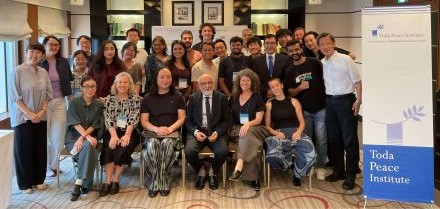
Workshop participants in Tokyo Toda Peace Institute, in collaboration with Metagov, held a workshop as part of its “Social Media, Technology, and Peacebuilding” program in Tokyo from July 29 to 31, 2026, on the theme of “Interoperable Deliberative Tools in the Asia-Pacific Region.” Participants included Dr. Lisa Schirch, Senior Research Fellow of the Toda Peace Institute, who leads the program, and Ms. Liz Barry, Executive Director of Metagov, as well as researchers, practitioners, and technology developers from 14 countries and regions—primarily in the Asia-Pacific region—engaged in fields such as peacebuilding, deliberative democracy, civic tech, AI, public administration, civil society, journalism, and conflict resolution. The workshop aimed to visualise deliberative processes being implemented in various regions, examine who is making key decisions and where, and identify recurring challenges, with the goal of exploring how to connect multiple technologies with human activities. During the meeting, participants discussed: (1) developing practices related to security, privacy, identity, interoperability, data sovereignty, and information integrity; (2) exploring the potential for building systems that incorporate local cultural traditions and wisdom in facilitation, and (3) comparing and examining various approaches to institutionalising deliberative systems and their impacts. Lively discussions took place as participants shared practical examples and challenges from their respective countries and regions. On the final day of the conference, Ms. Audrey Tang, Taiwan’s first Minister of Digital Affairs and a research advisor at Metagov, attended. During the discussion, she stated that democratisation should not be limited to the state or elections alone; rather, it can occur in any setting where people collectively learn to govern—such as schools, cooperatives, local communities, and open-source communities. She expressed the view that while formal democracy is in retreat, accessible technology is giving rise to a broader “civic wave.” Based on the idea of 'civic care' or an 'ethic of care', she also argued that 'care' in the AI context should not be designed merely to maximise individual satisfaction, but rather should be viewed as a means to strengthen interpersonal relationships and mutual capabilities. AI, too, must be used in a way that fosters attentiveness, responsiveness, the ability to cooperate, and civic strength, rather than creating dependency among users. She argued that AI development should be viewed not as a competition to see “who wins,” but as a shared mission to ask “who is being left behind.” Regarding public broadcasting, she pointed out that it has the potential to serve as a platform for “public broad listening”—listening widely to the voices of citizens—rather than merely broadcasting information unilaterally. In the closing discussion, Dr. Schirch summarised that practitioners in Asia are not merely adopting Western technologies but are independently innovating the future of democracy. As concrete outcomes of this workshop, future activities were proposed, including a workshop report to be edited and revised by participants; academic and policy papers introducing AI-assisted democracy in Asia; an open, collaboratively authored handbook for civil society; and the standardisation and publication of the process diagrams created during the workshop. The most important conclusion of this workshop is that excellent deliberative technologies involve not only the introduction of the most advanced AI and multifunctional platforms, but also the design of socially and politically legitimate processes. Digital technology can engage large numbers of people, translate languages, analyse vast amounts of opinions, visualise points of agreement and conflict, and connect people in distant regions. On the other hand, it was also pointed out that these technologies carry the potential to centralise administrative authority, endanger vulnerable participants, homogenise local cultures, create token participation, and make local communities dependent on external corporations. Interoperability of deliberative technologies, in the broadest sense, is not merely about connecting different software systems; rather, it involves creating a state in which technology, institutions, facilitators, local communities, and cultures can collaborate while maintaining their respective differences, thereby enabling a more equitable distribution of power. Senior Research Fellow Lisa Schirch speaks at the workshop

Book Launch Celebrates Pacific Climate Scholarship in Suva, Fiji
May 2026 - News
A landmark scholarly event unfolded on the evening of 28 April 2026 at the Pacific Islands Forum Secretariat Conference Hall, as some 200 distinguished guests gathered to celebrate the launch of Climate Change in Pasifika Relational Perspectives, a groundbreaking volume that was an outcome of a collaborative project between the Toda Peace Institute and the Pasifika Communities University (PCU). The event, co-hosted by the two institutions, marked a significant milestone in Pacific-centred climate research and brought together diplomats, academics, policymakers, and community leaders in a spirit of shared purpose. Editor John Campbell presents a copy to the Prime Minister of Fiji Distinguished guests at the book launch The evening was graced by the Chief Guest, the Honourable Sitiveni Rabuka, Prime Minister of Fiji, whose presence underscored the deep political resonance of the book's themes. The diplomatic community was also well represented, with the Japanese Ambassador to Fiji among the distinguished guests, reflecting the international significance of the publication. Copies of the book were formally presented to the Prime Minister, the Japanese Ambassador, and other senior guests as a gesture of the volume's importance to regional and global climate conversations. Edited by Upolu Lumā Vaai, Volker Boege, Carol Farbotko, John Campbell, and Tammy Tabe, the book brings together contributions from over twenty scholars across the Pacific and beyond. Also featured are poems by six writers from Marshall Islands, Kiribati, Solomon Islands and Tuvalu, whose work brings a personal and individual perspective to complement the research-focussed chapters. The volume centres Pasifika relational ontologies—the understanding that people, land, sea, and cosmos are deeply interconnected—as a lens through which to examine and respond to the climate crisis. It is a direct challenge to dominant Western framings of climate change and an affirmation that Indigenous Pacific epistemologies have a vital role to play in shaping global climate futures. The project was initiated jointly by the Toda Peace Institute and Pasifika Communities University, reflecting a shared commitment to peacebuilding, environmental justice, and the amplification of Pacific voices in international discourse. Speakers at the launch praised the collaboration as a model for how research institutions can work alongside Pacific communities to produce scholarship that is both academically rigorous and grounded in lived experience. Climate Change in Pasifika Relational Perspectives is now available through PCU Press.

Toda Peace Institute marks 30 years
Feb 2026 - News
Today marks the 30th anniversary of the founding of the Toda Peace Institute. To celebrate the occasion, the Japanese version of the Toda Peace Institute website carries a timeline of notable events from the past 30 years. In addition, an article in the Seikyo Shimbun features an interview with the new director of Toda Peace Institute, Dr Stein Tønnesson, in which he outlines his dedication to the cause of peace which was established from childhood, as he attended anti-nuclear demonstrations with his father. He remembers his mother trembling with fear during the Cuban Missile Crisis. "I was also influenced by my encounter with Dr. Daisaku Ikeda, founder of the Toda Peace Institute," said Dr Tønnesson. "As the then-director of the International Peace Research Institute, Oslo (PRIO), I visited Japan in 2002 to present Dr. Ikeda with an award for his contributions to peace studies. Whatimpressed me most during our meeting was Dr. Ikeda's willingness to listen and learn. Rather than expressing his own views, he asked carefully prepared questions and listened intently to what I had to say. It seemed as though Dr. Ikeda expected me to speak more than he did. This spirit of dialogue is the key to overcoming the divisions of our time."