India’s Decaying Parties Can Only Cheer US Midterms
Debasish Roy Chowdhury
November 14, 2026
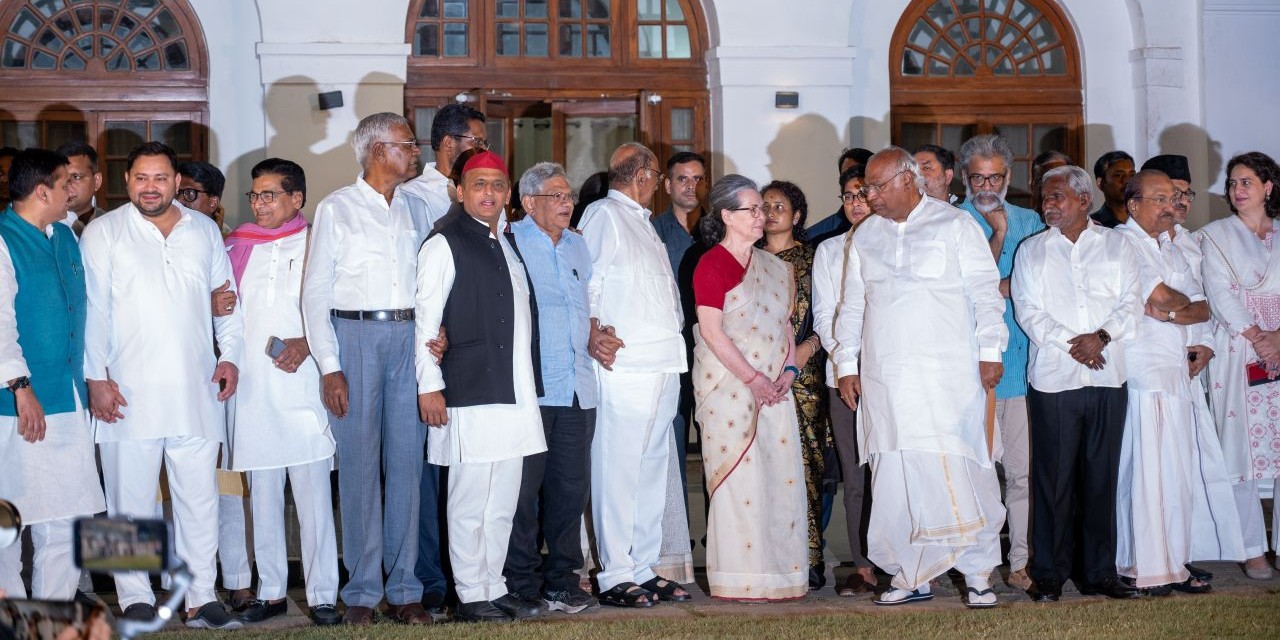
Image: Members of the Indian National Developmental Inclusive Alliance in 2024 │ PradeepGaurs / Shutterstock
The humbling of Donald Trump in the US midterm elections has been predictably greeted with relief by a world tired of the whimsies of the world’s most powerful man. For liberals everywhere, his electoral debacle restores faith in democracy’s capacity to heal itself. In countries like India, bearing the brunt of Trumpian disruption as well as the despotism ofhomegrown Trumps of their own, it offers a double measure of relief and hope.
“Today POTUS Tomorrow LOTUS” tweeted a leader of India’s opposition Congress party alluding to the floral symbol of Prime Minister Narendra Modi’s ruling Bharatiya Janata Party (BJP) after the midterm results. Her equally upbeat party spokesman, exulting in the felling of what he called “America’s Modi”, declared a similar fate awaited the Indian original.
Modi and Trump are often loosely grouped together as exemplars of a recent global trend of neo-authoritarian strongmen peddling toxic nationalism and hate while centralising power and curbing dissent. The equivalence for the most part is an oversimplification. Both India and the U.S. have indeed plummeted in global democracy rankings under the two leaders, but the circumstances are far from comparable – as the midterm results show.
Backed by an extremely well-organised, century-old Hindu supremacist movement, Modi is a far more sophisticated practitioner of the art. His policies are more measured and incremental, and actions more deliberate and effective than a perennially chaotic and provocative Trump. Modi gives the appearance of playing by the rules even as he is slowly rewriting them, while Trump revels in flaunting his utter disregard for any governing norms.
But more important than their individual styles are the democratic institutions within which they operate. America’s have proven to be relatively more resilient. The US mainstream media or the higher judiciary are far from captured the way they have been in India. Trump regularly speaks to the press; Modi has never done a press conference in his 12 years in power. Despite its conservative Republican majority, bolstered by Trump’s own appointees, the US Supreme Court is no rubber stamp. India’s Supreme Court, on the other hand, rarely defies the Modi dispensation.
But the midterms are a reminder that a major source of institutional resilience that goes unappreciated is America’s party system itself. Compared to India’s oligarchic, highly centralised parties, America’s decentralized political parties and broad-based civic and community organizations are far better equipped to channel shifts in popular mood. Which is why Trump was ousted after four years in power the first time and has been resoundingly punished after just two years this term, while Modi has been reigning supreme for 12 years, with India’s opposition still nowhere close to mounting any significant challenge. So, after a dip in numbers in the 2024 national elections, Modi has rebounded winning seven state elections since.
Parties as mass organizations have declined globally for a range of reasons—from growing atomization of society and the decline of mobilizing and funding flanks such as unions and associations, to the emergence of Big Money as the prime determinant of electoral outcomes. Neither Indian nor American parties are impervious to these trends. Yet, as recent electoral outcomes show, the open nature of the American party system leaves scope for renewal in a way that is impossible in India’s closed party machines.
The Democratic Party’s revival began not with the midterms but with the mayoral election of New York City last year when Zohran Mamdani forced his way into the ballot overriding resistance from the party elite and funders. His victory provided the much-needed validation that progressive politics was still electorally rewarding; Trump’s success seemed to have convinced a dazed Democratic elite otherwise. It was Mamdani’s steadfast articulation of an emotionally resonant affordability agenda, a grass-roots mobilization model, and a working-class-focused campaign that pulled the party out of the post-2024 malaise and provided it with a nationally replicable agenda that delivered it the midterms.
None of this would be possible had the party system in the US not created the space for an outlier like Mamdani to break the status quo. For Mamdani, it was his Democratic Socialists of America (DSA), which acts like a party within the Democratic Party with its own organizing infrastructure and volunteers, that allowed him to challenge the Democratic Party bosses. Such organized factions of ideological networks like DSA and Tea Party, caucuses, donor and civic associations, and myriad issue-based groups help make the two big umbrella parties in the US vibrant sites of ideation and mobilizing. They do the messy work of testing, sharpening and popularizing new ideas before they are adopted as political planks, as well as channel grass-roots energy into party campaigns.
The push and pull of these powerful and autonomous sub-groups can affect organizational coherence and increase the risk of polarization and proliferation of populist outsiders—like Trump—but the constant churn of ideas and activism also make American parties dynamic and transparent. Combined with the system of publicly administered primaries, they also significantly moderate the gatekeeping powers of party elites.
While repeated reform waves over the decades have shifted candidate selection from the ambit of party bosses and oligarchic conventions towards primaries in the US, India’s ossified party system remains blissfully untouched by such disruptions. Devoid of internal elections and run top-down like mom-and-pop stores—often with dynastic hierarchies—Indian parties ironically mediate access to democratic power without being democratically organised themselves, producing a unique contradiction at the heart of Indian democracy.
Mamdani’s win last year lit up Indian social media with liberals fed up with the opposition’s stasis yearning for an “Indian Zohran” to break Modi’s lock on power. But if Mamdani were in India, he would never win a ticket to run. For, nominations are not won in India, they are ‘distributed’ by all-powerful party bosses among their favourite acolytes, not rebellious radicals.
With no scope for insurgent candidates or institutionalised intra-party factions jostling over new ideas or forging new social coalitions, India’s opposition parties thus remain hollow electoral brands with no internal democratic life and little scope for renewal. Vicariously cheering distant democratic battles is their lot.
Related articles:
Modi’s ‘Regime Change’ Scare Exposes India’s Foreign Funding Hypocrisy (3-minute read)
Modi Chooses Violence. Again. (3-minute read)
Why India’s Opposition Parties Should Boycott Elections (3-minute read)