Workshop Held on the Theme of Deliberative Technology
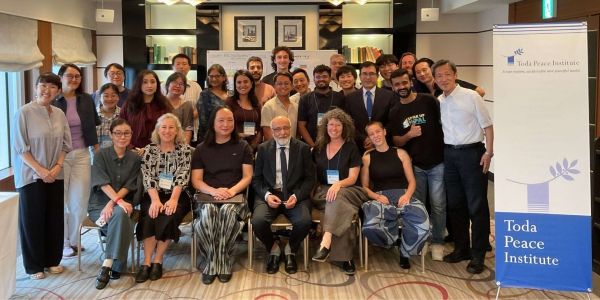
Toda Peace Institute, in collaboration with Metagov, held a workshop as part of its “Social Media, Technology, and Peacebuilding” program in Tokyo from July 29 to 31, 2026, on the theme of “Interoperable Deliberative Tools in the Asia-Pacific Region.” Participants included Dr. Lisa Schirch, Senior Research Fellow of the Toda Peace Institute, who leads the program, and Ms. Liz Barry, Executive Director of Metagov, as well as researchers, practitioners, and technology developers from 14 countries and regions—primarily in the Asia-Pacific region—engaged in fields such as peacebuilding, deliberative democracy, civic tech, AI, public administration, civil society, journalism, and conflict resolution. The workshop aimed to visualise deliberative processes being implemented in various regions, examine who is making key decisions and where, and identify recurring challenges, with the goal of exploring how to connect multiple technologies with human activities.
During the meeting, participants discussed: (1) developing practices related to security, privacy, identity, interoperability, data sovereignty, and information integrity; (2) exploring the potential for building systems that incorporate local cultural traditions and wisdom in facilitation, and (3) comparing and examining various approaches to institutionalising deliberative systems and their impacts. Lively discussions took place as participants shared practical examples and challenges from their respective countries and regions.
On the final day of the conference, Ms. Audrey Tang, Taiwan’s first Minister of Digital Affairs and a research advisor at Metagov, attended. During the discussion, she stated that democratisation should not be limited to the state or elections alone; rather, it can occur in any setting where people collectively learn to govern—such as schools, cooperatives, local communities, and open-source communities. She expressed the view that while formal democracy is in retreat, accessible technology is giving rise to a broader “civic wave.”
Based on the idea of ‘civic care’ or an ‘ethic of care’, she also argued that ‘care’ in the AI context should not be designed merely to maximise individual satisfaction, but rather should be viewed as a means to strengthen interpersonal relationships and mutual capabilities. AI, too, must be used in a way that fosters attentiveness, responsiveness, the ability to cooperate, and civic strength, rather than creating dependency among users. She argued that AI development should be viewed not as a competition to see “who wins,” but as a shared mission to ask “who is being left behind.” Regarding public broadcasting, she pointed out that it has the potential to serve as a platform for “public broad listening”—listening widely to the voices of citizens—rather than merely broadcasting information unilaterally.
In the closing discussion, Dr. Schirch summarised that practitioners in Asia are not merely adopting Western technologies but are independently innovating the future of democracy. As concrete outcomes of this workshop, future activities were proposed, including a workshop report to be edited and revised by participants; academic and policy papers introducing AI-assisted democracy in Asia; an open, collaboratively authored handbook for civil society; and the standardisation and publication of the process diagrams created during the workshop.
The most important conclusion of this workshop is that excellent deliberative technologies involve not only the introduction of the most advanced AI and multifunctional platforms, but also the design of socially and politically legitimate processes. Digital technology can engage large numbers of people, translate languages, analyse vast amounts of opinions, visualise points of agreement and conflict, and connect people in distant regions. On the other hand, it was also pointed out that these technologies carry the potential to centralise administrative authority, endanger vulnerable participants, homogenise local cultures, create token participation, and make local communities dependent on external corporations. Interoperability of deliberative technologies, in the broadest sense, is not merely about connecting different software systems; rather, it involves creating a state in which technology, institutions, facilitators, local communities, and cultures can collaborate while maintaining their respective differences, thereby enabling a more equitable distribution of power.
