Shenzhen Is Not Yalta: What a Historic China–US–Russia Summit Can—and Cannot—Achieve
Taiyi Sun
November 18, 2026
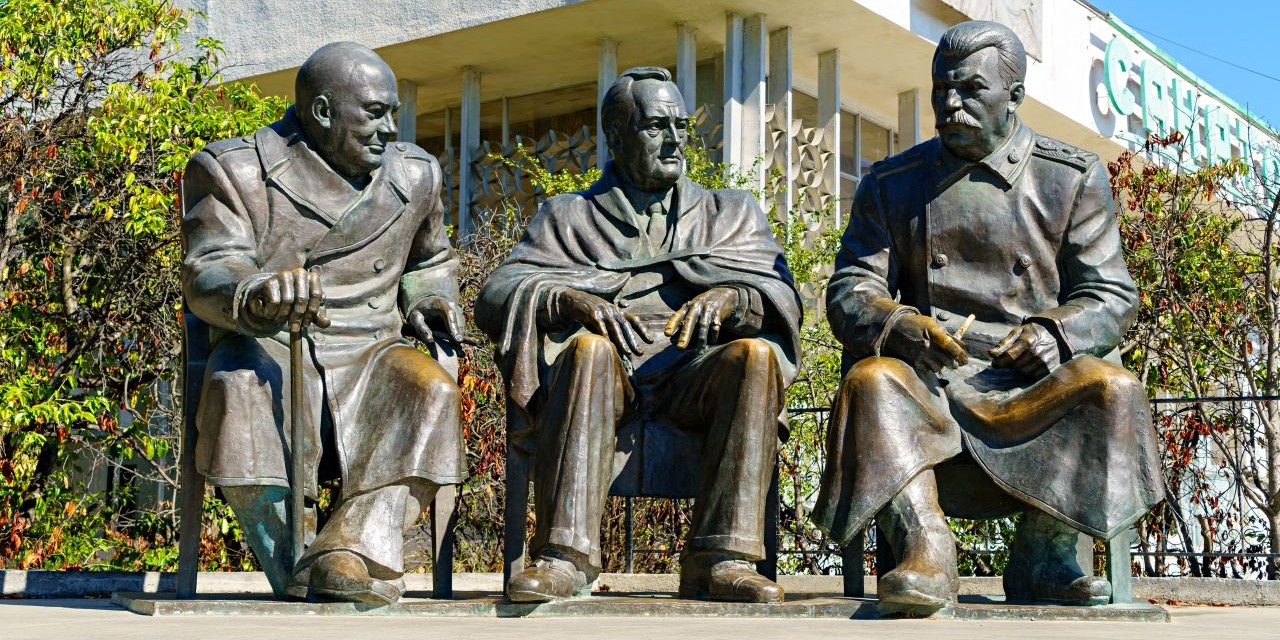
Image: Collection Maykova / Shutterstock
On November 19, in Shenzhen, the leaders of China, the United States, and Russia will convene their first-ever face-to-face trilateral summit. The meeting is historic before a single word is exchanged. Whether it becomes consequential, however, depends on what the three leaders choose to accomplish.
A New Yalta—or Something Fundamentally Different?
Comparisons of this trilateral meeting with the 1945 Yalta Conference are inevitable but potentially misleading. At Yalta, Roosevelt, Churchill, and Stalin represented wartime allies negotiating the final stages of a common struggle and the foundations of a postwar order. Washington sought Soviet participation in the war against Japan and support for the emerging United Nations. In return, Moscow secured promises concerning southern Sakhalin, the Kuril Islands, Outer Mongolia, and strategic privileges in northeastern China.
Shenzhen presents a fundamentally different configuration. Unlike the wartime allies at Yalta, the three participants in Shenzhen are bound together by a complex mixture of strategic competition and cooperation. Nevertheless, each has interests that could tempt observers to interpret the summit through a Yalta-style lens of spheres of influence.
Russia would welcome recognition of its territorial claims over the four Ukrainian regions it declared annexed in 2022—Donetsk, Luhansk, Zaporizhzhia, and Kherson—alongside guarantees against Ukraine’s integration into Western security structures. Washington, meanwhile, has increasingly asserted its primacy in the Western Hemisphere through what has become known as the ‘Donroe Doctrine’, seeking to limit competing powers’ strategic footholds in Latin America. Trump also hopes to enlist Moscow and Beijing in efforts to end the Iran war.
China has its own regional priorities. Beijing would prefer reduced American military pressure in East Asia, greater Russian sensitivity to Chinese interests in Central Asia, and manageable competition over influence in North Korea. The Taiwan question remains central to Beijing’s long-term political objectives, although it is unlikely to be meaningfully resolved through negotiations among the three leaders.
These interests are not necessarily compatible. Competing ambitions for spheres of influence do not imply that a grand bargain is either achievable or desirable. Unlike Yalta, Shenzhen is not expected to produce a formal agreement delineating spheres of influence or granting strategic privileges. Any private discussion of such arrangements would confront substantial political, legal, and practical obstacles, not least the objections of governments and populations whose futures would be affected.
Strategic Stability Without a Grand Bargain
The more realistic purpose of the summit is to promote strategic stability among the world’s three most consequential military powers.
Trump’s preference for personal diplomacy with leaders commanding large territories and formidable nuclear arsenals makes the gathering particularly attractive to him. For Xi and Putin, direct engagement offers opportunities to reinforce their international standing, clarify strategic intentions, and reduce uncertainty.
Even the anticipated photograph of the three leaders has diplomatic value. At a time of prolonged conflicts and intensifying geopolitical competition, visibly demonstrating a willingness to communicate can reassure international audiences that confrontation is not inevitable.
China and the United States have already embraced the concept of a “constructive relationship of strategic stability.” Shenzhen could become an opportunity to extend elements of that approach into a trilateral framework without pretending that the three bilateral relationships are equally cooperative or confrontational.
Nuclear arms control offers an especially revealing test. Since New START expired in February 2026, Washington and Moscow have lacked a functioning bilateral treaty limiting their strategic nuclear arsenals. Trump has expressed interest in a broader arrangement involving China. Yet the asymmetry remains enormous. According to SIPRI, the United States and Russia together possess approximately 86 percent of the world’s nuclear warheads, while China’s arsenal remains substantially smaller. Beijing consequently has little incentive to accept equivalent numerical constraints. Nevertheless, China’s willingness to participate in informal discussions, without accepting immediate reduction commitments, could itself constitute meaningful progress. Strategic dialogue need not begin with identical obligations.
The most substantive agreements may still emerge from bilateral rather than trilateral negotiations. In particular, the China–US relationship requires further clarification of what constructive strategic stability means in practice. Previous presidential meetings have established broad political understandings, but detailed implementation still depends heavily on negotiations among officials between summits.
Trump’s participation in the Quad summit and engagements with ASEAN leaders in Manila also provide a useful comparison. The relative time devoted to these meetings and the Shenzhen gathering, as well as their substance and diplomatic atmosphere, may reveal how his administration balances great-power accommodation with its traditional Indo-Pacific partnerships.
Turning a Historic Photograph into Lasting Stability
For Shenzhen to achieve significance beyond symbolism, several practical steps deserve consideration.
First, the three governments should establish a regular strategic-stability consultation mechanism. Initially informal and without binding obligations, it could facilitate communication on nuclear doctrine, crisis prevention, military incidents, and emerging strategic technologies. The objective should be to prevent unintended escalation rather than demand immediate agreement on fundamental disputes.
Second, nuclear negotiations should proceed on differentiated tracks. Washington and Moscow should take primary responsibility for restoring verifiable limits and transparency mechanisms, while Beijing could participate in discussions on nuclear risk reduction, early-warning communication, and confidence-building measures. This would recognize China’s comparatively smaller arsenal without excluding it from the broader conversation.
Third, conflict resolution must remain inclusive. Discussions concerning Ukraine and Iran could help identify possible areas of convergence, but no durable settlement can be negotiated over the heads of the directly affected parties. The three powers should facilitate broader diplomatic processes rather than attempt to substitute their own understandings for them.
Finally, summit diplomacy should be institutionalized rather than personalized. Working-level follow-up, agreed communication channels, and measurable confidence-building initiatives would help translate presidential understandings into practical arrangements. December’s G20 summit in Florida could provide another opportunity to assess progress, although another three-way encounter remains uncertain.
Shenzhen will not—and should not—be another Yalta. The international system is too interconnected, the principle of sovereignty too important, and other states’ interests too consequential for three leaders to redraw the global order around a negotiating table. Its more constructive historical legacy would be to demonstrate that great powers can manage strategic rivalry without demanding exclusive control over their respective neighborhoods. The success of Shenzhen should therefore be measured not by how much territory or influence the three leaders can divide, but by how much confrontation they can prevent.
Related articles:
Managing Competition: The New Logic of US–China Summitry (3-minute read)
Beyond the Trade Truce: AI and the Next Phase of China–US Risk Management (3-minute read)
Before Washington: Xi and the Contest Over Global Leadership (3-minute read)