Does the US Deserve Allies’ Trust?
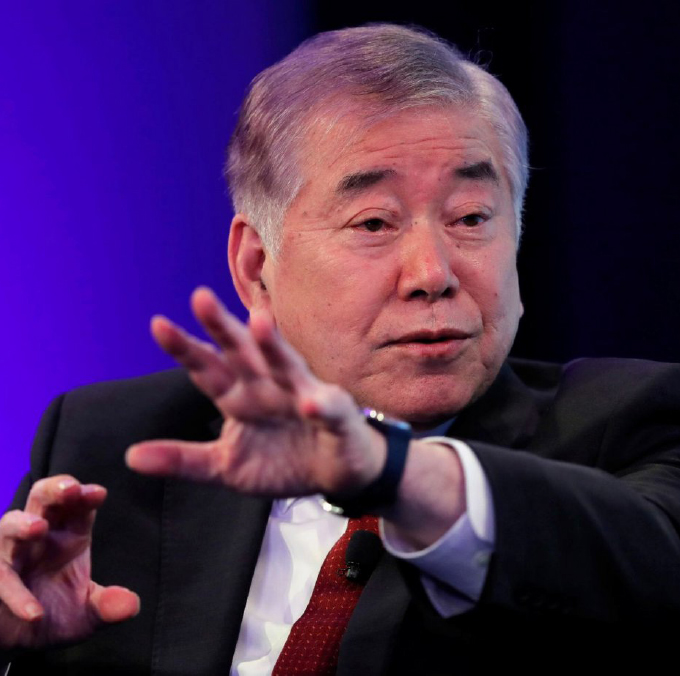
Chung-in Moon
August 19, 2026

Image: Executive Vice Foreign Minister of China Ma Zhaoxu meeting with Under Secretary of War Elbridge Colby in the Pentagon, July 2026 / Office of the Under Secretary of War, Wiki Commons
This article was first published by Hankyoreh on 18 August 2026 and is republished with permission
Just as allies in the region must not “take America for granted,” the US mustn’t take them for granted either
“We see Asia as of paramount importance,” Elbridge Colby, the US undersecretary of defense for policy, said in a speech at the Manila-based Stratbase Institute on Aug. 10.
“America is definitely not disengaging from Asia — to the contrary,” he said. “Our driving and abiding purpose is to maintain a favorable balance of power in the Indo-Pacific. [. . .] This requires us to maintain a posture of deterrence by denial along the first island chain.”
In effect, Colby was reaffirming the US’ basic strategy of blocking China from advancing into the western Pacific.
In Colby’s telling, it’s a serious error to regard the US as “too unreliable to work with anymore.” Rather, he said, the Trump administration has adopted a flexible and realistic “approach defined by common sense.”
When it comes to defense, “countries can no longer take America for granted,” and America’s allies and partners in the area are expected to assume their fair share of the burden of common defense.
Colby described recent talk about building a middle power alliance excluding the US as a “fashionable but superficial idea.” True deterrence, he said, derives from “fielded hard power and the demonstrated political will to use it,” with the implication that only the US has those to offer.
During a fireside chat in the Deterrence Symposium held in Omaha, Nebraska, on Aug. 5 by the US Strategic Command, Colby reportedly stressed three aspects of the US’ nuclear strategy.
First, Colby said that a “regional [. . .] conventional war” that could escalate through a nuclear exchange was more worrisome than a mass attack on the continental US.
Second, he said that the use of low-yield tactical nuclear weapons — “theater capabilities,” in his words — could be a “rationally employable” choice.
Finally, he said that the use of such nuclear weapons is being reviewed at the highest levels of US leadership.
That has inspired speculation that the US may seek forward deployment in Korea or Japan of tactical nuclear weapons aimed at China.
Colby’s comments are presumably intended as a reminder that the defense of the Indo-Pacific is a top priority for the US, as well as a warning not to doubt American capability, intentions or will in this regard. But they also leave a few lingering doubts.
I freely acknowledge that the US has immense economic and military power, but I am less certain that the US is using those resources wisely.
In an Aug. 5 column in Foreign Policy, Harvard University professor Stephen Walt argued that the 1991 Gulf War is “the United States’ only clear victory” since World War II. Walt described the Korean War as “a draw,” and the rest of the wars in those decades as defeats.
Walt said that the problem is not state power, combat ability or military morale, but the fact that the US “is usually fighting the wrong wars for the wrong objectives.”
Given that military record, does the US deserve our trust? That question is validated by the war against Iran.
There was no clear advantage or justification for the US’ attack on Iran. Rather than improving the situation in the Gulf or at least preserving the status quo, the war has only made things worse.
Arab states in the region that sided with the US have suffered serious collateral damage, and repeated vacillation on strategic decisions has raised concerns about American leadership. How else to explain the defense pact that Saudi Arabia, a loyal client of the US, has formed with Turkey and Pakistan?
Countries in the Asia-Pacific are almost certain to face the same dilemma.
For Colby’s appeal to be persuasive, it’s essential for the US and countries in the region to have a shared perspective on threats.
Perhaps Japan and the Philippines share the US’ view of the threat posed by China. But Korea and other ASEAN countries are likely to have a different view.
For South Korea, the primary threat is posed by North Korea. For the US, the threat emanates from China.
Would the Lee administration allow the US to deploy tactical nuclear weapons targeting China as part of the establishment of a new “Northeast Asia Command,” with US Forces Korea reformulated as its battle force? Koreans are not keen for the Korean Peninsula to become the front lines of the Cold War-esque alignment taking shape in Northeast Asia.
Finally, will the Korean government and civil society remain silent as the US government and Congress pressure Seoul on such issues as tariffs, a delayed investment package, and a criminal investigation into a Coupang data leak, and as they defend far-right groups in Korea and the US who are openly calling for Lee to be overthrown and replaced by the impeached former president, Yoon Suk-yeol?
The backlash is sure to be extreme.
I understand the point that Colby is trying to make when he declares that the US is alive and kicking and that Asia remains a top priority.
But just as allies in the region must not “take America for granted,” the US mustn’t take them for granted either.
What’s needed is a sure guarantee of credibility.
In addition, regional peace and stability aren’t guaranteed through deterrence and the balance of power alone.
The US needs to demonstrate leadership in the kind of “preventive diplomacy” that eases tensions and builds confidence so as to stop wars before they start.
That’s the only way for the US to regain its past glory.
Related articles by this author:
From Complete Denuclearization of North Korea to Managing Nuclear Risk (3-minute read)
Does Trump Get Another Shot at North Korea? (3-minute read)
Why North Korea Won’t Be Trump’s Next Target (3-minute read)