From Complete Denuclearization of North Korea to Managing Nuclear Risk
Chung-in Moon
June 3, 2026
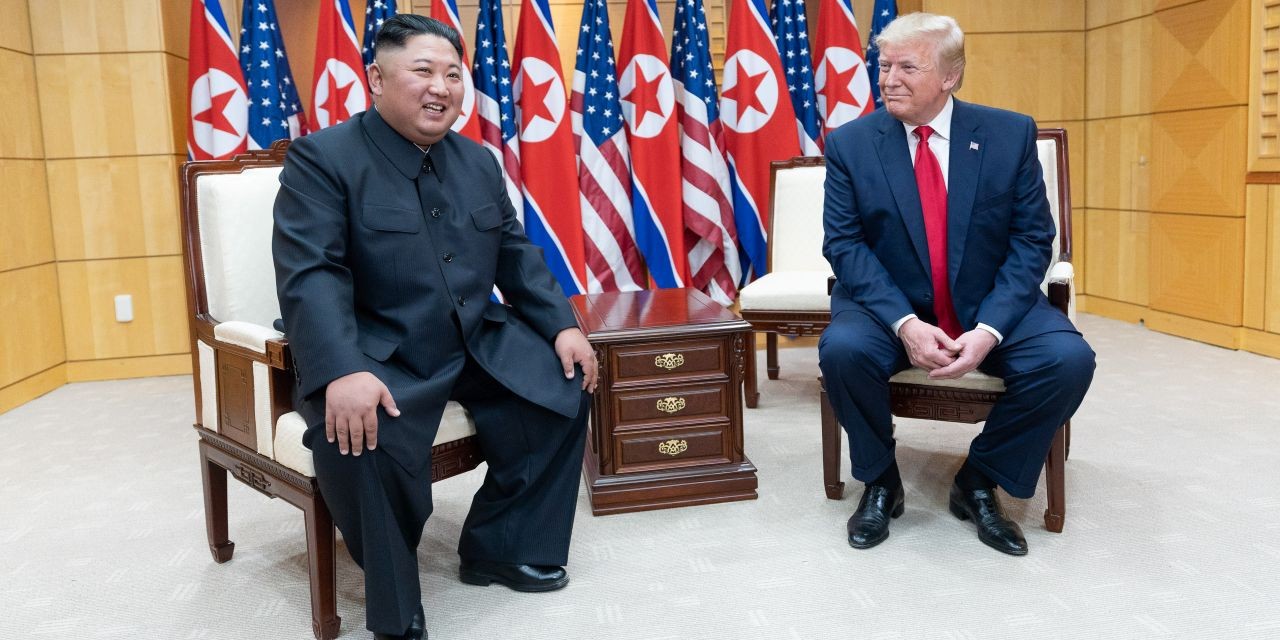
Donald Trump and Kim Jong-un meet in June 2019. Image: The White House / Wiki Commons
This article was first published by Hankyoreh on 1 June 2026 and is republished with permission.
It’s time that we realize that pressuring North Korea to completely denuclearize is an unrealistic approach and instead shift to easing tensions and building confidence to manage threats
The White House’s May 17 fact sheet about US President Donald Trump’s summit with Chinese President Xi Jinping said that “President Trump and President Xi confirmed their shared goal to denuclearize North Korea.”
But Guo Jia-kun, a spokesperson of China’s Ministry of Foreign Affairs, expressed a markedly different position the very next day.
One week later, Xi and Russian President Vladimir Putin expressed considerable sympathy for North Korea in a summit statement. Without making any mention of the denuclearization of the Korean Peninsula, the two leaders opposed threatening North Korean security through diplomatic isolation, economic sanctions or military pressure.
Nor did the denuclearization of the Korean Peninsula come up in a joint statement issued by the leaders of South Korea and Japan following their summit in Andong on May 19. That contrasted sharply to their January summit in Nara, Japan, when they expressed “the two countries’ firm commitment to the complete denuclearization of the Korean Peninsula and the establishment of a lasting peace regime.”
The opposite message was conveyed in a joint statement released after a meeting of the foreign ministers of the Quad countries (the US, Japan, India and Australia) in New Delhi on May 26: “We reaffirm our commitment to the complete denuclearization of North Korea in accordance with relevant UNSCRs [UN Security Council resolutions].”
These contradictions reflect these countries’ diverging viewpoints on the North Korean nuclear issue. The US and Japan are explicitly using the term “North Korean denuclearization,” but China and Russia are avoiding the term “denuclearization,” as is the South Korean government.
One thing that’s clear is that the denuclearization paradigm based on North Korea’s complete, verifiable and irreversible denuclearization is losing momentum. The strategy of linking the denuclearization of the Korean Peninsula to a peace regime—the preferred approach of the Chinese government and former South Korean President Moon Jae-in—also failed to make any tangible progress.
Past approaches would seem to be inadequate given Pyongyang’s emphatic rejection of denuclearization, which it says will never occur.
Based on a realistic view of the situation, attention is shifting toward the argument for managing nuclear risk while temporarily tolerating North Korea’s possession of nuclear weapons.
North Korea’s nuclear arsenal, which is growing by the day, cannot be ignored. But at the same time, the fact is that coercive measures, such as military action, are not realistic. Rather than ineffectual demands for denuclearization, it might be better to manage the security risks and crisis on the Korean Peninsula by persuading North Korea to suspend its nuclear weapon and missile activities and gradually reduce its arsenal.
That’s consistent with the gradual approach advocated by South Korean President Lee Jae Myung, and similar to the Chinese and Russian approaches as well.
A growing number of US experts support managing the nuclear risk for now and pushing for denuclearization later.
Siegfried S. Hecker has long advocated the step-by-step approach of halting North Korea’s nuclear program, paring it back, and ultimately eliminating it.
In May 2025, Frank Aum and Ankit Panda, researchers at the Carnegie Endowment for International Peace, proposed the idea of “stable coexistence,” arguing that the US should treat North Korea’s possession of nuclear weapons as an accomplished fact and initiate talks aimed at nuclear risk management and arms reduction.
On April 15, the editors of Newsweek called for the US to move away from the illusion of “complete denuclearization” and reorient its negotiating strategy on the reality of North Korea’s nuclear program.
Even Victor Cha, the Korea chair at the Center for Strategic and International Studies and a one-time outspoken advocate of complete denuclearization, has been underlining the need to accept the reality of North Korea’s nuclear program “as it is” and to pursue a “cold peace” through dialogue and negotiations.
All these scholars say that complete denuclearization is an unrealistic approach and emphasize the urgency of safely managing nuclear and conventional threats on the Korean Peninsula by easing tensions, building confidence, and pursuing arms control and arms reduction.
They’re right. To achieve those ends, there are a few pre-emptive steps that should be taken.
First, it’s critical that we develop a new negotiating narrative that avoids language about the goal of complete denuclearization and that focuses instead on arms control, arms reduction and nonproliferation.
In addition, the US and South Korea need to take the lead in developing an elaborate roadmap for negotiations oriented not on denuclearization but on a nuclear freeze and reduction.
Second, it will be difficult to resume dialogue and negotiations with North Korea as long as it’s treated as a rogue state and part of the ‘axis of evil’. There needs to be an effort to end the policy of hostility against North Korea and recognize it as a normal state.
In that regard, the US needs to offer the normalization of relations with North Korea and the relaxation of independent sanctions (in the areas of exchange and finance) as incentives in the first stage (nuclear freeze).
Finally, a North Korea–US summit is essential for addressing the North Korean nuclear issue. Consequently, another meeting needs to be quickly arranged between Trump and North Korean leader Kim Jong-un.
The priority of this summit (unlike those that went before) ought to be arranging a political declaration that disavows the pre-emptive use of nuclear weapons. For that declaration to have binding force, it needs to be guaranteed through a multilateral framework involving China, Russia, South Korea and Japan.
That will require the activation of ‘2+4’ deliberative structure—with North Korea and the US in one group, and South Korea, China, Russia and Japan in the other—from the outset of the talks.
Related articles from this author:
Does Trump Get Another Shot at North Korea? (3-minute read)
Why North Korea Won’t Be Trump’s Next Target (3-minute read)
North Korea Searches for a Path Out of International Isolation (3-minute read)