Syria’s Political Transition: Towards a New Personalist Politics?
Layla Saleh
September 21, 2026
This report critically assesses the institution building that has taken place in post-Assad Syria over the past several months. Taking the ‘Constitutional Declaration’ of March 2025 as a benchmark, it suggests that the country’s new institutions, combined with rule by presidential decree, indicate the emergence of an increasingly centralized political system. Rather than signalling democratic openings, institutionalization is at the service of a centralized system where the (interim) president, and his close inner circle, reign supreme. Political contestation is near-absent, as the deferred initiation of political parties exemplifies. After cataloguing progress in the institutional domain, the paper moves to a crucial question: In the burgeoning personalist politics of the new Syria, has the country advanced beyond authoritarianism through “election fetishism” of the pre-2011 era? To conclude, the report considers avenues available to those eager for democratization or political pluralism.
Contents
- Abstract
- Introduction
- The Constitutional Declaration: Blueprint from above
- Parliamentary politics
- A return to Arab ‘electoral authoritarianism’?
- Conclusion
Abstract
The appointment of members of a new Constitutional Court and the first session of the new legislature convening in early July certainly signal ongoing institution building in post-Assad Syria. Taking the ‘Constitutional Declaration’ of March 2025 as a benchmark, this report critically assesses the institution building that has taken place over the past several months. It suggests that the country’s new institutions, combined with rule by presidential decree, indicate the emergence of an increasingly centralized political system. Rather than signalling democratic openings, institutionalization is at the service of a centralized system where the (interim) president, and his close inner circle, reign supreme. Political contestation is near-absent, as the deferred initiation of political parties exemplifies. After cataloguing progress in the institutional domain, the paper moves to a crucial question: In the burgeoning personalist politics of the new Syria, has the country advanced beyond authoritarianism through “election fetishism” (Sadiki, 2009) of the pre-2011 era? To conclude, the report considers avenues available to those eager for democratization or political pluralism.
Introduction
Syria’s many transformations continue apace, more than 18 months after Bashar Assad’s downfall and the assumption of rule by former anti-regime militia leader Ahmed Al-Sharaa. Boundless excitement over the ouster of the country’s former dictator has been understandable. It was not just Assad himself but ‘Assadism’ itself that was eviscerated. This “dynastic republicanism”[1] (recall that in 2000, Bashar inherited the presidency from his father Hafez) was built on the ruthless repression, incarceration, and torture of a military regime; a formidable security apparatus that infiltrated society; sectarian rule; and the total absence of even minimal civic and political freedoms. In the long revolution-turned-internationalized war (2011–2024), Assad’s crimes multiplied and Assadism became synonymous with not just repression and occasional murder-by-incarceration, but abundant war crimes. After 8 December 2024, then, a new page was waiting to be written, in politics as in the economy and society. For optimists, the ‘dawn of freedom’ could be nothing but promising.
Such jubilation seems exaggerated now, an affective response to the moment rather than a realistic assessment of how political transformation could and would take place. This report evaluates post-Assad politics in Syria, now that the country’s transitional political institutions (including the People’s Assembly and the Constitutional Court) have taken shape. These new institutions are to a large extent enactments of the provisions in the Constitutional Declaration passed in March 2025. But how far do these developments begin to deliver on the promise of more participatory, pluralist politics? The argument here is that post-Assad politics in Syria appears to be more and more personalist, centered around the president and his inner circle. Political contestation is veritably absent, and political participation limited. Section 1 offers an overview of the Constitutional Declaration, and briefly assesses the implementation of its political provisions. The following section takes a look specifically at the nascent legislature, and the debate about political parties in the new Syria. The final section asks what lingering patterns of ‘Arab electoralism’, sans democracy, remain in Syria even 15 years after its popular revolution. To conclude, the report makes some policy recommendations for safeguarding and expanding political participation and contestation, relevant to civil society and research communities.
The Constitutional Declaration: Blueprint from above
Drafted by a seven-person committee of legal experts appointed by the president, then ratified by him, Syria’s Constitutional Declaration came into effect in March 2025. The Declaration effectively functions as the country’s constitution during the transitional period, until March 2030. It is not meant to be permanent or comprehensive, but to fill a legal-constitutional void created by the fall of the previous regime. This was not the first such Arab experiment with a temporary constitution. After Ben Ali’s departure in January 2011, in response to a popular revolution, Tunisia had its own Constitutional Declaration, Decree-Law 2011–14 of March 2011. This Decree-Law was short-lived, replaced in December 2011 by the temporary Constitution put in place by the National Constituent Assembly (NCA) elected in November of that year, until the NCA drafted and ratified the much-vaunted Constitution of 2014. Certainly, then, Syria’s version of a Constitutional Declaration is no political or legal invention. Objections to the Declaration have more to do with the process of its drafting (by a group handpicked by the President himself), the role of the drafters (limited and ‘technical’, after they received the broad contours of the Declaration from the president), the duration of its operation (a five-year transition), and its content (power highly centralized in the hands of the president).
To be fair, the Constitutional Declaration [2] does not claim to establish a democratic political system. Its more modest goals are to inaugurate “a political system based on the principle of separation of powers, and guarantees freedom and dignity for the citizen” (Article 2). It pledges the protection of “human rights and fundamental freedoms” in accordance with international human rights agreements (Article 12), including the “freedom of belief” (Article 3)—significant given Syria’s confessional diversity. The Declaration guarantees people’s right to participate in “associations and unions” (Article 14). In a nod to gender equality and inclusion, the Declaration notes that the state will ensure the “social, economic, and political rights of women, and [the state will] protect them from all forms of oppression, injustice, and violence” (Article 21). These and other provisions are notable in their politically liberal bent, at least on paper. As a common refrain in Arab politics (and authoritarian politics more generally) holds, constitutions may promise political freedom and democratic politics that do not bear out in practice.
If the Constitutional Declaration is the blueprint for its political transition, however, there is a built-in tension evident from the first glance at its text. The “separation of powers” it promises appears to be contradicted in more than one place—more than one institution—by the outsize role allotted the president. As noted above, the president chose the legal experts who drafted the Declaration. In addition, the president himself selects the members of the Supreme Constitutional Court (Article 47). In this manner the executive branch (the president) is directly responsible for shaping the judicial branch (the Supreme Constitutional Court), without necessitating approval by the legislature as is the case in presidential democratic systems, including the US. True to the Declaration’s word, the president suddenly appointed the seven members of the Supreme Constitutional Court on 5 July 2026. The justices (five men and two women) were chosen prior to the law to be passed by the legislature, outlining the responsibilities and operation of the Court. As some critics put it, this botched sequencing detracts from the Court’s putative function as an instrument of checks and balances in the new system.[3] The Court’s mandate is primarily judicial review based on the Constitutional Declaration. It can rule on the constitutionality of specific laws or bills at the behest of the president or the speaker of the legislature.
Parliamentary politics
Judicial politics, including the selection and dismissal of judges and supreme court justices, can be quite contentious in any political system. However, the initiation of Syria’s new legislature has fomented even more extensive scepticism from Syrians and outside observers alike. The selection process for the new legislature was an intricate and confusing system, whereby a committee (again selected by the president) toured the country and chose large sub-committees (50 people per seat) for each governorate. These sub-committees then voted for MPs from among themselves. This truncated voting was only for two-thirds of the legislature, however. The president would pick the remaining third (Article 24). Formal political participation, by both voters and those elected, is quintessential to democratic politics, in theory to ensure some level of political representation by the country’s citizenry. The vast majority of Syrian citizens have missed out on the political participation enumerated in the Constitutional Declaration. From the start the selection process of the new legislature has been controversial. Justifications for circumventing full-fledged elections through this ‘indirect’ process, according to the High Election Committee, include the still-fragile security situation. Moreover, the nearly eight million Syrians remain outside the country, and the disordered state of the civil registry after years of war-time casualties and displacement rendered proper elections impossible.[4]
The deliberate absence of political parties has resulted in what appears to be an eclectic combination of disparate individuals
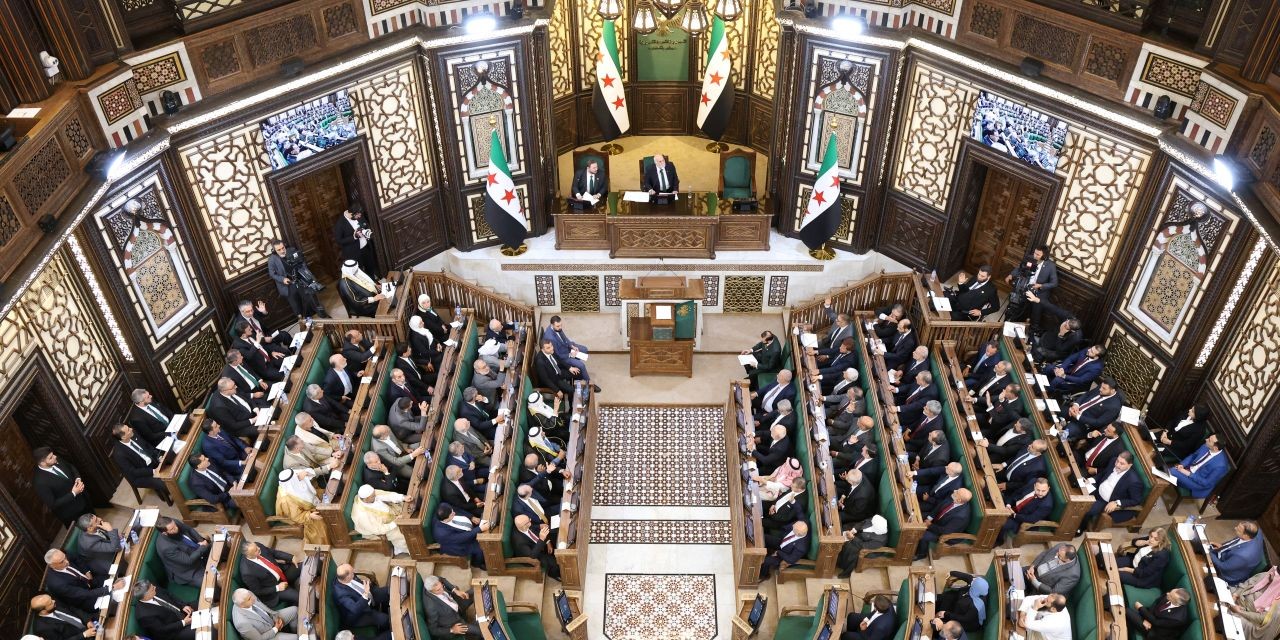
The indirect elections were held in late September 2025, yielding 137 new MPs. After repeated delays and false starts, the drama mounted in anticipation of the remaining third, the President’s picks. Official and unofficial promises that he would, for instance, correct the under-representation of women, and of other religious and ethnic minorities, likely whetted the political ambitions of many in civil society. Finally, on 2 July the President named his picks, a group of 70 people (including 14 women) that spanned former revolutionary fighters and activists, members of the High Election Committee, leaders of the revolution-era political opposition, tribal representatives, the Muslim Brotherhood (as individuals, not as party members, of course), professionals from a number of minority religious communities, Kurdish politicians, and even an actress.[5] The deliberate absence of political parties has resulted in what appears to be an eclectic combination of disparate individuals, due to the absence of a political party law and the selection process described above. In the new People’s Assembly, we see token representation of some ethnic/religious groups to indicate tolerance; reward for public-facing loyalty by an old and new group of insiders; and absorption (even taming) of revolution-era activists and politicians who might otherwise become vocal critics. However, the new parliamentary lineup is not likely pleasing to anyone in search of substantive representation of Syrian political positions, ideologies, and aspirations beyond the symbolic domain. The new legislature’s powers of executive oversight are limited; the People’s Assembly’s responsibilities include with passing and amending some laws, ratifying treaties, and convening hearings of ministers (Article 30 of the Constitutional Declaration). The near-absent power to limit the extensive executive authority of the president and his ministers has not appeared to blunt the competition to secure places of prominence within the Assembly. There have even been accounts of the timeless Aleppo–Damascus rivalry breaking to the surface, in informal campaigning over the leadership positions (speaker and vice speakers, etc.) before the first session.
At the Parliament’s first session on 13 July 2026, Dr. Abdulhamid Al-Awwak was elected (99 votes) speaker. The law and politics professor has been actively involved in the transition, serving as head of the committee that drafted the Constitutional Declaration in spring 2025.[6] The legislature’s first task to pass its by-laws. The decision to rename the Foreign Affairs and Expatriates Committee as the Diplomatic and Consular Affairs Committee was controversial in and outside of parliament, raising fears that such rebranding would limit legislative oversight over executive foreign policy decisions, including new treaties or international agreements.[7] Despite the abundant criticism of its membership and even its legitimacy, the new People’s Assembly is already a symbolic political gain over Assad-era politics. That Al-Sharaa’s short speech at the first speech was not met with wild applause by the new MPs was not a minor detail of protocol. Rather, the point was that this is not Bashar Assad’s notorious ‘applause assembly’ (majlis al-tasfiq), toothless and inoperative save for its effusive praise of the former dictator.[8]
It was another set of brief remarks, also from the ornate Parliament building, that sparked a firestorm. A social media influencer known to be close to the new government addressed the new MPs. Let us not “transform the voice of the people to the voice of parties and [political] currents,” he declared, which would result in “dismantling” the people’s assembly that should be a “solid structure” (al-bunyan al-marsoos, a Qur’anic term enjoining unity among Muslims). [9] Falling prey to partisan divisions will be the “beginning of the end,” presumably diverting the MPs from their mission of representing a unified Syrian people and leading their rebirth after war. The fallout from these comments has been remarkable. A political party law, which should identify the requirements and procedures for registering parties that can contest elections, is outlined as a future piece of legislation by the Constitutional Declaration itself. Presumably it is the People’s Assembly who will pass such a law. Yet the debate has shifted—regressed—to questions over the timing of such a law (why the delay?) to the need for such a law in the first place.
Since mid-July, a number of social media posts, articles, and television commentaries have centered on the issue of whether Syria’s new political system is ‘ready’ for political parties. Like the viral video filmed from the floor of the People’s Assembly, those warning against political parties emphasize the divisive nature of political parties and their narrow interests. Syrian politics (and politicians) are simply not ‘mature’ enough to transcend sectarian, regional/geographical, or ethnic cleavages in the country, but will actually deepen such fault lines. [10] Rather shockingly to some, this is not an isolated opinion. Other voices are more circumspect, suggesting the much-awaited political party law: it must be accompanied by a lustration law, preventing members of Assad’s Baath party and security apparatus from regrouping and infiltrating the new system.[11]
For participants and followers of Syrian politics, and Arab politics more broadly, questioning the legitimacy of party politics itself is a shocking step backwards. These polemics are reminiscent of the rampage against ‘mediating bodies’, including political parties and even civil society organizations, by Tunisian President Kais Saied.[12] Scholars have long studied the evolution of Arab party politics even under authoritarian systems. While “the region suffers from a deficit of the party competition associated with democracy,” for decades parties have been a significant part of political life and “major instruments for the spread of politicization.”[13] In Egypt, Iraq, Syria, Yemen, and other republics, parties transformed from movements mobilizing against colonialism, to groups of notables, to mass-based parties disseminating ideologies, socializing citizens, and recruiting members to the state bureaucracy—and propping up authoritarianism.[14]
Of course, those more explicitly advocating for democratic transition in Syria refuse the anti-party tirade. There is even some idealization of a ‘golden age’ of relative political openness, where political parties of various ideologies competed for seats in the late 1940s and early 1950s.[15] It was not just the Nationalist Bloc, the People’s Party, and the Baath but even the Muslim Brotherhood who contested parliamentary elections and won seats beginning in 1947.[16] Recurrent military coups in Syria’s ‘praetorian’ system interrupted parliamentary politics. And upon the union with Egypt (in the United Arab Republic, 1958–1961), Egyptian President Gamal Abdel Nasser was quick to outlaw Syrian political parties, to the alarm of political notables.
From the Baathist coup in 1963 (followed by Hafez Assad’s coup in 1970) until the regime’s collapse in December 2024, the Baath was the official party of the state.[17] It may not be surprising that ‘the party’ has a bad name in Syria—the single Baath party. But why should a transition from a militarized dictatorship entail sidestepping a cornerstone of modern, and potentially democratic, political life? This ‘reset’ of political life effectively obliterates, top-down, the rich history of political organization, including party and opposition politics (even under the most punishing security circumstances).[18] That previous iterations were elitist or repressively authoritarian does not discount the validity, or necessity, of political parties as such. How else are interests to be articulated and aggregated, and fair(er) representation of people’s diverse needs and identities to be ensured through political recruitment?
The pursuit of more balanced gender representation in politics, if not gender parity … has become a widely adopted norm in politics, a “virtue-signaling strategy” even among authoritarian regimes
One example illustrates the point. The low number of women MPs is shocking given the well-documented and storied roles women played in the anti-Assad revolution. This shortcoming has been attributed to many factors, including patriarchal mindsets and intense competition between individual MPs in the indirect elections. The pursuit of more balanced gender representation in politics, if not gender parity (equal numbers and influence between men and women) has become a widely adopted norm in politics, a “virtue-signaling strategy” even among authoritarian regimes.[19] Through quotas, parity laws, and targeted strategies, political parties play a crucial role in recruiting women to their ranks, thus ensuring increased formal political representation in parliaments and even other political institutions.[20] Other critical contributions of political parties are too numerous to be mentioned here. Social and transitional justice, the new economic system, reconstruction, environmental issues, regional development, foreign relations, educational overhaul, cultural and ideological programs, are just some multi-sided issues that must be addressed in ways that aggregate and express diverse groups’ interests in the policymaking process. Despite rampant democratic backsliding across the world, political parties remain the primary vehicle for developing and pursuing public policy for these and other issues. Without parties, state policies will derive from the people’s will as interpreted by the President’s will, by whoever manages to catch his ear. Both as agent and expression of political pluralization, political parties can safeguard against personalization of politics that has been the bane of Arab political life in the postcolonial era.
A return to Arab ‘electoral authoritarianism’?
Neither autocratization nor democratization is a foregone conclusion, particularly in transitional states such as Syria. The Assad regime’s widely celebrated collapse, through a combination of military force and internationally brokered agreements, brought with it important questions about the kind of political system that would emerge in its stead. Rather than be assumed, the direction of political transitions must be empirically assessed, as this report attempts to do. So how does the new Syria fare so far, in an authoritarian region beset by violence and a de-democratizing world? In some ways, we seem to almost be at a standstill from the versions of authoritarianism prevalent in the years prior to the Arab uprisings and revolutions. It may be that the region has even moved backwards from the ‘electoral fetishism’ Sadiki wrote about in the years before 2011. At the time “electoralism [was] everywhere but democracy [was] nowhere.”[21] In the 1990s and 2000s, “elections [became] additional emblemata of sovereign statehood and badges of ‘liberal universalism’ and ‘enlightened’ rule,” even as those in power maintained “political monopolies” and personalist or tribalist rule.
[22] Certainly Gulf states such as Qatar and even Kuwait—a country with a relatively active civil society with longer experience than other Gulf counterparts—no longer appear to deem elections (even not free and fair) necessary to their modernizing images. Syria, then, is very much a part of the regional trend where elections are not deemed urgent by power-holders.[23] Nor are elections, let alone actual substantive re-distribution of power born of political recognition, inclusion, and contestation, deemed by external powers necessary for international legitimacy, however precarious. Where ‘democracy’ was once an ongoing target, however far-off and deferred, rulers such as Al-Sharaa, his foreign minister, and now media-friendly MPs speak of a state rooted in ‘institutions’ (dawlat mu’assasat), as opposed to personalist or dynastic or sectarian rule. The irony, of course, is that while a number of institutions are emerging in post-Assad Syria, from the Supreme Constitutional Court to the People’s Assembly, they seem to be at the service of exactly that personalist rule. At the very least, they have been designed with limited powers, their personnel vetted (directly or indirectly) by the presidency. Few observers, both supporters and detractors of Al-Sharaa, doubt that once the interim period is up, he will himself contest the presidency within whatever electoral system takes shape by then. He may even form and head his own political party. If his rumoured dreams of kingship have been dashed,[24] Al-Sharaa can still hold onto power the electoral way—even if it is not democratic. (Bashar Assad himself held presidential elections 2007, 2014, and 2021.)
But what happens between now and March 2030 is a lifetime in politics, especially a region as turbulent as the Middle East. The relative stability which Syria has achieved, especially with serious talks underway about integrating the Kurdish-led Syrian Democratic Forces militia into the new army, may be a chimera.[25] Despite resurgent talk of an impending ‘security agreement’ still being negotiated, Israeli expansionism in Syria is by no means on the wane. Syrians in the Qunaitara region adjacent to the occupied Golan Heights confront the Israeli occupation on a daily basis. Arrests, raids of homes, theft of livestock, and destruction of agriculture have become commonplace as they feel ‘abandoned’ by both their own government and the UN.[26] Nobody, even Arab autocrats, can decode Donald Trump’s exact plans for a region whose leaders are increasingly dependent on the US. It is unfortunate that in Syria as elsewhere, stability will continue to take precedence over freedom (institutionalized as democratic rule). In fact, the Constitutional Declaration itself takes into account the possibility of “immediate danger that threatens national unity or the integrity and independence of the homeland or hinders state institutions from carrying out their constitutional duties,” in which case the president may invoke a state of emergency for three months, renewable with the agreement of the People’s Assembly (Article 41). Citizens and residents across the Arab geography have lived for decades under such ‘emergency’, actual or simply declared. They know well the obstacles such unfettered presidential power holds for civic and political freedoms, and functioning, representative democratic institutions.
Yet despite the personalist characteristics of the transitional regime in Syria, there is no comparison between the country today and life under Assad. Admittedly, incidents of sectarian violence still occur, although they are on the decline.[27] But most of Syria’s population, the ‘republic of fear’ has largely waned. In a recent visit, one Syrian philanthropist based in the US recently was moved by resumption of “the quiet miracle of ordinary life,” despite clashing interpretations among the populace of the current political moment.[28] Within the relative freedom and the relative stability of post-Assad Syria, the remaining years of the transitional period can be a boon for civil society and political activists. Certainly, cases including that of filmmaker Hassan Akkad, [29] arrested and held for days presumptively for his satirical social media activity critical of the government, was alarming for the prospect of freedom of speech and other civil liberties. Yet popular pressure seemed to have taken effect in Akkad’s case, and he was released. Others are still imprisoned. The case of Mohammad Ghamira, a White Helmets (civil defence) volunteer who died in detention after being beaten by security officials, has sparked widespread outrage and an Interior Ministry investigation.[30] Where is the protection of sacrosanct human dignity that Syrians fought for through revolution and war?
Conscientious, politically-minded citizens can keep up the impetus for civic and political participation that was so palpable in the days after Assad’s fall
In addition to issues of individual rights, a much-awaited new civil society law, less restrictive (many hope) than the 1958 Law 93 currently in effect, is yet to appear. It should be high on the agenda of the People’s Assembly. Still, much can be made of the current environment of freer expression, (limited) freedom of assembly,[31] and existing associational life. Conscientious, politically-minded citizens can keep up the impetus for civic and political participation that was so palpable in the days after Assad’s fall. In recent history, no Arab leader (perhaps with the exception of Tunisia’s ‘troika’ government in 2013) has given up power of his own accord. Al-Sharaa will not likely be an outlier to this rule. Yet he is not the only political player in town: he need not be, and he should not be. The former ‘revolutionaries’ that have become part of the formal political system, from the People’s Assembly to the legislative and judicial branches, admittedly have manoeuvring room. And there are thousands of other Syrians whose voluntary, even self-sacrificing efforts in revolutionary, anti-Assad civil society and political opposition, can engage with the formal system and with each other.
Conclusion
Prior to the Arab revolutions, often at great risk to themselves, individuals and groups spoke out against authoritarian rule, corruption, and repression in various countries. As Sadiki wrote about Arab democratization in 2009, “Bread rioters, bloggers, and online voters all exemplify the societies in the [Arab Middle East] are not passive. They may not be politically organized; but they are politicized. Democratic struggles for the purpose of political organization are underway.”[32] With some technological updates (social media influencers instead of bloggers), these observations still hold true in Syria as elsewhere. In fact, protest in the country has markedly returned, as demonstrators make demands as diverse as transitional justice, pay raises, employment, neighbourhood safety, and the rule of law.[33] Marked deference to the president among many has not dampened the politicization of the Syrian people, as divided and poverty-stricken as they are. True, Syria’s ‘civic culture’ remains underdeveloped. Ideological, sectarian, geographic, and other forms of polarization, remain a significant weakness in Syria as in other Arab polities. As a society still recovering from conflict, Syria is particularly vulnerable to such polarization. Yet the essential kernel of meaningful, non-authoritarian political participation—active interest in politics—still seems to grip Syrians. One irrefutable dimension of “democratic learning/unlearning” in Syria involves the living, breathing memory of revolutionary mobilization and activism. [34] It is not uncommon to encounter references to the ‘achievements’ or ‘values of the revolution’, namely, civic and political engagement, freedom, dignity, along with the dissipation of fear.[35] Numerous collective efforts in humanitarian, educational, political (including self-governance), diplomatic, and political domains challenged the loss and trauma of wartime violence and mass displacement.
Civil society thus has a very strong foundation to build on. Political and civil society elites and associations, including NGOs, syndicates and professional associations, and religious leaders should all continue to capitalize on widespread popular discussions about politics and civic life, online and offline, to disseminate awareness of the political system, transitional justice processes, political participation, citizenship and civic/political rights, legal equality, citizen initiatives, and more. Individuals and groups with political ambitions should not idly await a political parties’ law to begin developing political party programs, recruiting members, and building constituencies through engagements with Syrian society. International support for civil society and independent media should be forthcoming through reciprocal partnerships, relying on Syrians themselves to identify needs and build programs. Researchers and journalists following Syria’s transition should attend not only to the presidency and various institutions of government (politics from above), but also to the movement of civil society and everyday citizenry (politics from below). This dual approach is necessary for a comprehensive understanding of change in Syria, particularly given the example provided by the close synergy between academia, thinktanks, and the foreign policy establishment in the Western world.
NOTES
[1] Larbi Sadiki, “Like Father, Like Son: Dynastic Republicanism in the Middle East.” 2009, Nov. 25. Carnegie Endowment for International Peace, https://carnegieendowment.org/posts/2009/11/like-father-like-son-dynastic-republicanism-in-the-middle-east
[2] See “Constitutional Declaration of the Syrian Arab Republic,” March 2025, https://constitutionnet.org/sites/default/files/2025-03/2025.03.13%20-%20Constitutional%20declaration%20%28English%29.pdf
[3] For instance, see Shkay, Janblat. 22 July 2026. “The Supreme Constitutional Court in Syria…Among its Tasks is the Separation of Powers and it Meets in the Former Headquarters of Faruq Al-Sharaa.” Al-Quds Al-Arabi [in Arabic]. https://bit.ly /4pDryeY
[4] For instance, see Muaz, Ghaith. 30 September 2025. “Everything You Need to Know About the People’s Assembly Elections in Syria.” Aljazeera [in Arabic], https://bit.ly /4hzF1SX.
[5] Al-Ghadhawi, Abdullah. 3 July 2026. “Syria’s New Parliament of Networks.” Newlines Magazine,
https://newlinesmag.com/spotlight/syrias-new-parliament-of-networks/
[6] Al-Jnaidi, Laith and Rania Abushamala. 13 July 2026. “PROFILE- Abdul Hamid Aqil Al-Awak, Prominent Academic Leads Syria’s New Parliament.” Anadolu Agency, https://www.aa.com.tr/en/middle-east/profile-abdul-hamid-aqil-al-awak-prominent-academic-leads-syria-s-new-parliament/3996009
[7] See Karkass, Mohammed. 29 July 2026. “The Diplomatic Affairs Committee in Syria’s People’s Assembly: Debate about Oversight.” Al-Araby Al-Jadeed [in Arabic], https://bit.ly /4wBTQbv
[8] For instance, see Syria TV. 13 July 2026. “No ‘Applause Assembly’ after Today…Details of the First Session of Syria’s New Parliament.” https://www.y outube.com/watch?v=ukSDrsE4qjQ
[9] Jamil Al-Hassan Facebook page, July 13, 2026, https://www.facebook.com/share/v/1DyyqvWu6E/
[10] Ali, Adnan. 25 July 2026. “Renewed Debate over Forming Parties and the Opening of Political Life in Syria.” Al-Araby Al- Jadeed, https://bit.ly /4wK3aeF
[11] Ibid.
[12] First elected in 2019, President Saied orchestrated a self-coup in July 2021, setting in motion the country’s dramatic de-democratization. See, for instance: Sadiki, Larbi and Layla Saleh. 20 June 2023. “The End of Tunisia’s Spring?” Eurozine, https://www.eurozine.com/the-end-of-tunisias-spring/
[13] Hinnebusch, Raymond A. 2017. “Political Parties in MENA: Their Functions and Development.” British Journal of Middle Eastern Studies 44(2), 159.
[14] Ibid, 160.
[15] Maryud, Louay. 26 July 2026. “The Artery of Democracy: Why Political Life Goes Astray without Political Parties.” Al- Modon [in Arabic], https://bit.ly /4h1iTAW
[16] For instance, see Teitelbaum, Joshua. 2004. “The Muslim Brotherhood and the ‘Struggle for Syria,’ 1947–1958 between Accommodation and Ideology.” Middle Eastern Studies 40(3): 134–158.
[17] In the constitutional amendments of 2012, Assad’s feeble attempt at ‘reform’ in the face of popular revolution, the Baath party was no longer identified as ‘leader of the state and society’.
[18] Safar, Ali. 2023. “Syrian Civil Society Confronts the Regime: A History of Confrontation.” Qalamon Journal: 107–119, https://bit.ly /4xaVthm
[19] See, for instance, Tripp, Aili Mari. 2026. “Instrumentalizing Women’s Rights in the United Arab Emirates.” International Feminist Journal of Politics 28(1): 50–72.
[20] For instance, see Petra Meier, Sabine Lang, asnd Birgit Sauer. “Between Party Democracy and Parity Democracy.” In Gendering Party Politics: Feminist Institutional Perspectives, Eds. Meryl Kenny and Elin Bjarnegard. Oxford: Oxford University Press, 15–26.
[21] Sadiki, Larbi. 2009. Re-thinking Arab Democratization: Elections without Democracy. Oxford: Oxford University Press, 277.
[22] Ibid, 77, 82.
[23] See Sadiki, Larbi. 4 March 2026. “The Arab Spring Rollback and Varieties of Arab ‘Autocratization’.” Toda Peace Institute, https://democracylighthouse.com/the-arab-spring-rollback-and-varieties-of-arab-autocratization/
[24] Jazmati, Husam. 14 July 2026. “Monarchy: One Code [to Unlock] in Ahmed Al-Sharaa’s Rule.” Aljumhuriya [in Arabic],
https://bit.ly/4hD7OpO
[25] See, for instance, The Arab Weekly. 5 August 2026. “Sharaa Hosts SDF Leaders as Integration Talks Enter Decisive Phase.” https://thearabweekly .com/sharaa-hosts-sdf-leader-integration-talks-enter-decisive-phase
[26] Shahla, Zeina. 23 July 2026. “Life in the Crosshairs of the Occupation.” Aljumhuriya [in Arabic], https://bit.ly /4h3rzH0
[27] ACLED. 11 December 2025. “Sectarian Violence Threatens Syria’s Chance at Stability.” https://acleddata.com/report/sectarian-violence-threatens-syrias-chance-stability
[28] Attar, Lina Sergie. 6 August 2026. “The Quiet Miracles of Ordinary Life in Syria.” Time,
https://time.com/article/2026/08/06/syria-post-war-rebuilding-ahmed-alshaara-damascus
[29] Enab Baladi. 6 June 2026. “From ‘Where’s the Money’ to Courtroom Corridors…Hassan Akkad in a Legal Confrontation.” [in Arabic] https://bit.ly /4woKkcF
[30] Christou, William. 19 August 2026. “Death and Alleged Torture of Man in Detention Sparks Protests in Syria.” The Guardian, https://www.theguardian.com/world/2026/aug/18/death-alleged-torture-man-detention-sparks-protests-syria
[31] Syrian Network for Human Rights. 4 May 2026. “Between Licensing and Demonstrating: Syria’s First Framework for Peaceful Assembly.” https://snhr.org/blog/2026/05/04/between-licensing-and-demonstrating-syrias-first-framework-for-peaceful-assembly /
[32] Sadiki. Rethinking Arab Democratization, 282.
[33] Shahla, Zeina. 8 May 2026. “Will Protests be a Medium of Change in Syria?” Aljumhuriya [in Arabic], https://bit.ly /4yJ7TOO
[34] Sadiki, Larbi. 2020. ‘Interpreting Arab Democratic Learning and Unlearning: From Bloom to Heidegger and Beyond.’ Annals of the Japan Association for Middle East Studies, 36(2): 101–133
[35] For instance, see Al-Jaraf, Maya. 18 March 2026. “After the Fall of the Assad Regime: How do we Safeguard the Gains of the Syrian Revolution?” Noonpost [in Arabic], https://www.noonpost.com/361738/

The Author

Toda Peace Institute
The Toda Peace Institute is an independent, nonpartisan institute committed to advancing a more just and peaceful world through policy-oriented peace research and practice. The Institute commissions evidence-based research, convenes multi-track and multi-disciplinary problem-solving workshops and seminars, and promotes dialogue across ethnic, cultural, religious and political divides. It catalyses practical, policy-oriented conversations between theoretical experts, practitioners, policymakers and civil society leaders in order to discern innovative and creative solutions to the major problems confronting the world in the twenty-first century (see www.toda.org for more information).
Contact Us
Toda Peace Institute
Samon Eleven Bldg. 5thFloor
3-1 Samon-cho, Shinjuku-ku, Tokyo 160-0017, Japan
Email: contact@toda.org