‘Dirty Hands’: Should the AfD Be Banned?
Wolfgang Merkel
October 18, 2026

Image: Pim Kraster / Shutterstock
This paper discusses the moral dilemma facing German politicians and intellectuals today: which is the most ethical or responsible way to act for German decision makers facing the question of whether to ban the right-wing authoritarian Alternative for Germany party (AfD)? The paper references two opposite views on how to treat threats from extremist parties in the period between the two world wars, a theatre play by Jean-Paul Sartre, and concludes with a carefully considered opinion.
Contents
- Introduction
- A recurring German debate
- The Dirty Hands dilemma
- Party ban
- Refraining from a ban
- The AfD – the party which might be banned
- The dilemma
- Conclusion
Introduction
A spectre is haunting Europe: the spectre of right-wing populism. All democrats—not only in old Europe but also in the new America—are joining forces to hunt this spectre down.[1] However, there is no consensus on which strategy for hunting it down works best without violating liberal democratic principles. Hundreds of books and academic articles have been written. In Germany, in particular, a polarized political debate has developed. The heart of the political debate centres on the question of whether one should cooperate with the right-wing populists of the AfD, whether one should erect a firewall between the AfD and all democratic parties, or whether one should ban the party to save democracy.
Which is the most ethical or responsible way to act for German decision makers facing the question of whether to ban the right-wing authoritarian Alternative for Germany party (AfD)? With reference to two opposite views on how to treat threats from extremist parties in the period between the two world wars, and a theatre play by Jean-Paul Sartre, this article discusses the moral dilemma facing German politicians and intellectuals today—and concludes with a carefully considered opinion. [2]
A recurring German debate
In German-speaking countries and beyond, the normative framework of the debate on party bans is defined by two prominent 20th-century constitutional theorists: Karl Löwenstein on the one hand and Hans Kelsen on the other.
With his two groundbreaking articles, published in 1937 in the American Political Science Review, Löwenstein (1937) became an important legal and political-scientific reference for all those who advocated—and continue to advocate—the banning of anti-constitutional parties to protect democracy. Löwenstein’s articles were written at the height of fascist-Nazi and Stalinist totalitarianism and were undoubtedly shaped by these historical circumstances. A decontextualization, such as that frequently undertaken today by proponents of banning the AfD, should therefore be treated with caution. Normative reasonings and political proposals from the 1930s cannot easily be applied to rather stable democracies in the 2020s.
Two quotations here are intended to illustrate the core of Löwenstein’s plea for a ban on extremist parties in the name of ‘militant democracy’.
‘Fascism’, Loewenstein argued, can only be defeated on its own turf and with its own means. The belief that the normatively superior idea of democracy will prevail over fascist violence merely emboldens fascism without stabilizing democracy. It is the excessive formalism of the rule of law and the “enchantment with formal equality” that prevent democracy from “removing from the playing field those parties that do not accept its basic rules.” Democracy must be prepared to sacrifice certain fundamental principles in order to preserve precisely those principles: “Democracy must become militant” (Löwenstein 1937, 423 ff.). Löwenstein became the most influential point of reference for all those who advocate the ban of extremist anti-democratic parties.
The fundamental counter position to Loewenstein was formulated by one of the most significant constitutional theorists of the 20th century, the Austrian jurist Hans Kelsen. Kelsen advocates a radical philosophical relativism: “Relativism is the worldview of democracy. Democracy values the will of all equally, just as it respects every political opinion equally, since each represents the expression of a political will. In this way, it grants every political conviction the same opportunity to express itself and to compete freely for the minds of the people.” (Kelsen 2018 [1929], 132). “A democracy that attempts to assert itself against the will of the majority—especially through violence—has ceased to be a democracy” (1932, as cited in Dreier 2023, 163).
Kelsen is even clearer: A tolerant democracy can remain tolerant only as long as it does not suppress the peaceful expression of anti-democratic views. The red line is violence, not the mere existence, programmatic stance, or expression of views by anti-democratic parties or individual politicians (Kelsen 1953, as cited in Dreier 2023: 166). In an initial essay on the topic of banning the AfD, I expressed a preference for Hans Kelsen’s radical, uncompromising view of democracy (Merkel 2024) and characterized Löwenstein’s position as illiberal. Here, I wish to make a new attempt and examine the issue of banning through the lens of the ‘dilemma of dirty hands’.
The Dirty Hands dilemma
Kelsen’s uncompromising commitment to the fundamental principles of democracy is intellectually convincing, but it can be deeply unsatisfying in political practice when a right-wing authoritarian party is steadily gaining popularity among voters and the liberal-democratic parties are continuously losing voters. Löwenstein’s normative opportunism, on the other hand, is troubling because he is willing to compromise liberal-democratic principles in order to defend democracy. Both positions face a dilemma; neither seems to be resolvable.
This dilemma can be illustrated by the concept of ‘dirty hands’. It was originally formulated in Sartre’s 1948 play Dirty Hands. The play revolves around the fundamental conflict between moral integrity and political responsibility. In Sartre’s drama, a young intellectual in the Communist Party is tasked with assassinating a party leader accused of betraying the doctrine of communism and the Communist Party.
…those who wish to act effectively in politics may have to make morally problematic compromises and thereby risk “getting their hands dirty”
The dilemma facing the protagonist, Hugo, is this: Those who wish to act morally reject lies and violence, but risk remaining politically ineffective. Max Weber described this as “ethics of conviction.” However, those who wish to act effectively in politics may have to make morally problematic compromises and thereby risk “getting their hands dirty”—which Weber termed “ethics of responsibility.” Acting in politics invariably means taking on responsibility; remaining morally pure or failing to act, however, often means shirking responsibility and thus acting irresponsibly.
In its most concise form, the dilemma is as follows: Politically justified goals can often be achieved only through morally or democratically questionable means; if one seeks to avoid this morally questionable action by refraining from action, one runs the risk of unwittingly contributing to a political outcome that may be highly objectionable from the perspective of the ethics of responsibility. How, then, can the ‘dirty hands’ dilemma be applied to the question of banning the right-wing authoritarian Alternative for Germany (AfD)?
Party ban
From Löwenstein’s perspective, the dilemma of a party ban can be formulated as follows: Banning the AfD is a necessary condition for averting an existential threat to democracy in Germany. There are situations where a liberal-democratic goal to protect democracy can only be reached through illiberal means. This is the case in Germany now. From this perspective, the overriding moral goal of safeguarding democracy legitimizes the ban —that is, the use of illiberal means; it would be especially illiberal if imposed by an unelected institution such as the Federal Constitutional Court.
Among the less severe illiberal interventions—as provided for in Article 18 of the Federal Republic of Germany’s Grundgesetz (Basic Law)—are the revocation of certain rights held by individual politicians or the exclusion of a party from public funding. The former is frequently discussed using the example of Björn Höcke, the AfD chairman in Thuringia, who continuously provokes the democratic public with fascist terms and national-socialist slogans. Höcke is considered to be particularly close to the Nazi tradition in his interventions into the political discourse.
…measures such as revoking the political rights of a politician do not eliminate the democratic costs of illiberal interventions in a democracy; they can, however, reduce them
However, measures such as revoking the political rights of a politician do not eliminate the democratic costs of illiberal interventions in a democracy; they can, however, reduce them. One’s hands remain ‘dirty’, although less so than with a complete party ban. This also applies, albeit to a lesser degree, to the withdrawal of public funding, because this undermines the level playing field necessary in a democracy for parties that are not banned. It limits the pluralism inherent in the free political competition and thus pluralism itself.
Refraining from a ban
Conversely, the moral goal may be to protect a liberal democracy solely through liberal means. This avoids the risk of being drawn into the illiberalism of a democracy that defends itself too hastily through illiberal measures. However, refraining from a ban—based on strict adherence to liberal-democratic principles—carries the risk that an extremist party will gain power to hollow out or even overthrow the democratic system.
Kelsen’s prohibition on party bans carries, at the very least, the risk of serious democratic damage—namely, the collapse of the regime—albeit with a relatively low probability in rather stable democracies such as Germany today. Löwenstein’s proposal for a ban, on the other hand, is highly likely to result in some democratic damage, which is, however, comparatively minor, since democracy would continue to exist, albeit in a less liberal form.
The AfD – the party which might be banned
No thorough analysis of the right-wing populist party AfD can be provided here. Well over 100 books and scientific articles have been written about it over the past 10 years. Most of them are critical of the democratic credibility of the so-called Alternative for Germany. There is no major newspaper or significant TV station that would advocate for the AfD. Virtually all parties have reached an informal consensus to build a ‘firewall’. No one will form any coalitions with right-wing populists at any political level. The line drawn against right-wing populists in Germany remains sharper and the so-called ‘firewall’ higher than in any other European country. The domestic political intelligence agency, the Federal Office for the Protection of the Constitution, classifies the AfD at the federal level as a “suspected case” of “unconstitutionality”, while in individual federal states—particularly in eastern Germany (the former GDR)—it issued the verdict “confirmed as far-right extremist.” The party is isolated in official public discourse, at least as a subject. Nevertheless, it is powerfully present in the social media and is gaining more and more voter support. In the last parliamentary elections in 2025, the party rose to become the second-strongest party. One year later, opinion polls see the AfD in front of all parties. On the other hand, similar conditions were present in Sweden until two years ago. No other parties would cooperate with Sverigedemokraterna, the right-wing extremist party of that country. This changed with the general elections in 2018; Sverigedemokraterna was the second largest party in the country and forms part of the parliamentary basis for a centre-right coalition government.[3] Similar external parliamentary support for a centre right or centre left coalition in Germany is highly unlikely. It would be fulminantly criticized by the media and declared a political sin. Here, the political legacy of the holocaust and other Nazi-crimes against humanity still works against the inclusion of the far-right party in the government. However, voting for the AfD out of protest is different from electing German right-wing populists into the government.
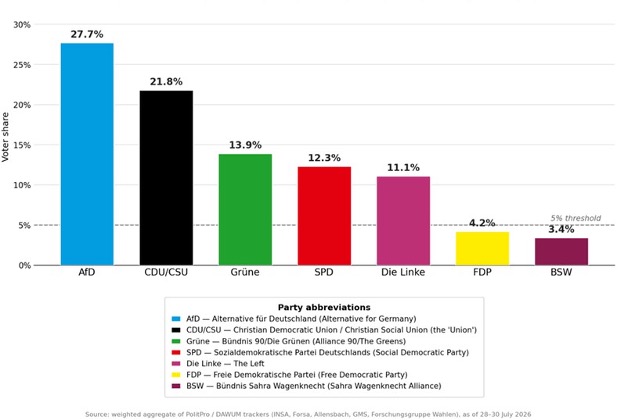
Nevertheless, although the participation of AfD in government is still considered as a red line which the other parties cannot transgress, its electoral rise seems to be unstoppable. In all polls taken in the second half of 2026, the AfD is now the strongest party and has overtaken the once-mighty ‘catch-all parties’ CDU/CSU and SPD. A ban of the biggest party makes the dirty hands dilemma increasingly acute.

To the so-called Sunday question “Which party would you vote for, if next Sunday would be elections?”, the German people opted in July 2026 as shown in the graph below: The AfD got 27.7 percent of the electorate becoming the strongest Party by 5.9 percent. The CDU/CSU was second and the once catch-all party SPD (Social Democratic Party) declined to the level of a small party. Both of the former mainstream parties, which were the strongest parties in Germany from 1949 to 2025, lost many voters to the AfD and with that their status of hegemonial catchall parties (Volksparteien).
On September 6, 2026, the AfD won the state elections in the small state of Saxony-Anhalt (2.5 percent of Germany’s total population and only 1.7 million voters) with 43.8 percent of the popular vote, becoming by far the strongest party in the state, ahead of the Christian Democrats (CDU) with 17.2 percent. Despite the state’s small size and the AfD’s modest share of the total German electorate, this election victory triggered a political earthquake. The media, political elites, and active citizens have made it clear that the issue of the AfD—and a possible ban on the party—has become one of the dominant topics of political discourse in Germany. The question. The question of whether the AfD should be banned or not to be banned has definitely now taken centre stage in the political debate.
The dilemma
That is to say, in today’s Germany banning the AfD would not target a fringe group, but potentially the country’s largest political party according to polls in August 2026 (see table 2[E1] ). This would not only constitute a significant restriction of the fundamental principle of popular sovereignty but would also likely provoke violent reactions among far-right supporters. These, in turn, would necessitate state repression, which would further increase both the normative and political costs of a ban. This is a classic spiral of escalation that responsible, ethical political action and political prudence should seek to avoid. Otherwise, the democratic state would continue to lose acceptance not only among AfD followers, but also among undecided volatile voters who are looking for new alignments. Here, another dilemma becomes apparent: If the party facing a ban has a large following, banning it is highly problematic from the perspective of democratic theory and practice. However, if it is too small, there is insufficient evidence that it is capable of successfully disrupting the democratic order, and thus there is less need for a ban. In constitutional discourse, this is discussed under the concept of ‘lack of potentiality’.[4] The temporal dimension—between initiating a ban too early or too late against a rising threat—is therefore problematic. Making the right choice at the right time requires political wisdom and a solid ethic of responsibility.
Conclusion
A comparison of the democratic costs associated with the two approaches—to ban or not to ban—can serve as a normative guide for government policy toward the AfD. There is reason to believe that the harm caused by an illiberal policy of prohibition could, in the long run, outweigh the risks associated with letting the AfD continue its rise.
But these are not the only options available to democratic ruling parties. The more democratic alternative would be to regain the trust and support of citizens that have been lost during the last decade. In a democracy, this can happen above all when governments represent the values and interests of broad segments of the population in their concrete policies. Democratic governments have to deliver. They must demonstrate that they are responsive to citizens and their material and non-material interests, recognize the major problems of our time, and make a serious effort to solve them. Such policies for the citizens are a more democratic response than banning a party that enjoys the greatest support among voters.
It is interesting to note that the majority of those voting in favour of banning the AfD comes from the Left, while those sceptical of a ban are found primarily in the conservative Christian Democratic camp. The Greens and the Left tend to be guided by an ‘ethics of conviction’, whereas parts of the conservative camp tend to follow an ‘ethics of responsibility’.
This is not a value judgment in favour of conservatives. But it is an unconscious reevaluation of their values on the part of both conservatives and progressives. While progressives normally favour the greatest possible freedom, pluralism and participation—that is, a radical form of democracy—in the debate over bans, they forget these values and, without realizing it, opt for a paternalistic restriction of opportunities for political participation. The reason for this is likely that the ban in question targets a far-right party. However, neither political camp—neither the progressives nor the conservatives—are free from tactical considerations regarding whether a ban will help or hurt them at the polls.
Sceptics of the ban also point to the comparatively high quality and stability of German democracy through the 77 years since its founding. Although in recent years about half the population has expressed dissatisfaction with how democracy functions, about 80 percent still affirm that they prefer democracy to any other political system. In international comparisons of democratic quality, Germany has for a long time ranked among the top 15 countries. Its comparatively high quality and stability have made it unlikely that its democracy can be overthrown and transformed into an authoritarian regime by one party only. In such a context, banning a party that represents about 25 percent plus of the electorate would do more harm than good to democracy. In the long term, it could also shift the public’s understanding of democracy toward a more illiberal and paternalistic model.
Nevertheless, there is also a risk that an AfD in government could lead to illiberalization of certain policy areas, such as immigration, internal security, and cultural policy. It is the nature of dilemmas that they cannot be resolved even through brilliant political leadership. There are always costs involved. Whatever decision is made on the question of whether to ban or not to ban, the decision-makers will not come out of it with completely clean hands. They must always assess, in a context-sensitive manner, where their hands will remain cleaner. In such cases, an ethics of responsibility is usually a more helpful guide than an ostentatiously displayed ethics of conviction. On these grounds, I stick to my opinion from 2024: Allowing the AfD to exist remains the less risky and more responsible course of action than the preventive banning of a political party.
REFERENCES
Dreier, Horst. (2023). Hans Kelsen zur Einführung. Hamburg, Junius Verlag.
Kelsen, Hans. (2018 [1929]). Vom Wesen und Wert der Demokratie. Leipzig, Reclam.
Kelsen, Hans. (1932). “Verteidigung der Demokratie”, in Blätter der Staatspartei, No. 2, 90–98.
Kelsen, Hans. (2016 [1953]). Was ist Gerechtigkeit? Leipzig, Reclam.
Loewenstein, Karl. (1937). “Militant Democracy and Fundamental Rights.” The American Political Science Review 1937, Vol. 31, No. 3, 417–432.
Malkopoulou, Antonia. (2026). “Democratic Self-Defense as a Dirty Hands Problem.” Democratization, 2026, No. 2, 1–21.
Merkel, Wolfgang. (2024). “Die Fallstricke der wehrhaften Demokratie.” MIP, Zeitschrift für Parteiwissenschaften, 2024, No. 2, 156–164.
Merkel, Wolfgang. (2026). “What is Democratic Resilience?” Democratization, 1/ 2026 (01 December 2025, DOI: 10.1080/13510347.2025.2590677).
Sartre, Jean-Paul. (1969 [1948]). “Dirty Hands,” in Sartre, Jean-Paul, Gesammelte Dramen. Hamburg, Rowohlt.
Walzer, Michael. (1973). “Political Action. The Problem of Dirty Hands.” Philosophy and Public Affairs, 1973, No. 2, 160–180. Walzer, Michael. (1977). Just and Unjust Wars: A Moral Argument with Historical Illustrations. Harmondsworth: Penguin.
Weber, Max. (1946 [1919]). “Politics as a Vocation”, in From Max Weber: Essays in Sociology, edited and translated by Gerth, H.H. and Wrigth Mills, C., New York: Oxford University Press, 77–128.
NOTES
[1] This is a modulation of the first two sentences from: Karl Marx/ Friedrich Engel, The Communist Manifesto in 1848.
[2] The focus is on the theoretical discussion of the dilemma involved and not on an empirical account of the rise of the right-wing populist party AfD. I am using ‘right-wing populist’ and ‘right-wing authoritarian’ as synonyms.
[3] However, the Sweden Democrats lost about three percent of the vote in the most recent parliamentary elections in September 2026 and are now only the third-largest party in Sweden, with 17.5 percent of the vote.
[4] This was exactly the main argument why the Federal Constitutional court did not ban the Neo-Nazi Party (NPD) in the year 2017, when the NPD received only 0.4 percent of the popular vote.

The Author

Toda Peace Institute
The Toda Peace Institute is an independent, nonpartisan institute committed to advancing a more just and peaceful world through policy-oriented peace research and practice. The Institute commissions evidence-based research, convenes multi-track and multi-disciplinary problem-solving workshops and seminars, and promotes dialogue across ethnic, cultural, religious and political divides. It catalyses practical, policy-oriented conversations between theoretical experts, practitioners, policymakers and civil society leaders in order to discern innovative and creative solutions to the major problems confronting the world in the twenty-first century (see www.toda.org for more information).
Contact Us
Toda Peace Institute
Samon Eleven Bldg. 5thFloor
3-1 Samon-cho, Shinjuku-ku, Tokyo 160-0017, Japan
Email: contact@toda.org