Thoughts on Decolonising Democracy
John Keane
August 25, 2026
Image: Boguslaw Mazur/ Shutterstock
This paper examines the disturbing and potentially ruinous effects of our crumbling global order on the spirit and substance of democracy, not only within the heartlands of the declining American empire but also in Canada, Germany, South Africa, the Netherlands, Italy, Australia, South Korea and other small and medium-sized outlier democracies which were once its loyal allies. Some gloomy spectators speak of the terminally catastrophic breakdown of the post-1945 rules-based international order and degeneration into economic rivalries, lawlessness and unending savage wars, or perhaps a nuclear war to end all wars. Others say we are returning to a mostly benign era of ‘sovereign’ nation state bargaining and rivalry or instead predict the birth of a new world order variously described as ‘multi-polar’, ‘heteropolar’ or a ‘new medievalism’. In all of this, thoughtful reflection on democracy is of enormous political importance.
Contents
- Turbulence and chaos
- The rules-based order
- Pax America
- Flooding the zone
- Imperium militare
- Imperial boomerangs
- Decolonising democracy
- Reactions
- Solidarity?
Turbulence and chaos
Our world is passing through a moment of mounting nervousness and bitter political disagreement about the breakdown of the post-1945 rules-based international order. Some gloomy spectators speak of its terminally catastrophic breakdown and degeneration into economic rivalries, lawlessness and unending savage wars, or perhaps a nuclear war to end all wars. Others say we are returning to a mostly benign era of ‘sovereign’ nation state bargaining and rivalry or instead predict the birth of a new world order variously described as ‘multi-polar’, ‘heteropolar’ or a ‘new medievalism’. What’s so far missing in these categorisation struggles is thoughtful reflection on a topic of enormous political importance: the disturbing and potentially ruinous effects of our crumbling global order on the spirit and substance of democracy, not only within the heartlands of the declining American empire but also in Canada, Germany, South Africa, the Netherlands, Italy, Australia, South Korea and other small and medium-sized outlier democracies which were once its loyal allies.
The rules-based order
Although the deep structural dependence of the ideals and institutions of democracy on the post-1945 rules-based world order led by the United States has become clearer in hindsight, it’s worth recalling that this rules-based order centred in the Atlantic region came in two connected phases.
There was the so-named ‘golden era’ period of welfare state-regulated capitalism founded at the 1944 Bretton Woods Conference and later shaped by a clutch of new institutions such as the International Monetary Fund (IMF), the International Bank for Reconstruction and Development (IBRD), the Antarctic Treaty, the United Nations and NATO. Among the hallmarks of this first phase were the unregulated spread of nuclear weapons and chronic military tensions with the Soviet Union. There was also free trade, controlled inflation, fixed rate currency exchanges, progressive tax rates, strong labour unions, reduced barriers to corporate investment, and the sanctification of private property in ‘social market’ form. There were new laws against genocide and human rights violations and celebrations of ‘liberal democracy’, an oxymoronic phrase that had first begun to flourish only during the 1930s, along with the proliferation of popular works on democracy by mainstream liberal thinkers such as Joseph Schumpeter, Karl Popper and Robert Dahl. For three decades, emboldened by leaders’ commitments to “pay any price, bear any burden, meet any hardship, support any friend, oppose any foe to assure the survival and the success of liberty” (John F. Kennedy), talk of a ‘liberal’ and ‘democratic’ international order flourished. But remember: during this ‘golden era’, democracy was only for the loyal friends of America. It was mainly a white-skinned affair reinforced by an anti-democratic arsenal of US dirty tricks, assassinations, torture, disappearances, economic sanctions and military interventions in countries such as Iran, Guatemala, Congo, Brazil, Chile, Granada and Panama.
The golden age was terminated by the stagflation and exchange rate crises of the 1970s. There followed a radical reshaping of the Bretton Woods arrangements into what commonly came to be called the age of ‘neoliberalism’. The United States still played the role of master dramaturg and nuclear-tipped protector-manager of the liberal democratic ‘free world’. In the name of ‘freedom’ and ‘democracy’, terms that were used interchangeably, there were more than a hundred US military interventions and untold numbers of engineered coups d’états, CIA-led assassinations and covert operations. This period also saw dramatic policy shifts in favour of anti-democratic, market-based accumulation freedoms championed by neo-liberals. Intellectuals, policy advisors and politicians openly insisted that inflation, fiscal problems, political instability and the shrinking authority of ‘overloaded’ government were caused by what the Trilateral Commission called an “excess of democracy.” Currency speculation, hot money flows, and the opening of markets to foreign investment came to be normalised. Corporate tax rates were lowered while the super wealthy evaded taxation altogether by moving their assets to safe havens. Backed by US-dominated bodies such as the World Bank, IMF, and the World Trade Organisation (WTO, established in 1995), the global offshoring of production, local plant closures and job losses became commonplace. The trends prompted new regional integration initiatives such as the Caribbean Community (CARICOM), the European Union, and the Shanghai Cooperation Organisation (SCO). The Soviet empire collapsed. China returned to the global order, this time as a formidable state capitalist rival to the United States. In the heartlands of the American zone, efforts to privatise state industries, welfare programmes and other public services multiplied. Rising public and household debt and widening income and wealth gaps predominated. The seeds of citizen ressentiment, populism and demagoguery were planted.
Pax America
In these decades after 1945, at various points on our planet but especially within the white and wealthy democracies, America’s public reputation as a ‘liberal democracy’ rode high. The young rising empire had since the 19th century prided itself on its support for ‘democracy’, as in its military conquests of Mexico (1846–1848) and the Philippines (1899–1902), but after its World War II victories against Japan and Nazi Germany it had a free hand in playing the role of defender-in-chief of democracy and stoic guardian of the entire ‘free world’.
…in the post-1945 period, the American way of life centred on ‘liberal democracy’ was said to be its gift to the whole world, a comprehensive ‘natural law’ binding on all states and their peoples
American governments bragged about their capacity to promote the building of new middle classes and functioning representative democracies. Local reactions were frequently sceptical or outright—think of the smouldering tensions between the Indian government and the United States (an apocryphal but telling anecdote has John Foster Dulles demanding to know whether India was for or against the United States, to which prime minister Jawaharlal Nehru replied: “Yes”). But in countries such as Britain, the Federal Republic of Germany, Norway and Italy, America stood for free and fair periodic elections, uncorrupted government, economic growth and shared prosperity, high-quality roads, education, health care and other public services, and belief in the principle that citizens are entitled to choose their own government. To paraphrase Hugo Grotius: in the post-1945 period, the American way of life centred on ‘liberal democracy’ was said to be its gift to the whole world, a comprehensive ‘natural law’ binding on all states and their peoples. In popular culture, there was the alluringly popular ‘democratic’ mixture of Hollywood, jazz, the all-shook-up Elvis Presley, Motown, Marilyn Monroe, Woody Allen, the rebel poetry of Bob Dylan, the melancholy magnetism of blue grass, gospel, soul and country music, the good-times fluff of the Beach Boys and the Monkees. Even when things were not going well, America seemed reformable, capable of doing better and for the time being worthy of global support. The belief in American-backed progress lingered long, into the opening moments (circa 2008) of the first Obama administration, when prominent democracy scholars such as Larry Diamond issued the first warnings about “democratic recession” tempered with a call for the United States and its democratic allies to secure “the spirit of democracy” and a “renewed democratic boom” in favour of “good governance” defined as “the rule of law, security, protection of individual rights, and shared economic prosperity”.
Flooding the zone
Talk of a new ‘democratic boom’ in Washington DC has stopped. The times they are now changing for America, and not for the better. We’re yet to see how much damage the belligerent Trump administration does to America’s global reputation in the coming years. The world is already awash with bad news about the United States, its double standards, big-money politics, media untruths, homelessness, gun violence, loud-mouthed leadership, second-rate infrastructure and general social decadence. Unsurprisingly, the number of tourists visiting the United States is in sharp decline. There’s rising global awareness of the disaffection among American citizens, six-in-ten of whom already say that life for them is worse than it was 50 years ago and who add, when looking to the future, that in 2050 their economy will be weaker, the United States will be less important in the world, political divisions will be wider and that there’ll be an even bigger gap between the poor and the rich in a country in which the wealthiest three Americans, each of them indulgers of the MAGA fantasy, currently own more wealth than 50 percent of the whole society.

Source: Elekes Andor / Wiki Commons
America’s old reputation as the model ‘liberal democracy’ is being dismantled as well by the way its current crop of political leaders and diplomats evidently care little or nothing for democracy. Their silence about ‘liberal democracy’ is spooky. Some MAGA enthusiasts openly welcome its abandonment. Curtis Yarvin, a leading MAGA ideologue and ‘dark enlightenment’ and ‘techno-feudalism’ champion, says it bluntly. “The leader must use the mass movement to win the democracy game, then demand and take absolute power.” Multi-billionaire co-founder of PayPal and Palantir Peter Thiel openly denounces democracy as a threat to ‘freedom’ and insists that the coming of the universal franchise, including women’s suffrage, has made it difficult for ‘capitalism’ to function because democracy has empowered an “unthinking demos” of idiots easily fooled and captured by populist politicians demanding higher taxation and stricter corporate regulation that have the effect of choking innovative techno-experiments with cryptocurrency, AI-powered agriculture, and the conquest of outer space.
Other tough-minded, hardcore MAGA supporters say democracy is no longer the only game in town because brute power and winning are all that matter. Demagoguery and despotism are their thing. The rules are plain. Flood the zone. Strengthen executive power. Cross red lines. Defy constitutional niceties, existing laws and legal precedents. Bewilder citizens by issuing non-stop executive orders. Abolish guardrails and watchdogs. Arbitrarily dismiss inspectors general, judges and other guardians of public integrity. Reduce the power of legislatures to appropriate tax money and determine its spending. Trample on workers’ rights. End immigration. Freeze research, educational, social support and foreign aid programmes. Silence dissenters.
Ridicule ‘No Kings’ citizen fightbacks. Recognise that the quintessence of politics is that the few tell the rest what to do. Expect unquestioning loyalty from bureaucrats. Denounce journalists and experts who expose misconduct, corruption, and malfeasance as ‘far left’ purveyors of fake news and partisans of the ‘deep state’.
Imperium militare
Not only has talk of ‘liberal democracy’ and democracy promotion dropped to the bottom of the fading empire’s list of global priorities. Treating the rules-based order it created after 1945 as a sham constraint on ‘national sovereignty’ is the new priority. Contrary to long-standing predictions that a rising China would seek to revise or overthrow the old rules-based order, it’s the United States, not China, which is now hellbent on scrapping the rules. Bully politics backed by a might-is-right mentality is the new American gold standard. “We live in a world in which you can talk all you want about international niceties and everything else,” says deputy chief of staff Stephen Miller. “But we live in a real world…that is governed by strength, that is governed by force, that is governed by power…These are the iron laws of the world.”
With these words America, treading the path of previous fading empires, is now foolishly resorting to military force as a prime solution to its mounting global ills. The depth and breadth of the militarisation of the American empire are terrifying. Currently backed by a network of 800 military bases in at least 75 countries, US military spending (according to the Stockholm International Peace Research Institute [SIPRI]) is now more than three times larger than China’s (US$296 billion) and higher than the next 20 governments combined. Military spending is currently ballooning: the Trump administration has proposed a budget of $1.5 trillion for 2027, a substantial increase from previous years. And the US is by far the biggest global arms dealer: between 2016 and 2020, 37 percent of global arms exports were from the United States (during the same period China accounted for 5.2 percent of the total).
America’s rulers have long insisted that interventions are good and necessary because they promote peace, human rights, international law, alliances, counterterrorism and democratisation
The disturbing point is that the failing empire is now permanently at war. Since its founding as a republic, the United States has invaded other territories nearly 400 times; more than a quarter of these invasions have happened since the collapse of the Soviet Union. There have been untold numbers of engineered coups d’états, CIA-led assassinations and covert operations although, as might be expected of an empire losing its grip on the world, the rate of military interventions has recently been accelerating. As the 2026 joint Israel/United States war on Iran unfolds, the wise warning of old Montesquieu in his Considérations sur les causes de la grandeur des Romains et de leur décadence (1734) that militarism corrupts republics and ruins empires goes unheeded.
America’s rulers have long insisted that interventions are good and necessary because they promote peace, human rights, international law, alliances, counterterrorism and democratisation. The alibis are contradicted by ugly realities. Since the Second World War, including the Vietnam fiasco, the Iraq debacle, the Ukraine quagmire and the failed war on Iran, the United States has lost just about every war. Its inability to win small or medium wars in asymmetric conflicts has been matched by shocking losses of life and ecological destruction. The American military is the world’s largest global polluter. The invasion and two-decades ‘Operation Enduring Freedom’ military occupation of Afghanistan resulted in the deaths of at least 250,000 people and a sudden withdrawal that left behind contaminated land and rivers, toxic burn pits and unexploded weapons containing known carcinogens, teratogens and genotoxins.
The military imperium, with its reliance on excessively expensive and outdated technologies of aerial bombardment with no boots on the ground, is faltering, as the catastrophes unleashed in Iraq, Afghanistan and the Gulf region confirm. The military imperium is also now the regular victim of perversely unintended consequences which can’t easily be remedied by military methods. A case in point: the sanctioning and blockade of Iran not only triggered widespread nervousness about the fragility of global supply chains and the damaging consequences of higher inflation; the long-standing military encirclement and attempted economic strangulation of Iran encouraged that country to shift its payment systems to cryptocurrency convertible into renminbi, the reliance on hawala networks and barter arrangements, the combined net effect of which has been to promote the de-dollarisation of the global economy and the strengthening of what analysts describe as a global ‘axis of evasion’ capable of outflanking America’s geo-military might.
Then there is a fact of sobering importance: the People’s Liberation Army and its strategy of what I have elsewhere called the yīn-yáng doctrine of “militarised peace.” The PLA is now the chief rival of the United States. It is the globe’s largest standing army, with two million troops backed by an expanding nuclear arsenal, more submarines than any other power, and sophisticated military hardware. The PLA is heavily involved in UN peacekeeping operations. In Libya, Yemen and the Sudan, it has practised the difficult arts of military evacuation of its citizens from conflict zones. Its hand has been strengthened by the settlement of disputes with neighbouring states, including India. The PLA’s militarised peace strategy is backed by a military-industrial-aerospace complex featuring mega-companies sporting trade names such as China North Industries Group Corporation (NORINCO) and the Aviation Industry Corporation of China (AVIC). It is reinforced by space power aspirations, a heavy reliance on smart diplomacy, and a commitment to a new and formidable model of warfare that presupposes, runs the Chinese saying, that melons forced from the vine don’t taste sweet.
Success in war, runs this way of thinking, demands self-control, forbearance, and the ability and willingness to wait (wuwei: non-action). Only fools rush into war. Wars are won, or avoided, not in the American way of Operation Inherent Resolve (the more than decade-long intervention in Syria and Iraq) but by outfoxing opponents, slowly wearing down or frightening enemies without firing a single shot.
Imperial boomerangs
In the history of democracy, militarism has been democracy’s chief nemesis. A new form of militarism is now infecting the empire’s heartlands with damaging effects on the spirit and substance of democracy everywhere. The boomerang effects of empire are palpably damaging its own democracy. It’s as if the shrinking empire is coming home; the American way of life is experiencing military colonisation. Despite previous promises, the president has a definite fancy for military symbolism. The imperial presidency has robbed taxpaying and arms-bearing citizens of their say in matters of war. The Congress has so far failed to restrict the war-making powers of the presidency. The arbitrary design and execution of military goals and strategies are now high-level imperial secrets and prerogatives. Troops are meanwhile despatched to home borders to protect America from the scourge of unwanted immigrants. Undocumented civilians are rounded up in frightened communities, flung into military camps or deported to Guantánamo Bay. The US military sells off or transfers its used or surplus weaponry to domestic police agencies. Militarised policing is consequently the new fashion. Officers kitted out in combat gear and armed with stun guns, tear gas cannon, pepper spray, sniper assault rifles, armoured trucks, drones, and tanks are becoming the new normal. The data shows that in the United States around fifty thousand SWAT (special weapons and tactics) raids are carried out annually on household dwellings by teams dressed in military gear and wielding military weapons, including grenades thrown prior to the raids. Military-style police teams are also active during street demonstrations and in urban communities, where disproportionately they are deployed against African American, Muslim and other minority communities. And now there is the body known as ICE (Immigration and Customs Enforcement) specialising in aggressive arrests in schools, hospitals and airports and high-volume deportations of suspects by masked officers in plain clothes and unmarked vehicles.
Decolonising democracy
Pressured by these various trends, which double as symptoms of America’s accelerating decline, more than a few illusions about democracy are being destroyed. An example: the old dictum that “a democracy is incapable of governing and managing an empire” (as the Athenian historian Thucydides famously wrote in his late 5th century BCE History of the Peloponnesian War) has been turned on its head. For the foreseeable future, the empire will manage without democracy. That’s the rule in the history of empires. When on the rise, durable empires, often pressured by the resistance of their distant subjects, extend them a measure of self-government. But when empires are in decline, they are bad losers. Shrinking empires grow self-absorbed, skittish, mean-spirited, and bellicose. Outbursts of megalomania (‘Make America Great Again’) come mixed with paranoid violence repeatedly directed at enemies abroad.
In these new circumstances, America’s obligations to smaller and less powerful outlier territorial democracies like Canada, South Africa, Chile, India, Ghana, Australia, New Zealand, or France, Germany and other member states of the EU are fast crumbling. Their leaders, diplomats and citizens are being forced to cope as best they can. That they call themselves democracies or appeal to democratic ideals isn’t of much significance or concern to the flailing empire. To use a favourite backroom phrase of American diplomats, their governments can go fuck themselves. They are going to be forced to face up to the new reality: don’t naïvely suppose that America is automatically on your side, pay your debts and higher tariffs, honour your military commitments, “start learning how to fight for yourself” (Trump), buy our weapons, do what we tell you to do, or we’ll make life difficult for you. Recognise that we intend to back away from costly conflicts (‘forever wars’) where our military grip is slipping. Understand that since our primary priority is America First, we want to consolidate our power ruthlessly in certain zones, especially our new focus on the Western Hemisphere, and to withdraw from others, all the while supporting the vision of a Greater Israel, which for instance involves building a new mega-embassy and surveillance and command centre in Lebanon. The fierce American logic of withdrawal and regrouping is what now matters. It’s brutal: with apologies to Thrasymachus, injustice is the will of those who were once strong. The rest of the world can go to hell.
If hope is the anticipation of a future that’s judged to be both possible and desirable, then what are the chances that the outlier democracies, which were once America’s under-the-wing friends, will survive and thrive?
The abusive language hurled by Trump at the leaders of the EU member states, the announced withdrawal (in January 2026) of the United States from 66 international organisations and the recent call to dismantle the International Criminal Court “brick by brick” are most probably a harbinger of things to come after he leaves office. Unless democracy’s friend serendipity steps in, the consequence will be that the democratic world will experience something like a 21st-century perverse replay of the century before, when by 1941, after a half-century of social unrest, economic stagnation, dictatorship, global war, and totalitarianism, a year when President Roosevelt called for “bravely shielding the great flame of democracy from the blackout of barbarism,” only eleven parliamentary democracies had managed to preserve their independence. They did so by knuckling down and keeping their distance, as far as they could geographically and emotionally, from the general anti-democratic trends of the age.
For all democrats, civil society defenders and democratically elected governments in cities, states and cross-border organisations, present-day trends and troubled futures are arguably going to be just as challenging as they were during those dark times. Within the outlier democracies, some right-wing parties and governments have already been emboldened by Trumpism, but it’s to be hoped (with examples like Hungary in mind) that not everything will go the way of the failing empire. Whatever happens, there’s a new question facing democrats of our age: if hope is the anticipation of a future that’s judged to be both possible and desirable, then what are the chances that the outlier democracies, which were once America’s under-the-wing friends, will survive and thrive? Will their leaders and citizens wake up to what is going on? Might they come to understand that every crisis is an opportunity? Or that this is the moment when they must create and muster outside sources of support which serve to preserve and enliven their spirit and substance?

Wiki Commons
Newly rephrased in older language familiar to previous global victims of Atlantic region empires: can the democracies once under the thumb of the United States decolonise themselves? Can they come to accept that decolonisation is not exclusively a problem confronting new nation states and the ‘Global South’? Have they the foresight, courage and wisdom to understand that entrapment in an empire, whatever material advantages it brings, is not just a matter of corporate takeovers and military bases but (as Aimé Césaire’s Discours sur le colonialisme [1955] famously pointed out) involves the deep scarring of bodies, hearts, minds and ways of thinking and speaking? Are these democracies able to shed their own inner illusions, throw off old habits, ditch words and phrases (mantras about liberal democracy, for instance) that function as soothing and numbing alibis of their disempowerment? Can they come to the realisation that dependence on America had damaging and disabling effects, and that there are new imperatives, that they must strive to find new words for capturing more precisely their altered thoughts, feelings and expectations, say goodbye to indifference and fatalism as forms of complicity, straighten their spines and stand up together in new and more boldly imaginative ways in support of the spirit and substance of their own democracies?
Reactions
It’s difficult to answer these unfamiliar and searching questions, or even to know if these are the right questions. Quite aside from the impossibility of predicting the future, the history that’s closest to us is always the most difficult to interpret. Yes, for the moment, it’s safe to say that the MAGA demagogue and his backers will do what they can to stave off American decline and defeat; that amidst the mounting global tensions and confusions, with its nuclear-tipped dome collapsing around its ears, the sudden demise or outright collapse of the United States ‘liberal democratic’ imperium is probably not on the cards; that rather like the Ottoman and British empires, our world will instead probably witness a string of slow-motion, spits-and-splutters episodes of retreat, regrouping and revenge; and that perhaps US imperial decline will happen the Hemingway way, slowly at first, then suddenly. It’s equally probable that the final crack-up of the American-led rules-based order will be protracted, disorderly and painful, and that there’ll be many cartoonishly crazy and contradictory happenings in which the prospects for democratic survival and renewal everywhere seem rather dim, or dismal.
For the moment, amid all the uncertainties, what is also obvious is that differences of opinion and policy among and within the outlier democracies are beginning to balloon. The short list below is both symptomatic of the breakdown of the old American-dominated global order and probably no bad thing, if only because it is pressuring the leaders and citizens of outlier democracies to consider how best to save their own skins.
Citizen hostility: The clearest trend, though it might not immediately count for much, is rising citizen hostility to the bearish American empire. This disaffection with America evidently runs much deeper than a passing dislike of the Trump administration. It’s true that there’s plenty of ambivalence, as in India, where roughly two-thirds of people praise what they call American ingenuity, hard work, higher education and respect for India, all the while simultaneously expressing positive views of Russia and hostility to China. But in other outlier democracies, the latest surveys of people’s opinions by market research agencies such as Ipsos and Pew (in 24 countries in mid-2025) indicate that belief in the United States as a force for good is both heavily contested and falling, with fewer than half of people now holding a favourable view of America’s role in the world. The highest level of hostility (8 in 10 citizens) is in Sweden; more than six-in-ten citizens view the United States negatively in neighbouring Mexico and Canada; majorities in Australia, France, Poland, Germany, the Netherlands, and Spain are of the same opinion, while in African democracies such as South Africa and Ghana approval of China now outranks support for the United States.
Loyal optimism: Despite these public opinion poll trends, there are governments whose promises of loyalty to the ailing United States outdo Pangloss in their ignorance of adversity and danger and their expression of naïve faith in a future where everything will turn out for the best. Masochistic wallowing (Tsitsi Dangarembga) is their thing. Unveiling a 2026 National Defence Strategy, Australian Defence Minister Richard Marles reaffirmed that the alliance with the United States would “always be fundamental to Australia’s defence.” He echoed Benjamin Netanyahu, who has long daily praised the ‘partnership’ of Israel and the United States as a tryst based on ‘the truth’. In New Zealand, Prime Minister Christopher Luxon welcomed the result of Donald Trump’s second election victory as a “comprehensive win,” subsequently called for the strengthening of the American alliance, and manoeuvred to shift his government’s position to display “explicit public support” for the US/Israel-led war on Iran.
Fence sitting: A clear majority of democratically elected governments are currently sitting on splintery fences. They feel the force of American decline and the turbulence it is triggering, but they act as if the storm will pass, and that, thanks to electoral defeat or a heart attack, Trump will be deposed so that when a future United States government comes to its senses things will get back to normal. They wring their hands while sitting on them. In psychoanalytic terms, these feckless governments suffer neurosis, a perception disorder triggered by anxieties they are trying (in vain) to repress. Their leaders may talk tough, and sometimes frankly. Germany’s Chancellor Merz risked the wrath of the Trump administration by telling high school students that the United States government’s decision to attack Iran was foolish, but truth is that Germany remains a loyal ally of the United States. An unconditional supporter of Israel, Germany remains the hub for US military might by hosting the U.S. European Command (EUCOM) and Africa Command (AFRICOM) in Stuttgart, along with Landstuhl Regional Medical Centre. As a crucial NATO partner, it contributes to the Enhanced Forward Presence in the Baltics, participates in missions against ISIS, works closely with the United States in supporting Ukraine and initially by materially backing the invasion of Iran.
Drifting ambivalence: There are outlier democracies whose governments nervously disobey American power but only on an ad hoc, opportunistic basis, as when the Italian government refused to allow US fighter aircraft bound for Iran to refuel in Sicily, or when Denmark’s ‘Operation Arctic Endurance’, in cooperation with troops from multiple NATO allies (France, Germany, Norway and Sweden), launched a ‘tripwire force’ to deter a United States invasion of Greenland, if necessary by blowing up runways to prevent US war planes from landing.
Drifting ambivalence is also the preferred strategy of the Modi government, which weathers abuse (after Trump reposts a podcaster’s description of India as a “hellhole” and heavy US tariff penalties (for purchasing discounted Russian oil and running a trade surplus with the US) while playing off the United States with support for China and Russia and sneakily and slowly but surely terminating the joint efforts of the past quarter century to nurture cooperation between the ‘oldest’ and ‘largest’ democracies.
Guns and trade: The waverers and fence sitters, feeling in their backsides the pain of the splinters from the fences on which they are precariously perched, are beginning to recognise the need to act more decisively in support of the economic prosperity and military defence of their own states. Loud announcements about rearmament, big military spending increases, blacklisting American AI data giants such as Palantir, and new trade deals excluding the United States are the current fashion. Japan, once a regional wallflower under American tutelage, is embracing a more self-reliant military strategy. On behalf of the EU, Germany is attempting to negotiate a new deal with China, its top trading partner. Chile has successfully agreed a trade agreement with the EU; after two decades of difficult negotiations, Australia has suddenly agreed a similar major trade deal with the European Union. Following a widely-reported Davos speech on the power of the powerless, in which he declared the end of the “pleasant fiction” of the “rules-based international order,” Canada’s PM Mark Carney has negotiated a dozen trade and rearmament agreements on four continents, including deals with China and Qatar, and an agreed comprehensive strategic partnership with the EU, including joining SAFE, the European defence procurement arrangements. Free trade pacts with India, ASEAN, Thailand, Philippines and Mercosur are also under negotiation.
Democratic innovations: The task of militarily defending and rebuilding the investment and trade infrastructures on which democratic institutions and ways of life so obviously depend is obviously important. But it is strategically difficult and politically controversial. In matters of political economy, repositioning democracies which were once mainly dependent upon the United States within the wider alternative ‘neo-medieval’ multiplex of cities, provinces, regions and trans-continental NGO institutions and governmental bodies such as the International Criminal Court will prove to be a critically important priority made more urgent by the world-reshaping role now played by Russia, Iran, and China. The diversification of the outlier democracies’ partners—their renegotiation and renunciation of ties with the United States and their embrace of a more complex geometry of bilateral agreements, functional arrangements, regional and global bodies—is imperative. But there’s an equally important question now facing the outlier democracies: in the age of American decline, are these democracies capable at home of throwing off masochistic wallowing by breathing new life into the spirit of democracy and crafting new democracy hideaways, havens and hermitages? Alas, there are for the moment few signs of this happening; if anything, most of these democracies are plagued by public confusion, government policy laziness and citizen ressentiment.
Source: Heein Park / Shutterstock
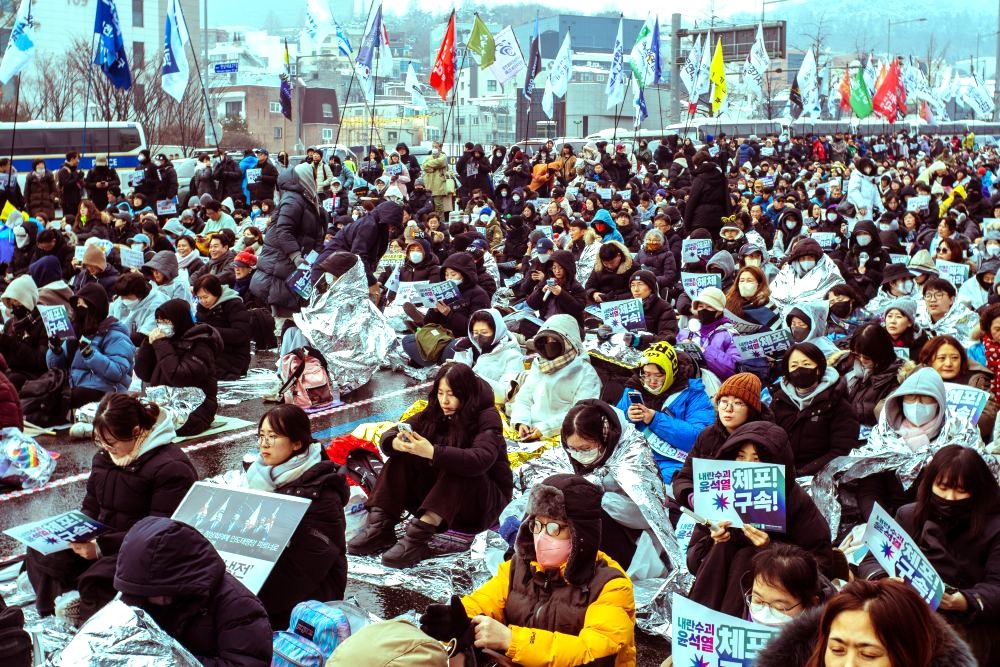
There are significant countertrends, it’s true. The parliament of the Republic of Korea recently impeached a president for declaring martial law and has signed off on the world’s first comprehensive laws against verbal abuse and bullying (gapjil) by family run conglomerates and other powerful organisations. The Welsh parliament has just passed legislation to make lying about matters of fact a criminal offence during Senedd elections and to establish a recall system, granting citizens the right to give the boot to underperforming or misbehaving representatives in between elections. The Spanish government has extended potential full citizen rights to more than half a million (undocumented) immigrants. In Australia, a major new Reclaiming Democracy Together citizens’ initiative has recently been launched.
Within these outlier democracies, bundles of prickly questions remain: will democrats get serious about the decolonisation of their democracies? Are they brave enough to stare down the Kissinger rule: to be the enemy of the United States is dangerous, to be its friend can be fatal? Will their independent media courageously carry on revealing scandalous things that are not to America’s liking, and serve to shame and restrain its shrinking power? Will the outlier democracies use free and fair elections to elect mutinous governments willing to speak and act against the United States? Might we come to see the rise of a new and younger crop of democratically elected leaders who speak frankly and practise the arts of leading others honestly and boldly by the head and heart, not by tugging and pulling at their noses? Will their judiciaries dare to stand firm and do as Brazil’s Supreme Court did (in September 2025) by convicting an American-backed demagogue and his aides of stage managing a failed conspiracy to overturn a general election in a coup d’état plot that included disbanding courts, empowering the military, and assassinating the democratically chosen president-elect?
Solidarity?
The future of small and middle-sized outlier democracies will depend heavily upon positive and practical answers to these kinds of searing questions. Here’s the hope: confronted by Russian-style despotisms, a rising Chinese galaxy empire and an angry America bearishly in retreat and decline, democrats everywhere might realise that this is a moment of opportunity not to be wasted, a tipping point in which the future of democracy no longer depends on the approval and support of the United States. New forms of post-imperial democracy will instead depend upon the “solidarity of the shaken” (Jan Patočka’s famous phrase) and the courage, inventiveness and determination of governments and people who are being sidelined, left behind, bullied and screwed. As things fall apart, the mounting uncertainties, setbacks and misfortunes and American capriciousness will hopefully galvanise the minds and hearts of democrats on every continent, granting them courage to stand against the lawlessness and injustices of power exercised arbitrarily.
So serious are the times that my hope is that their commitment to democracy will toughen their resolve to stand firm together—to recognise that go-it-alone autarky and the narrow-minded nationalism of so many previous episodes ofdecolonisation are both impossible and undesirable—while searching at all levels of government and social life for new remedies for the maladies of representative democracy, all the while saying again and again: since uncontrolled power is dangerous, and since America on the skids is trying to sow division and disunity to its advantage and can no longer politically be fully trusted or relied upon, democracy is once again, for very different reasons than our grandparents supposed, an indispensable global virtue, a non-negotiable and basic requirement everywhere of a decent and dignified life for creatures large and small on an endangered planet we call home.

The Author

Toda Peace Institute
The Toda Peace Institute is an independent, nonpartisan institute committed to advancing a more just and peaceful world through policy-oriented peace research and practice. The Institute commissions evidence-based research, convenes multi-track and multi-disciplinary problem-solving workshops and seminars, and promotes dialogue across ethnic, cultural, religious and political divides. It catalyses practical, policy-oriented conversations between theoretical experts, practitioners, policymakers and civil society leaders in order to discern innovative and creative solutions to the major problems confronting the world in the twenty-first century (see www.toda.org for more information).
Contact Us
Toda Peace Institute
Samon Eleven Bldg. 5thFloor
3-1 Samon-cho, Shinjuku-ku, Tokyo 160-0017, Japan
Email: contact@toda.org