Democratic Resilience in the United States in the Second Trump Presidency
Robert R. Kaufman
August 15, 2026
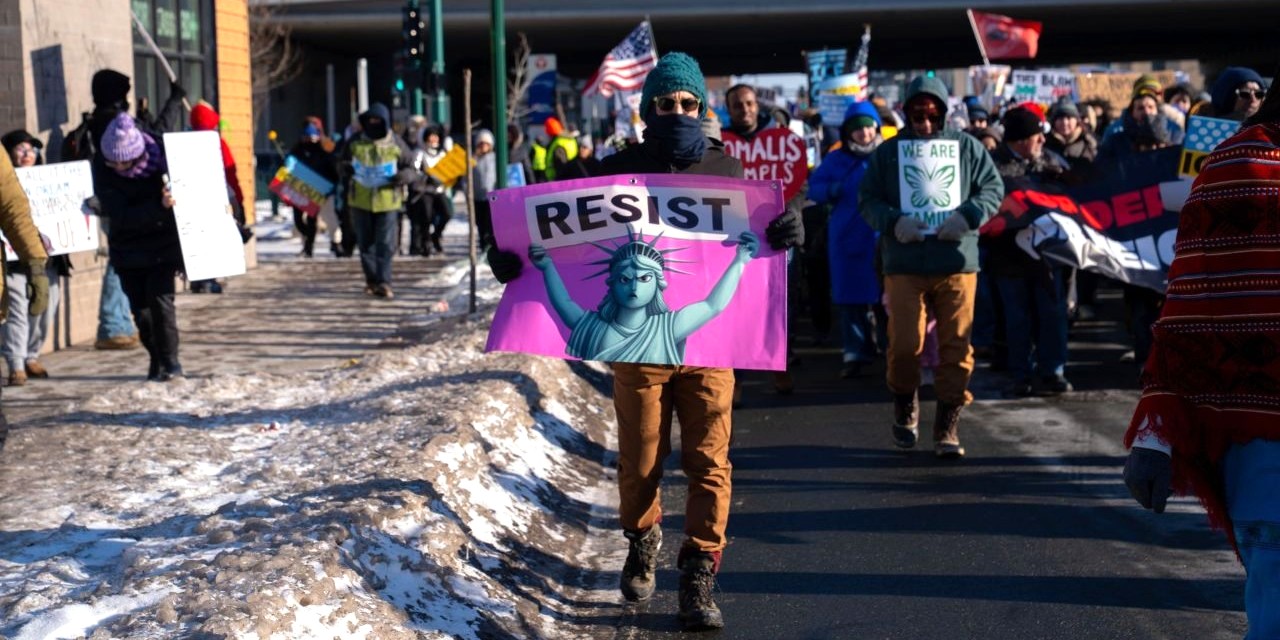
Cover image: Alejandro Diaz Manrique / Shutterstock
This paper focuses on the challenges of backsliding and recovery in the United States. What are the primary sources of resilience, and what are the chances that American democracy can rebuild in the aftermath of the Trump era? The paper begins with a comparative look at ‘recovering backsliders’—countries in which backsliding episodes have been halted and democratic political leaders have returned to power. The second section turns to the threats to democracy during Trump’s second term and the forces pushing back against them. The last section assesses the long-term prospects for democratic recovery. The report concludes that while political opposition to Trump’s autocratic initiatives has intensified, the prospects for a long-term recovery of American democracy are limited.
Contents
- Introduction
- Comparative perspectives
- Democracy during the second Trump presidency: Challenges and constraints
- Looking forward: Prospects for American democracy
Introduction
During the first decades of the 21st century, democracies around the world have come under increasing pressure from movements of the far right or left. The mid-2000s marked the beginning of what some have termed a ‘democratic recession’, in which the number of democracies experiencing institutional deterioration or collapse began to outnumber transitions to, or improvements in, democratic systems. By the 2010s, the threat of recession had expanded from the newer democracies that had emerged during the ‘third wave’ to the more established democracies in Western Europe and East Asia. And in the United States, following the rise of Donald Trump to the presidency in 2017, the American democratic system began a pronounced process of backsliding that the one-term presidency of Joseph Biden failed to halt. These developments have given rise to a large literature on ‘democratic backsliding’ and—more recently—on the potential resilience of democratic systems that face this threat (e.g. Boese et al. 2020; Merkel and Luhrmann 2021; Merkel 2025; Gamboa 2022; Capoccia 2024; Croissant and Lott 2024; Riedl et al. 2025).
In this paper,[1] I focus on the challenges of backsliding and recovery in the United States. What are the primary sources of resilience, and what are the chances that American democracy can rebuild in the aftermath of the Trump era? I begin with a comparative look at ‘recovering backsliders’—countries in which backsliding episodes have been halted and democratic political leaders have returned to power. The results of these restorations, as I will show, are not encouraging for democracy in the United States. Even in countries where backsliding episodes stop short of reversions to authoritarianism, complete ‘U-turns’ are rare. In most backsliding countries, democracies have not rebounded to the same level of electoral competition and civil liberties that they had achieved prior to the backsliding episodes, and many remain vulnerable to a resurgence of anti-democratic political movements.
Within this group of countries, the United States stands out as an especially challenging case. The effort under Joseph Biden (2021–2025) to rebound from the first Trump presidency (2017–2021) failed to prevent Trump’s re-election; and with the start of his second term in 2025, Trump launched an even more devastating attack on American political institutions. Indeed, the first months of the current term led some to conclude that we have already crossed the border into competitive authoritarianism (Levitsky, Way, and Ziblatt 2026).
But Trump’s bid to concentrate authority has also faced important constraints—from the courts, the federal system, and civil society. These constraints, moreover, have grown stronger as the economy has stagnated, as the conflict over immigration has escalated, and as public opinion has turned sharply against the decision to launch a war of choice in Iran.
With November 2026 midterm elections drawing closer, these contradictory pressures—of both political deterioration and resilience—pose major questions about where the US political system will go from here. The dangers to American democracy remain profound, but it is also possible that this is a moment in which the tide turns—at least in the short term—against Trump’s anti-democratic onslaught. After surveying the comparative landscape in section one of this paper, I turn in the second section to the threats to democracy during Trump’s second term and the forces pushing back against them. The last section assesses the long-term prospects for democratic recovery.
My conclusions, unfortunately, are mixed. The good news is that the political opposition to Trump’s autocratic initiatives has intensified, and there is a substantial possibility that pro-democracy actors can regain control of America’s political institutions in the coming years. On the other hand, given the severe damage already done to these institutions and the underlying polarization of American society, the prospects for a long-term recovery of American democracy are limited.
Comparative perspectives
Once autocrats or would-be autocrats have been removed from power, to what extent can such backsliding countries recover or improve on previous levels of democracy? [2] In a previous study (Kaufman 2025b) of twenty-four backsliding countries, I identified thirteen in which the autocrat was ousted and replaced by the reestablishment of elected constitutional governments (see Appendix Table 1).[3] Sadly, however, as of 2025, only a few—Ecuador, Moldova, and the Dominican Republic—regained the degree of electoral competition and political rights they had achieved prior to the onset of the backsliding episode—as measured by scores on V-Dem’s widely-used Liberal Democracy Index.[4] All of the rest, including the United States under Joseph Biden, emerged with weaker systems than they had before—that is, with less competitive or reliable election systems and less robust systems of ‘horizontal’ checks and balances.
The cases of Poland and South Korea are especially relevant from a comparative perspective, because like the United States, both had previously been characterized by relatively robust democratic systems.[5] As in the United States, both countries continued to experience high levels of political and social polarization even after backsliding governments were displaced, allowing the defeated authoritarian parties to remain major opposition forces and weakening the capacity of the state to implement the rule of law (Kaufman 2025b).
In Poland, the former ruling party (the PiS) had, during its long tenure in power, embedded its loyalists in major institutional and economic centres of power, seriously impeding attempts by the incoming government to reverse previous restrictions on civil liberties. In Korea, support for the new democratic government was weakened by a corruption scandal, but also by online-fuelled polarization that impeded its efforts to deliver on promises to rein in the powerful chaebol conglomerates, improve labour rights, and attack public corruption. Its failures opened the way to a narrow victory of conservative forces in the election of 2022 and an aborted, but very damaging, attempt at a coup d’etat by the incumbent Yoon Suk-yeol in 2024.
Post-mortem analyses of [Harris’s] defeat highlight both bad luck and bad decisions. But … deep social and political divisions society left very little margin for error.
The failure of the Biden administration to stabilize democracy in the United States reflects a similar path—one which led in 2025 to the return to power of Donald Trump. Biden, it should be emphasized, faced decades-old socio-economic and racial conflicts that preceded the rise of Trump, structural challenges related to increasing concentration of income, and deepening divisions that had escalated throughout Trump’s first term. Even more recent challenges, moreover, emerged from the devastating dislocations of COVID that erupted as his first term came to a close. Among other things, the pandemic led to the disruption of trade pipelines and soaring inflation in 2021, Biden’s first year in office. Moreover, although the incoming administration logged some significant achievements in the management of the economy, environmental protection, and infrastructure investment, unforced errors also contributed to the defeat of the incumbent party—most notably, Biden’s failure to withdraw earlier from the 2024 election.
Post-mortem analyses of this defeat highlight both bad luck and bad decisions. But underlying the debate over why the Democrats lost is the fact that—as in South Korea and Poland—deep social and political divisions society left very little margin for error. Trump’s popular vote margin over Kamala Harris (1.5 percent) was more decisive than expected, but it was still very narrow. This, in turn, reflected the precarious state of the United States’ polarized political system. Given the existential stakes at play in the election, the cost of defeat affected not only the incumbent party, but American democracy itself.
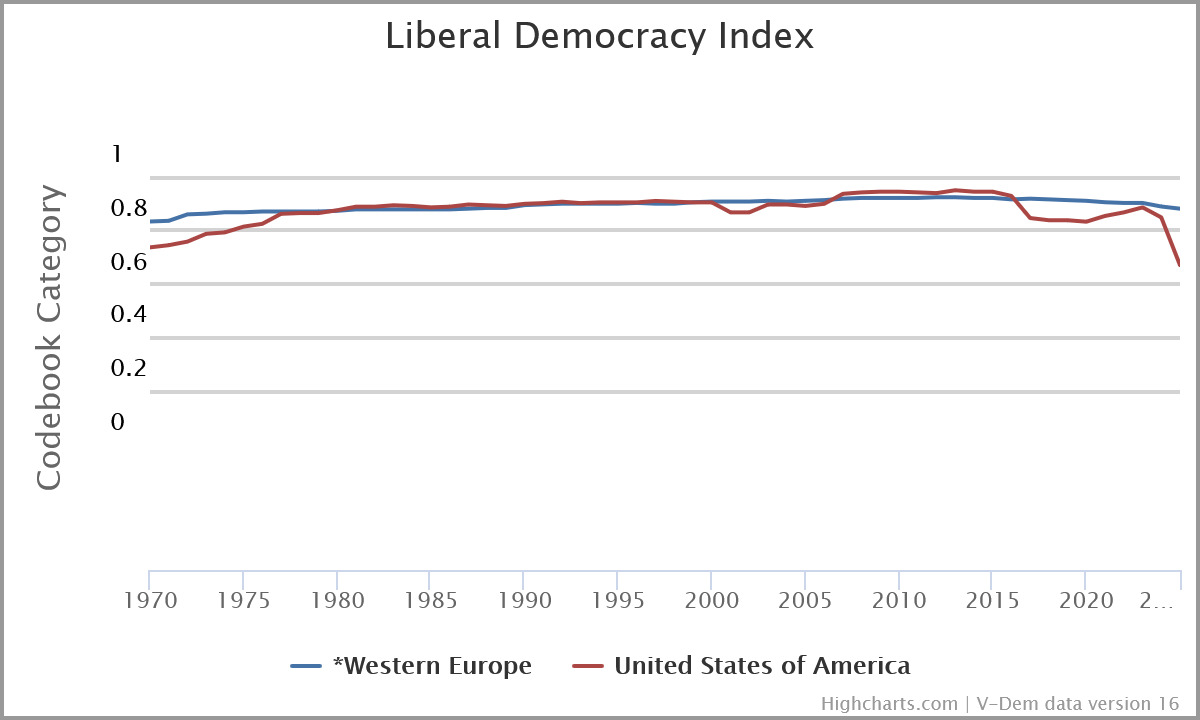
The V-Dem Liberal Democracy score in Figure 1—a composite measure of electoral freedom, constitutional checks, and individual rights—show the drastic decline in the basic features of American democracy following the election of Donald Trump in 2025. Following the landmark responses to demands for racial and gender equality in the 1960s, the United States sustained scores above 0.80 between 1976 and 2024, even throughout the first Trump term. In 2025, however, the score fell to only 0.57, after a small increase registered under Biden (V-Dem Democracy Report 2026). Typically, American democracy placed among the top 10 or 20 countries in V-Dem ratings, outranked mainly by democracies in Western Europe, Japan, and Australia. But in 2025, it fell to only 51st among the 179 countries in the report (Nord et al. 2026: 48). This left it tied with Slovakia and Greece and only a few points above Colombia (0.56), Timor-Leste (0.55), Solomon Islands (0.54), and Argentina (0.52).
Democracy in the United States may not be dead, according to these measures, but it has declined precipitously. In the next section of this paper, we look more closely both at the political and social processes reflected in these ratings, as well as at some of the factors that might impede further deterioration.
Democracy during the second Trump presidency: Challenges and constraints
The factors imperiling American democracy, as we have noted, predate the rise of Trump. But as we have also seen in the graph in the preceding section, these challenges have escalated drastically since his return to office in 2025. Their magnitude can be highlighted further by contrasting them with the threats he posed during his first term. From 2017 to 2021, Trump succeeded in eroding deeply held norms of political discourse and practice, but US political and constitutional institutions remained more or less intact. Challenges to the democratic system—including on January 6—were contained by congressional opposition, by the courts, by the press, and by civil society—as well as by opponents within the Republican party and independent voices within the executive branch. Significantly, as noted above, V-Dem continued to place the United States in the Liberal Democracy category throughout this period.
During the second term, constitutional institutions themselves have come under a much more devastating attack—by a far more unified governing elite. Throughout the first year, acquiescent Republican majorities in the Congress opened the way to an unprecedented concentration of executive power, and the President deployed this power to weaken or eliminate independent agencies, purge the government bureaucracy, and violate the civil rights of immigrants and racial minorities. Many law firms and universities were compelled to yield to pressure from his government, and powerful groups within the private sector—most especially the technology elites—either allied with the government or were cowed into submission. The judiciary did retain a degree of independence, as we will see, and it remained one of the few institutional checks on Trump’s grab for power. But—with some important exceptions—the highly conservative Supreme Court frequently acquiesced to initiatives that appeared to stretch the limits of the Constitution.
In 2026, the second year of Trump’s term, the executive’s attacks on institutional checks and the rule of law accelerated. One especially notable aspect of this acceleration was the enforcement of immigration policy. Trump’s pursuit of immigrants began quickly after his inauguration, but in the following year, it culminated in indiscriminate roundups that generally targeted religious or ethnic minorities and in the virtual occupation of major cities by ICE and Border Control agents, typically over the opposition of state and local officials.
Together with undocumented immigrants (few of whom had engaged in violent crime) [6], residents ‘with papers’, and some US citizens were caught up in the sweeps.
Abuses reached a peak in Minneapolis during the winter of 2026. Thousands of ICE and Border Control agents were dispatched to the city, provoking confrontations with civil society protesters and local authorities. The political fallout from these confrontations was intense, and it escalated dramatically after federal agents killed two US citizens engaged in peaceful protest. Notably, the government reacted to the growing public opposition to its enforcement policies with a temporary draw-down of the federal presence.But abuses—and the controversy they aroused—continued throughout the country.
Trump’s unilateral deployment of military power abroad posed a second, even greater threat—to both constitutional government and national security. These deployments began in July 2025, with a joint raid with Israel on Iranian nuclear sites, and they continued in September with the destruction of alleged drug boats and their crews in the Caribbean and Pacific. But the scope of military force increased dramatically the next January with the seizure of Venezuela’s president, Nicolas Maduro; and it culminated, at the urging of Israel, in the attacks launched on Iran at the end of February. Congressional oversight of presidential war powers, it should be noted, had been eroding for decades; but Trump ignored Congress almost entirely in this series of attacks, and he faced no significant objections from his foreign-policy team, which had been purged of experienced diplomats and replaced with loyalists.
In all likelihood, the February 28 assault on Iran was inspired by the success of the rapid coup in Venezuela, and it was intended as a quick blow that would crush the Iranian regime within days. As we discuss below, however, the war has dragged on for months, with profoundly unsettling effects on both the international political economy and the US political system.
COUNTERVAILING CONSTRAINTS
Political and institutional constraints on Trump’s challenges to American democracy have been seriously weakened over the last decade, but they have not been eliminated entirely. As noted, these constraints operated with some effectiveness during the president’s first term. And although they failed to prevent a more radical deterioration of American democracy during the second term, they have continued to pose obstacles to the centralization of power. The political and institutional headwinds Trump currently faces, moreover, have become considerably stronger as the public begins to feel the impact of his reckless policies. The sources of resilience correspond closely with Merkel’s (2025: 4) model that highlights the role of constitutional powers, political parties, civil society,
One important constitutional check on the central government has continued to come from the decentralized federal system (Kaufman, Kelemen, and Kolcak 2025).Even at the high point of his political honeymoon, Trump faced important push-back from governors and mayors in Democratic-controlled state and municipal governments. And, as noted above, these officials joined an aroused civil society opposition in Minnesota to force a retreat by the federal immigration police.
American federalism, to be sure, has always been a double-edged sword; historically, control of some state governments has provided local authorities with opportunities to repress the political rights of Black and Native American minorities (Gibson 2012; Grumbach 2022). But in the current situation, decentralized federal powers have worked to protect autocratic assaults coming from the national government.
As also noted above, the judiciary has also remained a significant impediment to Trump’s bid to concentrate power, notwithstanding the conservative turn of the Supreme Court.The institutional strength of this branch of the system is deeply rooted, both in centuries-old legal precedents and in professional norms established through established schools of law and influential bar associations. As a result, lower court and appellate judges of all political backgrounds (including Trump appointees) have repeatedly ruled against violations of immigrant rights and have generally held the line against Trump’s efforts to turn the legal system against the free press and political opponents.
Moreover, although the Supreme Court has acquiesced in much of Trump’s drive to concentrate power, it has also ruled against some of his most important initiatives.These include his attempt to dictate tariffs without congressional approval—a centerpiece of his economic program. And the Court is highly likely as well to block his effort to restrict birth-right citizenship, and to expand control over the Federal Reserve by firing officials or threatening them with frivolous criminal investigations.
Working within the institutional spaces provided by the courts and the federal system, civil society—another pivotal element in Merkel’s model (2025)—has also continued to impose a significant constraint. Although corporate leaders and most universities have offered little resistance, many segments of civil society did regain their voices. The most dramatic example came in the Minnesota protests, described above. But well before that time, civil society organizations and coalitions have engaged in the streets and in the legal system to contest abuses of authority and defend civil and political rights. Law schools and bar associations have bolstered judicial efforts to push back against abuses of authority. And thousands of groups at the state and local level have worked to mobilize protests and protect civil liberties.
A supine congress, currently dominated by Republican party loyalists, has been the weak point in this system of checks and balances during the first two years of Trump’s current term. Trump has faced virtually no legislative constraints on his power; according to the V-Dem 2026 report (Nord et al. page 5), congressional independence is at its “lowest point in over one-hundred years.”
Ironically, however, the weakness of legislative checks has also cleared the way for Trump to pursue increasingly unhinged and self-destructive policies. Notably, the Congress has virtually abdicated its constitutional responsibility to regulate international trade, opening the way for Trump to engage in erratic and unpredictable tariff policies that have dealt significant blows to price stability and growth.[7] And with the economy turning sour, the voting public has turned sharply against the Trump presidency. According to most opinion polls, approval ratings dropped from about 50 percent at the start of Trump’s term to around 35 percent by August 2026.
Congress’s abdication of its constitutional war powers also left the way open for Trump’s disastrous decision to initiate an air war against Iran at the end of February 2026. The president, as noted, was undoubtedly emboldened by previous unauthorized military attacks—especially the lightening incursion into Venezuela to capture Nicolas Maduro—a move that encountered almost no political fallout. But these unauthorized ‘successes’ encouraged an overconfident and unrestrained government, egged on by Israel, to launch the ill-fated assault on Iran.
For the Democratic opposition, the combination of a slumping economy and a profoundly costly and unpopular war vastly increases the odds of a reversal of fortune in the coming midterm elections.
This assault, as we now know, has backfired badly. The Iranian government quickly reconstituted itself after US and Israeli strikes decimated its top leadership; and despite the destruction of its conventional military arsenal, Iran turned the tables on the attackers by blocking the flow of oil and other vital commodities through the Strait of Hormuz, dealing a severe blow to the world economy. The geopolitical consequences of Trump’s enormous blunder will continue to unfold for decades. But it is already clear that they have further weakened his hold over the American public.
For the Democratic opposition, the combination of a slumping economy and a profoundly costly and unpopular war vastly increases the odds of a reversal of fortune in the coming midterm elections. Incumbents typically lose congressional seats in midterm elections; but the popular backlash against the current administration can well carry Democrats to an especially strong victory in the House of Representatives and possibly to a narrow majority in the Senate as well.
Such a transfer of legislative power, to be sure, is very unlikely to be smooth: Trump and the MAGA movement will try to stave off defeat through gerrymandering, voter restrictions, intimidation, and outright violence. And we cannot rule out the possibility that such efforts might succeed. Even so, it will be difficult for Trump and his followers to fully subvert the highly decentralized electoral system. MAGA groups might succeed in overturning some individual contests, but the overall effect of a broad popular shift to the opposition will be hard to reverse.
The change of party control in even one house of the Congress would have a major repercussion on the direction of American politics. At minimum, it would increase the opportunities for the opposition to hold hearings, compel testimony, and regain control of the news cycle. More directly, it would acquire the power to block authorization and funding for presidential initiatives. The President may continue to exercise unilateral, often illegal, authority, and I consider this possibility below. But with shrinking popular support and a change in the constitutional balance of power, the tide might be turning. Looking ahead to the early months of 2027, there are strong possibilities that Trump’s threat to US democracy will stall or even go into reverse.
Looking forward: Prospects for American democracy
The political decline of Trump and the defeat of the MAGA movement is necessary for the survival of American democracy, but it will not be enough to save it. The coming years are likely instead to be characterized as a period of flux in which we can imagine a variety of outcomes. In this concluding section, I point to several potential scenarios.
A TRUMP COUP?
Before we turn to speculations on a post-Trump era, we need to consider the possibility that Trump and his allies might attempt to break through constitutional constraints entirely, deploying the power of the state to crack down decisively on the political opposition and continue in power. Looming over the next two years of Trump’s term, after all, is the spectre of January 6, 2021. We should not underestimate the threat that a cornered president might pose to the constitutional system during the remainder of his term, using his control over the system of justice and police to crack down even more comprehensively on political opponents, the press, and civil society.
But although such an attempt is possible, Trump would not be likely to succeed in consolidating his hold on power in the face of collapsing public support. The President, it should be noted, has never been able to draw on the degree of strong popular backing that once propelled autocrats like Victor Orban or Recip Erdogan into power; even Trump’s plurality victory in 2024 fell slightly short of fifty percent of the voters. And as we have noted, his support has declined sharply since that time.
The weakness of this support, in turn, would limit Trump’s control over other levers of power that were also available to more successful autocratic leaders. With the economy stagnating and the quagmire deepening in the Middle East, Trump’s core MAGA support base has become increasingly divided.And with the strong political headwinds now facing his presidency, it highly unlikely that he would find enough support within either the business elite or the military establishment necessary to seize full control over the decentralized American system. We might well see severe political turbulence in the final years of Trump’s term, including violent assaults on competitors and critics. But this is unlikely to prevent the emergence of a much more robust opposition over the remainder of his time in office or an electoral transfer of presidential power in 2029.
A CRITICAL REALIGNMENT?
The United States political history has been marked in the past by major political realignments that upended the prior balance of power and produced major new majority coalitions. One of these—launched under William McKinley in the 1896 election—led to long-term dominance of the Republicans in the Northeast and Western states. Another, the New Deal coalition of Northeast labour, Mid-West progressives, and southern Democrats, was forged by Franklin D. Roosevelt, at the onset of the Great Depression. Both realignments, it should be emphasized, were engineered at the cost of unpardonable deals with southern white elites that denied the civil and political rights of African Americans. However, under the Republican coalition of the early 20th century, the United States emerged as an industrial economy and a major world power.And the New Deal coalition laid the foundations for the establishment of America’s modern welfare state—and, eventually, for responses to the demands for social justice for Blacks and other excluded minorities.
It is not inconceivable that the enormously destructive impact of Trump’s second term could open the way to another realignment—one that would produce a large, new majority coalition, marginalize Trumpian extremists, and establish a new foundation for competitive democratic politics. In the 21st century, however, a major realignment would look very different from either of these historical examples, and possibly less enduring.
Most assuredly, an attempt to resurrect the industrial and union-based foundations of the past—a project advocated by some on the political left—would founder in the face of revolutionary changes in production and communications technology, global integration, and artificial intelligence. A new coalition would require a project that combined the social and political interests that have emerged out of these changes with effective strategies to respond to the massive insecurities and inequalities that these changes have produced.
If such a coalition is possible at all, it would most likely emerge—as was the case under Roosevelt—through trial-and-error responses to unexpected events, rather than through a clearly planned-out, ‘top-down’ strategy, which would surely have negative side-effects that would be difficult to reverse. More important, attempts to construct such a coalition, whether from the ‘top-down’ or ‘bottom-up’, would carry very high—and quite possibly unacceptable—political and constitutional risks. Ironically, the institutional checks and balances that we hope might impede the concentration of power under Trump would also be likely to frustrate radical reforms pursued by a new governing coalition. Overcoming such obstacles might well require ‘democracy-reinforcing’ hardball strategies (Bateman 2025) that test the outer-limits of the norms and institutions of democratic politics. Such a strategy, moreover, is unlikely to succeed unless the current domestic and international crises become so devastating that Trump’s support is reduced to its hardcore minority. This scenario is certainly conceivable, as suggested above, but it is not necessarily one to be wished for.
MUDDLING THROUGH?
Short of a radical new political alignment, US democracy in the post-Trump era is likely to be burdened not only by the many of the challenges that led to his rise but also by the destructive legacy left in his wake.
Partisan polarization is a root cause of the problems we face in addressing the issues facing the American public. The division has multiple sources. These include underlying socio-economic factors that have produced deep social cleavages: long-standing racial conflicts, the decline of the labour-based manufacturing economy, the extreme concentration of wealth, and the profound dislocations caused by revolutionary new technologies in production and information.
Populist anxieties have also been stoked from above—by influential figures on the radical right and, of course, by Trump himself. The consequence is “the division of society into mutually distrustful Us versus Them camps in which political identity becomes a social identity” (McCoy, Rahman, and Somer 2018). Figure 2, which compares polarization in the United States with that in Western Europe, shows the extraordinary extent of these cleavages in the United States.

Extent to which political differences affect social relationships beyond political discussions. Societies are highly polarized if supporters of opposing political camps are reluctant to engage in friendly interactions, for example, in family functions, civic associations, their free time activities and workplaces. [scores between 3 and 4 indicate polarization to a ‘noticeable’ or ‘large’ extent]
The political failure of the Biden administration provides a sobering tale about the difficulty of overcoming these divisions. The highly competent Biden team was unable to right the ship despite a systematic attempt to combine targeted investment in new information and manufacturing technologies with an expansion of investment in job skills and social protections. The MAGA movement that came to power in 2025 and reversed these efforts has been weakened by the disastrous performance of the second Trump presidency. But continuing underlying divisions in American society are likely to pose serious challenges to Trump’s successor.
We can, moreover, expect these challenges to be compounded by the damage the Trump presidency has done to the United States’ position in the world and at home. By 2029, the country will be in much weaker position to ask for the support of historic allies, and it will compete within a much more disordered global economy featuring the intensification of challenges from China.[8]
But continuing underlying divisions in American society are likely to pose serious challenges to Trump’s successor.
Perhaps even more important, Trump’s successor will have to cope with the damage that has been done to the capacity of the American state, starting with Elon Musk’s DOGE purges at the beginning of Trump’s term. The attacks on the federal bureaucracy through mass firings and job uncertainty have severely weakened the state’s ability to deliver critical services, health and education, and public safety. The lost institutional memory and expertise that had built up over many decades will leave a new president with only a limited capacity to respond to popular expectations and demands.
Even in the face of such challenges, American democracy might well survive in a minimalist sense: incumbent governments might continue to be held accountable to the retrospective judgments of the electorate, with enough freedom of debate and assembly to make this possible. But without a fundamental restructuring of the political and economic landscape, American democracy will function at a very low level—a system that is not consistently able to protect individual rights or to respond effectively to the demands of popular majorities. Even after the (likely) defeat of the MAGA movement in 2028, democracy in United States would remain vulnerable to a resurgence of destabilizing waves of popular protest.
REFERENCES
Bateman, David A. (2025). “Democracy-Reinforcing Hardball: Can Breaking Democratic Norms Preserve Democratic Values?” Comparative Political Studies 59:6 (May): 1191–1225
Bier, David J. (2025). “5% of People Detained by ICE have Violent Convictions, 73% have no Convictions.” Cato Institute www.cato.org. (24 November).
Boese, Vanessa A., Amanda B. Edgell, Sebastian Hellmeier, Seraphine F. Maerz, Staffan I. Lindberg. (2020). “Deterring Dictatorship: Explaining Democratic Resilience since 1900.” V-Dem Institute. Working Paper, Series 2020:101. (May 2020).
Capoccia, Giovanni. (2024). “Counter Illiberalism in Liberal Democracies: Actors, Strategies, Temporalities.” Delivered at the Annual Convention of the American Political Science Association, Philadelphia (5-–8 September).
Croissant, Aurel and Lars Lott. (2024). “Democratic Resilience in the Twenty-First Century: Search for an Analytical Framework and Explorative Analysis.” Working Paper, Series 2024:149 Varieties of Democracy Institute.
Gamboa, Laura. (2022). Resisting Backsliding: Opposition Strategies against the Erosion of Democracy. Cambridge University Press.
Gibson, Edward L. (2012). Boundary Control: Subnational Authoritarianism in Federal Democracies. Cambridge: Cambridge University Press. DOI: 10.1017/CBO9781139017992.
Grumbach, Jacob M. (2022). Laboratories against Democracy: How National Parties Transformed State Politics. Princeton, NJ: Princeton University Press. DOI: 10.1515/9780691218472.
Haggard, Stephan and Robert R. Kaufman. (2021). Backsliding: Democratic Regress in the Contemporary World. Cambridge University Press (United Kingdom, New York, Melbourne, New Delhi, and Singapore).
Kaufman, Robert R. (2025a). “Democratic Resilience in the United States: Containing Trump’s Threat to Democracy?” Toda Peace Institute. Report No. 227 (4 July).
Kaufman, Robert R. (2025b). “Backsliding and Democratic Resilience: Prevention, Resistence, and Recovery.” Working Paper No. 8. IGCC/UC Institute on Global Conflict and Cooperation (November).
Kaufman, Robert R., R. Daniel Kelemen, and Burcu Kolcak (2025). “Federalism and Democratic Backsliding in Comparative Perspective.” Perspectives on Politics 23:1 (March), 15–34.
Keane, John (2026). “Notes on Empire: American and the Decolonization of Democracy.” Prepared for the TODA meeting on Global Challenges to Democracy, Oxfordshire, UK, (18–20 June).
Levitsky, Steven, Lucan A. Way, and Daniel Ziblatt (2026). “The Price of American Authoritarianism: What Can Reverse Democratic Decline?” Foreign Affairs 105:1 (January/February), 30–46.
McCoy, Jennifer, T. Rahman, and M. Somer (2018). “Polarization and the Global Crisis of Democracy: Common Patterns, Dynamics, and Pernicious Consequences for Democratic Polities. American Behavioral Scientist 62:1, 16–42.
Merkel, Wolfgang (2025) “What is Democratic Resilience?” Democratization 01 December 2025, DOI: 10.1080/13510347.2025.2590677).
Merkel, Wolfgang and Anna Luhrmann, eds. (2021) “Resilience of Democracies: Responses to Illiberal and Authoritarian Challenges.” Democratization 28:5 (special issue).
Nord, Marina, David Altman, Tiago Fernandes, Ana Good God, and Staffan I. Lindberg. (2026). Democracy Report 2026: Unraveling the Democratic Era? University of Gothenburg: V-Dem Institute.
Riedl, Rachel Beatty, Paul Friesen, Jennifer McCoy, and Kenneth Roberts (2025). “Democratic Backsliding, Resilience, and Resistance.” World Politics 77:1, 151–177.
Stokes, Susan C. (2025). The Backsliders: How Inequality and Trash–Talking Leaders Undermine Democracy. Princeton University Press.
APPENDIX
Liberal Democracy scores at the beginning and end of backsliding episodes and in 2025.

Notes
[1] This paper draws on two prior papers I have published (Kaufman 2025a and Kaufman 2025b).
[2] Following long-standing practices in the political science literature, I understand ‘democracy’ in terms of conventional standards of free elections, constitutional checks and balances, and the protection of individual rights.
[3] For a more extensive description of the selection methods, see Haggard and Kaufman (2021) and Stokes (2025).
[4] This conclusion is based on scores in the Liberal Democracy Index [a measure that assesses the degree of free elections and civil and political rights] in the year prior to the onset of the backsliding episode; the last year the leader was in power; and 2025—the most recent year in which the liberal democracy score is available.
[5] Prior to the onset of backsliding, the Liberal Democracy scores for Poland and South Korea were .82 and .79 respectively, compared to the United States’ pre-Trump score of .85.
[6] According to some estimates, over 70 percent of the detainees in 2025 had no criminal records. And only about 5 percent had been convicted of violent crimes. (Bier 2025)
[7] Although the economy grew at a moderate pace in 2025 (about 2.1 percent), this was slower than in 2024 (the last year of Biden’s term), and the year ended with a sharp slowdown in the last quarter (annualized at about 0.5 percent) and with inflation remaining at a high annual level (2.7 percent). Forecasts for 2026 vary, but are clouded by continuing uncertainty over trade policy and by the war in the Middle East.
[8] See John Keane (2026).

The Author

Toda Peace Institute
The Toda Peace Institute is an independent, nonpartisan institute committed to advancing a more just and peaceful world through policy-oriented peace research and practice. The Institute commissions evidence-based research, convenes multi-track and multi-disciplinary problem-solving workshops and seminars, and promotes dialogue across ethnic, cultural, religious and political divides. It catalyses practical, policy-oriented conversations between theoretical experts, practitioners, policymakers and civil society leaders in order to discern innovative and creative solutions to the major problems confronting the world in the twenty-first century (see www.toda.org for more information).
Contact Us
Toda Peace Institute
Samon Eleven Bldg. 5thFloor
3-1 Samon-cho, Shinjuku-ku, Tokyo 160-0017, Japan
Email: contact@toda.org