Advancing Indigenous Climate Mobilities Governance: Vaitupu–Kioa’s Cross-Border Fenua
Carol Farbotko and Taukiei Kitara
July 22, 2026
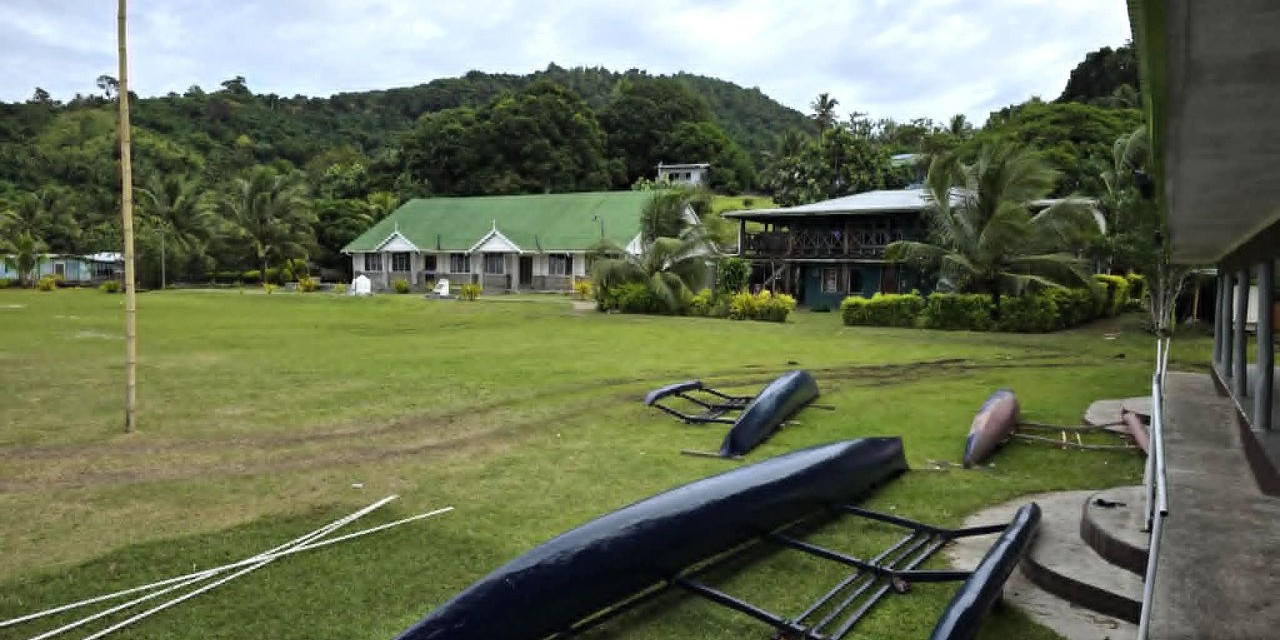
Image: Kioa Island / Supplied by the authors
This policy brief presents a case study of Indigenous climate mobility governance, through which communities exercise authority to make decisions on how their land or other resources might or might not become available to support groups wanting to move. It presents a summary of, and recommendations from, recent research on the Vaitupu–Kioa international fenua, a unique Indigenous community that spans an international border between Fiji and Tuvalu. It considers Kioa as a potential site of climate refuge for other fenua communities in Tuvalu, emphasizing that such an opportunity could only be achieved through the Indigenous authority of Vaitupu–Kioa, and likely also the Indigenous governance system of the Cakaudrove Fijian community, whose territory surrounds Kioa. Specific recommendations are provided for the governments of Tuvalu and Fiji and other international partners, in what is arguably their role as enablers of Indigenous climate mobilities. Our primary recommendation is for state-centric models of climate mobility to be re-examined for their tendency to preclude self-determined, culturally grounded governance of relocation among Indigenous communities, including across international borders.
Contents
- Abstract
- Introduction
- Defining Indigenous climate mobilities governance
- The case of self-determined migration to Kioa
- Perspectives of the Vaitupu and Kioa communities on future climate mobility among Tuvalu’s other communities
- Lessons from Kioa
- Recommendations
- Conclusion
Abstract
This policy brief presents a case study of Indigenous climate mobility governance, through which communities exercise authority to make decisions on how their land or other resources might or might not become available to support groups wanting to move. It presents a summary of, and recommendations from, recent research on the Vaitupu–Kioa international fenua, a unique Indigenous community that spans an international border between Fiji and Tuvalu (Kitara et al. 2026). It considers Kioa as a potential site of climate refuge for other fenua communities in Tuvalu, emphasizing that such an opportunity could only be achieved through the Indigenous authority of Vaitupu–Kioa, and likely also the Indigenous governance system of the Cakaudrove Fijian community, whose territory surrounds Kioa. Specific recommendations are provided for the governments of Tuvalu and Fiji and other international partners, in what is arguably their role as enablers of Indigenous climate mobilities. Our primary recommendation is for state-centric models of climate mobility to be re-examined for their tendency to preclude self-determined, culturally grounded governance of relocation among Indigenous communities, including across international borders.
Introduction
The relocation of some Pacific Island communities away from low-lying coastal areas and some atoll islands is a current policy issue. For low-lying nations such as Tuvalu, the prospect of all territory potentially becoming uninhabitable is a risk with no straightforward solution (Barnett et al. 2025). As sea levels rise, the question for many Indigenous communities is not only if they will move, but how any movement might be governed.
Governance models of climate mobility to date are dominated by the assumption that state-led programs are needed. However, when Indigenous people relocate through state-led programs rather than their own leadership, they are more likely to experience psychological, socio-economic, cultural and spiritual harm (Yumugalova et al. 2023; Raisele et al. 2025; Farbotko 2019; Baleinakorodawa & Boege 2024).
In this context, Indigenous climate mobilities could be holistically understood as an emergent political space, a way for Pacific Island communities to maintain their agency, identity, and ontological security in a world of climate loss, and minimize mobility-related harms (Mafile’o et al. 2026; Baleinakorodawa and Boege 2024).
Indigenous governance systems in many cases are well-positioned to nurture cultural resilience and uphold the self-determination and sovereignty of their own people if they decide to move (Yumugalova et al. 2023; Baleinakorodawa and Boege 2024). The role of the state, it is suggested, is to recognize and create an enabling environment for self-determined climate mobilities among communities.
This policy brief presents a case study of Indigenous climate mobility governance. The focus of research is often on populations who might need to move away from sites of climate risk, but this report considers research from a receiving community perspective conducted by Kitara et al. (2026). It asks what might be possible when an Indigenous group considers their own territory as a potential refuge for other people, whose territory elsewhere is at risk of uninhabitability, and addresses this issue through Indigenous governance. It highlights the importance of centralizing Indigenous governance, through which Pacific communities have authority to make decisions on how their land might or might not become available to support groups wanting to move (Kitara et al. 2026).
Defining Indigenous climate mobilities governance
This report suggests defining Indigenous climate mobilities governance as a system where the authority to make fundamental decisions regarding movement, settlement, and land use resides within Indigenous institutions. Such a model is predicated on the understanding that Indigenous governance systems, which in many Pacific Islands are long-standing systems of decision-making, customary land tenure, and chiefly leadership dating from the pre-colonial era, are inherently equipped to govern climate mobilities through their dynamic customary institutions for diplomacy, dialogue, dispute resolution and decision-making. The authority of Indigenous governance in the Pacific, such as the Tuvaluan falekaupule, is often recognized at the level of national (post-colonial) government (Stratford et al. 2013). Rarely, however, is Indigenous governance invoked as central to climate mobility planning, and yet these are the systems through which cultural resilience in the context of climate mobility is likely to be maintained (Yumugalova et al. 2023; Baleinakorodawa & Boege 2024). Cultural resilience in this context is the capacity of a community to maintain its social fabric, language, customary governance, and collective knowledge, despite the upheaval of relocation. Indigenous governance by definition prioritizes the maintenance of the community as a whole, and for many Pacific communities who might move, culture and community are key to a resilient future.
In cases of international climate mobilities, state-led programs are likely to disperse communities through cross-border migration of individuals or families, and thereby neglect the question of how customary governance and Indigenous sovereignty might be maintained. However, as this report explores, Kioa’s history demonstrates that Indigenous mobilities across an international border can occur by and for the community, maintain cultural resilience, expand Indigenous sovereignty, and build peaceful relations with new neighbours (Kitara et al. 2026). As such, Kioa provides a model of self-determination for other Pacific Island communities potentially facing a move across an international border should their own territory become uninhabitable.
The case of self-determined migration to Kioa
Tuvalu means ‘group of eight’, referring to the eight fenua, distinct communities each with their own island and their own customary governance system. In the 1940s, one of Tuvalu’s eight fenua, the community of Vaitupu, purchased Kioa island in the Cakaudrove Province of Fiji. The Vaitupu community negotiated with the colonial authorities to allow some of its members to move to Kioa, which was at the time uninhabited and available as freehold land, although from an Indigenous sovereignty perspective it also remained part of the Cakaudrove [1] Province. The purchase of Kioa was an act of Indigenous foresight, creating a Vaitupuan settlement governed through the Vaitupu customary governance system, operating both in its own right and within the Cakaudrove customary governance system.
Kioa today is a proud community of Tuvaluan-speaking people. Kioa is governed by the Kioa Kaupule (Council) and the 110 Matai (traditional landowners who represent the original families who contributed to the purchase) as well as Cakaudrove governance and the national laws of Fiji. Kioan customary governance thus operates largely harmoniously within the Fijian nation-state. But it also remains culturally, linguistically, and emotionally tied to Vaitupu in particular, as well as to the Tuvaluan nation, and is subject to transnational Vaitupu–Kioa governance arrangements which determine who can access land on Kioa. Kioa is often referred to by its residents as the ninth fenua of Tuvalu. It is unique, being both part of the customary sovereignty of Vaitupu and with its own political identity and governance.
The establishment of the Kioa community demonstrates that movement to a new physical territory does not necessarily equate to the loss of the fenua. Fenua, drawing from the Kioa case, is arguably not only a fixed geographical location but can be, when driven by communities themselves, an emergent and dynamic sovereign space. If movement to a new area is led by a community, in negotiation with other political entities in the destination area, it can lead to both an expansion of existing fenua and new fenua, as Kioa is both part of and separate to Vaitupu.
The history of Kioa is significant for climate mobilities because it demonstrates how Indigenous groups in the Pacific can establish successful settlements in new nations in ongoing negotiations with the state. In Kioa’s case, negotiations with the colonial authorities for migration rights later became negotiations for Fijian citizenship with independent Fiji. Through diplomacy, the Kioans maintained their Indigenous sovereignty without diminishing the Indigenous sovereignty of others. Kioa is a high island, with far less risk from sea level rise than Vaitupu, which is a low-lying atoll. Kioans from the start established and have maintained good relations with their Cakaudrove neighbours, who offered significant support in the early years of the settlement. Vaitupuans today can seek to move to Kioa through their existing customary governance system, separate to the Tuvaluan state and enabled but not led by the Fiji state—the governance arrangements between Kioa and Fiji are such that those who have access to land in Kioa under customary authority can then obtain Fijian citizenship. If the island of Vaitupu is no longer habitable at some point in the future, Kioa is available to those from Vaitupu who seek permission for land use in Kioa from the 110 Matai. Kioa is thus in a position to host Vaitupuans who wish to migrate to Kioa under its customary governance, but also to consider its role as a potential host for other Tuvaluan communities beyond Vaitupu.[2]
Indigenous authority can be expanded to new lands, as has successfully been the case in Kioa, where Vaitupu–Kioa customary governance remains authoritative. Kioa thus offers a model for how other Tuvaluan communities, and indeed other communities in the Pacific Islands, might navigate their futures through their own decision-making systems, and through Indigenous diplomacy with other groups.
Perspectives of the Vaitupu and Kioa communities on future climate mobility among Tuvalu’s other communities
Research conducted via sautalaga (Tuvaluan storytelling) explored the specific sentiments felt by Kioans and Vaitupuans towards other fenua—different Indigenous communities with their own governance systems—in Tuvalu, as Kioans and Vaitupuans consider a potential role in future climate mobilities (Kitara et al. 2026).
PERSPECTIVES FROM KIOA
Kioa residents expressed a profound sense of responsibility toward other Tuvaluan Indigenous communities, fenua, in the context of future potential climate mobility, with support among older and younger community members, as well as males and females, for Kioa possibly becoming a site of refuge for other Tuvaluan communities. Older Kioans often emphasized the existential threat of the climate crisis, viewing Kioa as a possible site of relocation for all people from Tuvalu’s low-lying islands. One male elder noted that Kioa is “big enough to have Tuvaluan people relocate to” and that “everyone should be in one place… where there is similarity in culture and language.” The Tuvaluan concept of fale pili, translated as ‘looking after your neighbour without expecting anything in return’, is the cultural-ethical cornerstone of the Kioa community’s consideration of Kioa as a potential site of climate refuge for other Tuvaluan Indigenous communities. Some participants were also concerned with the impacts on Kioa of welcoming others. Many pointed out the practical limitations if climate mobility arrangements resulted in a significant population increase. A female participant (18–50), for example, noted that while Kioa would “embrace and welcome people,” the island would “struggle because certain things like our freshwater sources will struggle to meet the high demand” (Kitara et al. 2026).
PERSPECTIVES FROM VAITUPU
In Vaitupu, the sentiment was more mixed towards Kioa as a potential site of climate mobility for other Tuvaluan fenua, reflecting the complex politics of land ownership. Several Vaitupuans emphasized that “Kioa belongs to Vaitupu” and that priority should be given to Vaitupu residents. One participant (male, 18–50) stated that “other islands of Tuvalu would be hard to go to Kioa because… the lands on Kioa belong to the 110 Matai.” Despite ownership concerns, there was also a clear recognition of fale pili obligations. A Vaitupuan elder (male, 50+) stated, “We cannot look away when our Tuvaluan brothers and sisters are suffering.” This participant noted that any relocation would need the “approval of the 110 Matai” and be situated in the Fijian nation-state’s legal frameworks (Kitara et al. 2026).
Lessons from Kioa
The 110 Matai system is a specific form of private–communal land ownership under the authority of Vaitupu–Kioa, operating in harmony with the Fijian national legal framework and Cakaudrove customary governance. Kioan sovereignty co-exists with Cakaudrove sovereignty and Fijian law. While the Fiji state may choose to grant citizenship to other Tuvaluans, it cannot demand Kioa allocate land to them due to Kioa’s Indigenous authority over its land. Frameworks for Indigenous climate mobilities can recognize such existing governance and facilitate climate mobility discussion and decision-making without diminishing customary authority. Any decision-making about Kioan land for climate mobility purposes must start with the 110 Matai. Recognition of this Indigenous sovereignty ensures that if the Kioa community entered into Indigenous forms of diplomacy with, for example, Tuvalu’s other seven fenua, and Cakaudrove customary institutions, then the role of the Fiji and Tuvalu governments is to recognize and support the authority customary governance in any climate mobility decision-making and planning.
Indigenous governance emphasizes relational obligations among communities and with place, conceptualised and practiced within and between fenua in Kioa and Tuvalu. While state-led international migration pathways can provide options for individual migration in a changing climate, such pathways do not necessarily recognize the fenua as a distinct cultural entity or nurture its resilience. Indigenous climate mobilities, however, can maintain the community as the foundational organizational unit. If the community organizes its move, and largely moves together, cultural resilience, as the Kioa case shows, is a more likely outcome than it would be in state-led mobility programs. Climate mobility policy frameworks, furthermore, need to recognize and support the community as the foundational organizational unit when customary or state borders are part of the climate mobility spaces being explored, not only when communities move within customary land. Indeed, maintaining cultural governance and political identity as a community is possibly even more important to consider when crossing cultural or international borders. Governments need to provide the legal and financial space for Indigenous diplomacy (see Carter, Fry & Nanau 2025) between Indigenous governance institutions in receiving areas and in areas of high climate risk. But such diplomacy is not an issue for states to suggest or orchestrate: identifying the kinship, political, historical and cultural relations that might form the basis for discussion is a matter for communities to self-determine.
systems approve the addition of hundreds or thousands of people from Tuvalu, even to stay on Kioa temporarily before moving to other areas in Fiji, there would need to be a gradual arrival process and large investment in community services and infrastructure. Any development partnerships to plan services and infrastructure must be led by the community’s own vision for their island, again in accordance with Kioa’s customary governance of land, and also in consultation with new arrivals through their own customary governance systems.
Recommendations
Transitioning to an Indigenous climate mobilities model requires addressing existing policies and frameworks to better centralize and recognize customary authority.
Recommendation 1: Recognise Indigenous sovereignty
Ensure that regional and national laws, frameworks and policies on climate mobility explicitly recognize the authority of customary governance institutions such as the Kioa Kaupule, the 110 Matai, the Cakaudrove chiefly system and all similar Indigenous bodies.
Recommendation 2: Establish a cultural heritage hub on Kioa
Support the Kioa community’s vision of Kioa as a resilient hub of Tuvaluan culture in a changing climate by funding programs that nurture Kioan and Vaitupuan language, culture and history.
Recommendation 3: Develop community-specific climate mobility plans
Move away from one-size-fits-all national strategies and instead support Indigenous communities in developing their own self-determined climate mobility plans.
Recommendation 4: Promote the Vaitupu–Kioa case study
Use Kioa as a model for community-led climate refuge, enabling other Indigenous groups who are interested in opening their customary land to other groups to explore Indigenous diplomacy with those exploring refuge possibilities.
Recommendation 5: Facilitate fenua-to-vanua and similar discussions
Support direct discussions between groups across borders, such as Tuvaluan fenua and the Cakaudrove Province of Fiji, fostering neighbourly relations on climate refuge and climate mobility grounded in Indigenous diplomacy.
Recommendation 6: Fund an Indigenous diplomacy fund
Establish a fund to support communities in conducting their own diplomatic exchanges on climate refuge and climate mobilities with other Indigenous groups in the Pacific Islands.
Recommendation 7: Enable technical and financial support
Provide regional mechanisms that allow Indigenous groups to access climate finance and technical support directly for land and infrastructure.
Recommendation 8: Monitor Indigenous climate mobility justice
Establish an oversight body to ensure that climate mobility policies do not undermine self-determination of Indigenous peoples.
Conclusion
Findings from research with members of the Kioa and Vaitupu communities show a high degree of care among Kioans and Vaitupuans for Tuvaluans from other Indigenous communities in Tuvalu who may face uninhabitability, balanced by logistical concerns regarding freshwater and infrastructure, and, most fundamentally, the maintenance of customary authority over land and community. Such welcoming sentiment can be transformed into Indigenous climate refuge under Vaitupu–Kioa customary governance through Indigenous diplomacy with the customary governance systems of the other Tuvaluan fenua. An enabling environment for exploring the potential of comparable Indigenous climate refuges could be facilitated in the Pacific Islands region. By shifting the focus from state-led to Indigenous governance of climate mobilities, the Pacific region could be better equipped to ensure that its people do not just survive climate change, but that their cultures, communities and identities thrive. The culturally resilient community of Kioa demonstrates that Indigenous governance is dynamic and innovative, and capable of solving some Pacific climate mobility challenges. States can act as enablers, respecting and embracing the Indigenous authority of customary governance, as the foundation for climate mobilities grounded in dynamic Indigenous sovereignties.
REFERENCES
Barnett, J., Farbotko, C., Kitara, T., & Aselu, B. (2025). Migration as adaptation? The Falepili Union between Australia and Tuvalu. Wiley Interdisciplinary Reviews: Climate Change, 16(1), e924.
Baleinakorodawa, P. & Boege, V., (2024). Climate Change-Induced Community Relocation in Fiji: Challenges and Ways Forward, Toda Peace Institute. Policy Brief 192, Japan.
Carter, Salā G., Fry, G. & Nanau, G.L. (eds) (2025). Oceanic Diplomacy: Reasserting Indigenous Pathways through the contemporary Pacific. Macmillan Brown Centre for Pacific Studies Press, University of Canterbury, Aotearoa New Zealand.
Farbotko, C. (2019). “Climate Change Displacement: Towards Ontological Security.” In Dealing with Climate Change on Small Islands: Towards Effective and Sustainable Adaptation?, edited by C. Klöck, and M. Fink, 251–266. Göttingen: Göttingen University Press.
Kitara, T., Farbotko, C., Boas, I., Talia, M., Vaiafua, S., & Lisati, P. (2026). Indigenous climate mobilities governance: The case of the Vaitupu–Kioa international migration route. Environmental Science & Policy, 180, 104394.
Mafile’o, T., Alofa, P., Kauongo, T., Saguba, L., Steven, H., Filoa, A., Sanga, F., Toloa, T., Isaako-Toloa, L., Nailasikau Halatuituia, S. & Hauma, T. P. (2026). ‘We do in the spirit of togetherness’: stories of collective resilience, wellbeing and climate (im)mobility in the Pacific. Climate and Development, 18(3), 280–291.
Raisele, K., Waqa, M., & Lagi, R. (2025). Climate crisis and indigenous well-being: ancestral land, psychological & ontological impact, and resilience in Fijian communities. Journal of Indigenous Social Development, 13(1), 15–39.
Stratford, E., Farbotko, C. & Lazrus, H. (2013) “Sovereignty and climate change: considering Fenua, the Archipelago and emigration,” Island Studies Journal, 8, pp. 67–83.
Yumagulova, L., Parsons, M., Yellow Old Woman-Munro, D., Dicken, E., Lambert, S., Vergustina, N., Scott, J.C., Michell, P. & Black, W. (2023) Indigenous perspectives on climate mobility justice and displacement-mobility-immobility continuum.
Climate and Development, 1–18.
Notes
[1] There were Indigenous Cakaudrove inhabitants of Kioa at the time the island was sold to the colonial authorities by Cakaudrove leaders, in around 1914. These inhabitants moved under Cakaudrove Indigenous governance to another location within Cakaudrove’s customary territory.
[2] Further research is needed to consider the role of the Indigenous governance system of the Cakaudrove Fijian community in any such deliberations. The Cakaudrove territory surrounds Kioa, and Kioa was part of Cakaudrove when colonial authorities acquired it and sold it to the people of Vaitupu.

The Author

Carol Farbotko
Carol Farbotko is a cultural geographer who conducts research on Pacific places, mobilities and cultures in a changing climate. She is currently Australian Research Council Future Fellow at the Griffith Centre for Social and Cultural Research, leading a four-year project on Indigenous Solutions to Global Challenges in the Pacific. Prior to joining Griffith University, she worked at the Australian government’s research organisation, CSIRO, and completed her PhD at the University of Tasmania. Carol’s research focuses on climate mobilities and immobilities as an empirical phenomenon, and as political and policy discourse. She undertakes co-production of knowledge with Pacific communities based in Indigenous knowledge systems and cultural protocols, together with critical discourse analysis of climate mobility in knowledge, the media, and governance, at local, national, regional and international scales.

Taukiei Kitara
Taukiei Kitara is from Tuvalu, and lives in Queensland, Australia. He completed his Masters of Global Development from Griffith University and is an Adjunct Research Fellow at the Griffith Centre for Social and Cultural Research, Griffith University, Australia. He was the President of the Brisbane Tuvalu Community from 2019-2022 and a council member for the Pacific Island Council for Queensland (PICQ).
Toda Peace Institute
The Toda Peace Institute is an independent, nonpartisan institute committed to advancing a more just and peaceful world through policy-oriented peace research and practice. The Institute commissions evidence-based research, convenes multi-track and multi-disciplinary problem-solving workshops and seminars, and promotes dialogue across ethnic, cultural, religious and political divides. It catalyses practical, policy-oriented conversations between theoretical experts, practitioners, policymakers and civil society leaders in order to discern innovative and creative solutions to the major problems confronting the world in the twenty-first century (see www.toda.org for more information).
Contact Us
Toda Peace Institute
Samon Eleven Bldg. 5thFloor
3-1 Samon-cho, Shinjuku-ku, Tokyo 160-0017, Japan
Email: contact@toda.org