AI-Facilitated Youth Consultation in Yemen
Felix Kufus
March 31, 2026

Image: AI generated by the author using Nano Banana 2
This report examines an AI-facilitated youth consultation conducted in Yemen to address persistent challenges of inclusion, scale, and security in peace processes. In a context marked by protracted conflict, territorial fragmentation, and severe constraints on physical convening, the initiative piloted a digital consultation methodology combining a WhatsApp-based chatbot with AI-powered qualitative sensemaking. Findings reveal broad youth support for an existing political vision for Yemen alongside sharp divisions on reconciliation, international involvement, and sequencing of democracy and stability. Beyond empirical insights, the case demonstrates how AI-enabled tools can expand civic space, surface contested priorities transparently, and meaningfully incorporate youth perspectives into peacebuilding processes where traditional consultation methods are infeasible.
Contents
- Abstract
- Introduction
- Context and conflict dynamics
- The Yemeni vision-building process
- Digital response to consultation constraints
- Tool architecture and implementation
- Methodological contributions
- Empirical findings
- Data security and privacy considerations
- Limitations and implications
- Conclusion
Abstract
This case study examines an AI-facilitated youth consultation conducted in Yemen to address persistent challenges of inclusion, scale, and security in peace processes. In a context marked by protracted conflict, territorial fragmentation, and severe constraints on physical convening, the initiative piloted a digital consultation methodology combining a WhatsApp-based chatbot with AI-powered qualitative sensemaking. Implemented by CMI – Martti Ahtisaari Peace Foundation, the process engaged 150 youth participants across 17 governorates and multiple political affiliations, enabling them to respond asynchronously to open-ended questions through voice and text. Using AI-assisted transcription, translation, and thematic clustering, the consultation preserved qualitative depth while operating at unprecedented scale for a conflict-affected setting. Findings reveal broad youth support for an existing political vision for Yemen alongside sharp divisions on reconciliation, international involvement, and sequencing of democracy and stability. Beyond empirical insights, the case demonstrates how AI-enabled tools can expand civic space, surface contested priorities transparently, and meaningfully incorporate youth perspectives into peacebuilding processes where traditional consultation methods are infeasible.
Introduction
Inclusive consultation is a persistent challenge in contemporary peace processes, particularly in contexts of active conflict where security constraints, political fragmentation, and logistical barriers limit participation.Yemen exemplifies these challenges acutely. More than a decade of conflict has devastated governance structures, displaced millions, and systematically excluded the country’s largest demographic group—youth—from formal political decision-making. While previous initiatives, including Yemen’s National Dialogue Conference, demonstrated the potential of broad-based engagement, they also revealed the fragility of inclusion when implementation falters and participation remains uneven. Against this backdrop, peace actors face a critical question: how can diverse, geographically dispersed, and politically marginalized populations meaningfully contribute to shaping political futures when physical convening is dangerous or impossible?
This case study explores one response to that question through an AI-facilitated youth consultation designed to widen civic space under severe constraints. By pairing a familiar communication platform (WhatsApp) withAI-powered sensemaking tools, the initiative sought to overcome the traditional trade-off between breadth and depth in political consultation. Rather than reducing youth input to closed-ended survey data, the process preserved open-ended narrative expression while enabling large-scale analysis and feedback. The study documents the tool architecture, methodological innovations, empirical findings, and limitations of this approach, offering lessons for peacebuilding practitioners, policymakers, and technologists seeking to responsibly integrate AI into inclusive political processes in conflict-affected settings.
Context and conflict dynamics
Yemen’s prolonged conflict, now well into its second decade, remains one of the world’s most severe humanitarian crises, with millions continuing to face widespread food insecurity and displacement. The conflict’s complexity stems from multiple overlapping fault lines: the Houthi movement (Ansar Allah) backed by Iran controls significant northern territories including Sana’a, while the internationally recognized government, supported by a Saudi-led coalition, maintains fragmented authority across southern and eastern regions.
Additional fragmentation emerges through secessionist movements in the south, particularly the Southern Transitional Council, and various local armed groups pursuing distinct political and economic objectives.
The demographic dimension proves particularly salient: Yemen’s median age of 19.8 years means 69 per cent of the population is under 30, yet this majority remains systematically excluded from formal political processes. The conflict has displaced 1.7 million people internally, disrupted educational systems, and collapsed economic opportunities for young Yemenis. Despite intermittent ceasefires and diplomatic initiatives, including the National Dialogue Conference of 2013-2014—which engaged diverse participants but ultimately collapsed amid implementation disputes over federalism and power-sharing arrangements—sustainable peace remains fragile.
The Yemeni vision-building process
CMI – Martti Ahtisaari Peace Foundation has maintained long-term engagement in facilitating peace dialogues in Yemen. In recent years, CMI facilitated a multi-track dialogue process engaging representatives from Yemen’s major political parties. This initiative produced a jointly articulated vision for Yemen’s political future, developed through sustained consultations using CMI’s foresight methodology—a structured approach combining participatory conflict analysis with futures thinking, in which stakeholders collectively examine key conflict drivers before jointly envisioning alternative futures and crafting shared policy roadmaps.[1] It envisions Yemen by 2040 as a federal democratic republic governed by constitution and law, committed to political pluralism and peaceful transfer of power, equal citizenship, fair distribution of wealth and power, and the meaningful inclusion of women and youth in decision-making.
However, while senior political party representatives had developed a shared vision, youth—who constitute the demographic majority and future political base—remained largely absent from the process.
Underrepresenting their perspectives could risk undermining both the vision’s legitimacy and its eventual implementation. To address this disconnect, CMI developed a digital consultation methodology using a customized WhatsApp chatbot paired with an AI-powered sensemaking backend built on “Talk to the City,” an open-source platform developed by the AI Objectives Institute.
The consultation was designed and implemented by CMI staff, drawing on their sustained engagement with Yemeni political stakeholders and the thematic priorities that had emerged through prior dialogue rounds. Youth participant recruitment was conducted through party focal points, who nominated politically active youth members from their respective organizations.
The consultation presented the full vision statement to participants at the outset and then posed ten open-ended questions exploring their reactions thematically. Questions moved from broad alignment—asking to what extent the vision reflected participants’ hopes for Yemen’s future—through identification of gaps and omissions, prioritization of elements for the near term, perceived obstacles to implementation, additional efforts needed for peace and economic stability, the role youth can play in realizing the vision, and participants’ own top priorities. This design invited participants to engage with the vision holistically, surfacing cross-cutting concerns and connections between themes rather than channeling responses into feedback on individual elements of the vision statement.
Face-to-face dialogue sessions often privilege certain voices while marginalizing others through social dynamics of pressure to conform with accepted narratives, respect for hierarchy, and deference to authority figures
Digital response to consultation constraints
Engaging hundreds of geographically dispersed youth representatives across Yemen’s 21 governorates presented substantial methodological challenges. Security conditions rendered in-person gatherings challenging in most regions. Travel between government and non-government controlled areas requires navigating multiple checkpoints and presents physical risks to participants. Beyond security concerns, traditional consultation methods face additional barriers in conflict settings. Large-scale in-person consultations demand complex approval processes, substantial logistical coordination, and financial resources for venue rental, participant transportation, accommodation, and security arrangements—resources rarely available in conflict-affected contexts.
Even when physical gatherings prove feasible, conventional consultation formats confront inherent limitations in capturing diverse perspectives. Face-to-face dialogue sessions often privilege certain voices while marginalizing others through social dynamics of pressure to conform with accepted narratives, respect for hierarchy, and deference to authority figures. Those with lower status or those holding minority opinions may self-censor in group settings due to fear of social repercussion or political retaliation. The presence of authorities can constrain open expression, particularly from women, youth, or individuals from marginalized communities. Time constraints in physical meetings necessarily limit the depth of individual contributions, as facilitators must balance broad participation against substantive engagement. These challenges compound in Yemen’s highly polarized environment, where sectarian, regional, and political divisions create additional barriers to inclusive dialogue.
Digital approaches provide a potential solution to these constraints, one that could transcend physical barriers while enabling substantive engagement. The goal was a broad-based consultation process capturing youth input in ways that combined quantitative breadth with qualitative depth, reflecting Yemen’s demographic reality. This required enabling participants to respond to open-ended questions through voice and text messages, yielding rich accounts that could subsequently undergo AI-powered sensemaking. CMI developed a two-component system: a WhatsApp-based data collection frontend paired with an AI-powered analytical backend for processing qualitative responses at scale.
Tool architecture and implementation
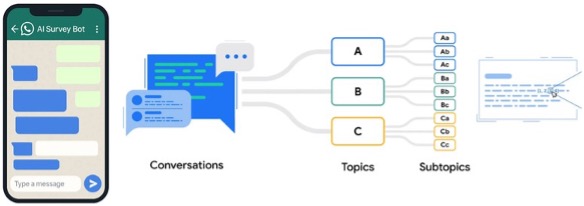
The frontend consisted of a customized WhatsApp chatbot leveraging Twilio’s messaging infrastructure. WhatsApp’s availability in Yemen with high penetration rates exceeding typical telecommunications infrastructure made it a highly suitable platform. The bot initiated consultations by explaining the process purpose and presenting the vision statement developed through prior cross-party dialogues. Following this orientation, the system collected demographic information regarding participants’ gender, age, geographic location, and political party affiliation through interactive button responses. The bot then conducted structured interviews through 10 open-ended questions in Yemeni Arabic, accepting both text and voice responses. Voice messages, comprising approximately 60 per cent of submissions, were transcribed using OpenAI’s Whisper model, then translated to English while preserving dialectical nuances and culturally specific terminology.
The facilitation structure was fully automated: the chatbot sequentially presented each question only after receiving a response to the previous one, eliminating the need for human facilitators during data collection. Backend oversight enabled CMI staff to manually verify transcription and translation accuracy, with all participant responses stored in an internal database containing both original Arabic audio or text and English translations.
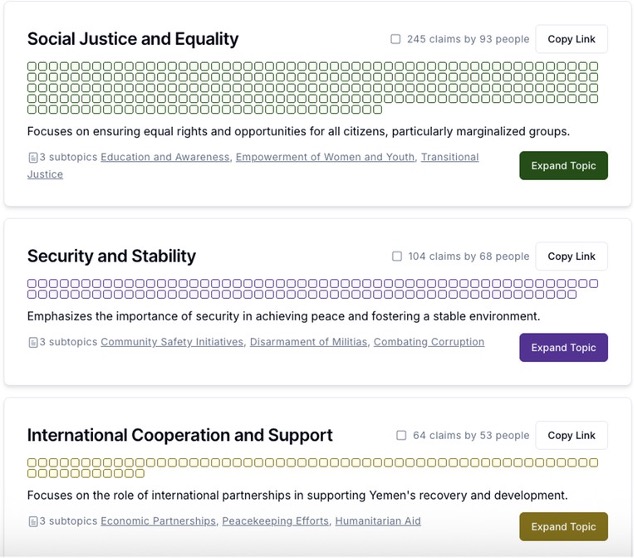
The backend employed “Talk to the City,” an open-source sensemaking tool developed by the AI Objectives Institute. This system utilized natural language processing to identify thematic clusters, extract representative arguments, and surface areas of consensus and contestation. The tool’s grounding feature linked analytical outputs directly to participant quotes, maintaining transparency between raw data and synthesized findings and enabling manual verification of categorization accuracy. Figure 2 illustrates the resulting interactive visualization, showing thematic clusters and representative arguments as displayed in the sensemaking platform.
Participant recruitment followed a structured nomination process through party focal points, who identified politically active youth members. Between January and March 2025, the system engaged 150 participants from 17 of Yemen’s 21 governorates. Participants represented seven political parties and components, including several independents. The distributed geographic representation, while not capturing all governorates, provided coverage across front lines and population centers.
Methodological contributions
This approach addresses three persistent challenges in conflict-zone consultations. First, it enables qualitative depth at quantitative scale—participants provided comprehensive responses averaging 250 words per question, while the system processed thousands of individual responses. This combination circumvents the traditional trade-off between reach and depth that characterizes conventional consultation methods. Large-scale surveys typically employ closed-ended questions that fail to capture nuanced perspectives, while in-depth qualitative methods like focus groups necessarily limit participant numbers. The digital tool deployed here maintained open-ended question formats that encouraged detailed narrative responses while scaling to hundreds of participants, preserving the richness of qualitative data at unprecedented scope.
Second, voice message functionality circumvented literacy barriers, but more significantly, it encouraged participants to share substantially more comprehensive accounts than text-based responses typically get. Voice input reduces the time burden of written messages, enabling participants to articulate complex thoughts more naturally and comprehensively. Analysis of response patterns revealed that voice messages averaged distinctively longer than text responses and contained more specific examples and contextual details. This modality proved particularly valuable for capturing perspectives from rural areas and broader youth demographics, populations often excluded from text-heavy digital consultations.
Third, asynchronous engagement accommodated irregular internet access, with participants able to respond during windows of connectivity rather than requiring simultaneous and continuous presence at scheduled sessions. Yemen’s fragmented telecommunications infrastructure means internet access varies dramatically by location and time of day, with many areas experiencing intermittent connectivity due to infrastructure damage or power shortages. The store-and-forward nature of the WhatsApp platform allowed participants to receive questions, formulate responses offline if necessary, and submit when connectivity permitted. This flexibility proved essential for inclusive participation across Yemen’s diverse contexts.
The methodology demonstrates how digital tools can preserve open-ended consultation formats rather than reducing complex political views to predetermined survey categories. Unlike structured polling, participants articulated priorities in their own terms, revealing nuanced positions on federalism, security integration, and economic recovery that standardized instruments might have obscured. The AI analysis subsequently identified patterns and themes within these unstructured responses without imposing predetermined categories, allowing participant priorities to shape the analytical framework.
Empirical findings
Analysis revealed that 77 per cent of youth respondents expressed favorable views toward the vision statement as a whole, though many conditioned support on implementation mechanisms. Positive responses emphasized appreciation for the vision’s focus on federal democratic governance, peaceful power transition, and transparent resource distribution. However, respondents frequently noted concerns about implementation feasibility given current security and economic conditions. Only 8.7 per cent expressed predominantly negative views, with critique reflecting primarily differences regarding Yemen’s future as a unified state versus potential Southern independence.
The AI sensemaking system processed these responses through multiple analytical stages. Initial natural language processing identified seven main thematic clusters and seventeen specific subtopics within participant responses to open-ended questions on the vision statement, its gaps, and youth priorities for Yemen’s future. Economic concerns emerged as the dominant theme, with participants emphasizing employment creation, economic development strategies, and equitable wealth distribution as critical additions to the vision framework. Military integration procedures constituted a second major cluster, with respondents detailing specific mechanisms needed for demobilization, disarmament, and reintegration of armed groups.
Guarantees for women’s political representation formed a third significant theme, with participants proposing specific quota systems and institutional safeguards.
The system extracted 1,742 representative arguments that captured the range and frequency of distinct positions expressed by participants. These representative arguments functioned as empirically grounded summaries of participant perspectives, each linked to specific response excerpts for verification. For instance, regarding economic priorities, the system identified 247 distinct arguments spanning immediate humanitarian needs, medium-term employment generation, and long-term development strategies. On military integration, 183 representative arguments addressed sequencing questions, command structures, regional security arrangements, and transitional justice mechanisms. Regarding women’s representation, 156 arguments ranged from constitutional quota provisions to grassroots capacity building initiatives.
Most significantly, the sensemaking tool surfaced three highly-contested claims where youth opinion split nearly evenly, indicating fundamental fault lines requiring focused dialogue. First, whether national reconciliation remains viable given current territorial divisions: approximately half of respondents viewed reconciliation as essential for sustainable peace, while the other half considered current divisions insurmountable without prior political settlement. Second, the role of international support versus foreign intervention: participants diverged sharply between those emphasizing international cooperation as necessary for recovery and those viewing external involvement as perpetuating conflict dynamics. Third, prioritization of democratic frameworks versus immediate stability measures: responses divided between those advocating for establishing democratic institutions before addressing governance gaps and those arguing that immediate stability and service delivery should precede democratic reforms.
These contested areas represent critical dialogue points for sustainable peace architecture. The identification of such divisions among youth participants suggests that sustainable agreements must either bridge these divides or establish frameworks for managing ongoing disagreement.
The 94 per cent completion rate across all ten thematic questions, with participants providing detailed responses despite technical constraints, suggests strong engagement with the consultation process. Manual verification of AI-generated topic clusters against the raw data material confirmed accurate categorization in most cases, though some semantic nuances in political terminology required human adjustment.
Discrepancies occurred, among other things, in distinguishing between closely related concepts—such as ‘federalism’ versus ‘decentralization’—where participant usage varied and contextual interpretation proved necessary.
To establish reciprocity and close the feedback loop, the final sensemaking report was shared back with participants—ensuring that data was not merely extracted but returned to contributors in summarized, synthesized form. Beyond participant feedback, the consultation outputs were shared with the political party representatives involved in the broader vision-building process, with findings intended to inform subsequent policy roadmapping aimed at operationalizing the shared vision. This approach positioned participants as stakeholders in the analytical process rather than passive data sources.
Data security and privacy considerations
Security considerations were paramount in designing the consultation process. WhatsApp itself provides end-to-end encryption for all messages. Data collected through the platform was stored in a Google Firebase database with servers located in Europe, ensuring General Data Protection Regulation (GDPR) compliance.The system collected no personal identity markers—names or other identifying information—that could connect individual responses to specific contributors. Access to raw data remained restricted to dedicated CMI staff members.
Beyond technical safeguards, participant trust was critical. Engagement with the WhatsApp chatbot relied substantially on the institutional trust CMI had cultivated through long-term engagement in Yemen, reinforced by endorsement from party leadership who nominated participants. This trust dynamic merits careful consideration in other contexts: participants engaging with anonymous chatbots often express reluctance to share sensitive political views without knowing who receives their responses. In Yemen, the high participation and completion rates suggest that institutional trust outweighed such hesitancy—a relationship that may not transfer automatically to contexts where implementing organizations lack established credibility.
Limitations and implications
Several constraints warrant acknowledgment. Digital literacy requirements excluded rural populations with limited connectivity, potentially skewing results toward urban, educated youth. The top-down participant selection through party structures likely biased sampling toward politically connected youth over grassroots activists without formal organizational affiliations. The translation process, while technically proficient in preserving semantic content, at times compressed culturally specific political concepts that carry particular resonance in Yemeni Arabic—this was later corrected manually. Additionally, the time-limited nature of the consultation prevented iterative engagement that might have deepened participant investment and refined understanding of the vision’s intended scope.
Nevertheless, this methodology offers a replicable framework for inclusive consultation in conflict settings where physical convening proves impossible. The reliance on open-source tools made implementation significantly more cost-effective than traditional analog data collection and analysis methods would have been. The combination of familiar communication platforms with sophisticated analytical tools enables meaningful engagement without requiring specialized technical knowledge from participants. For peace processes increasingly recognizing youth inclusion as essential for sustainable outcomes, such approaches provide pragmatic pathways for amplifying marginalized voices while maintaining substantive depth in political consultation. The methodology’s transferability extends beyond Yemen to other contexts characterized by geographic fragmentation, security constraints, and contested political space where conventional consultation methods prove infeasible or insufficiently inclusive.
Conclusion
This case study shows that AI-facilitated consultation can meaningfully widen civic space in conflict-affected settings where conventional participation is unsafe or infeasible. In Yemen, pairing a familiar platform (WhatsApp) with AI-powered sensemaking enabled youth across fragmented geographies to contribute rich, open-ended perspectives at scale. High completion rates and detailed voice-based responses suggest that, when combined with trusted intermediaries and transparent analysis, digital tools can lower barriers to participation while preserving the qualitative depth essential for peacebuilding. Substantively, the process revealed broad support for a shared political vision alongside sharp divisions on reconciliation, international involvement, and the sequencing of democracy and stability. This ultimately highlights the value of surfacing disagreement clearly rather than forcing premature consensus.
Methodologically, the case demonstrates how AI can help overcome the traditional trade-off between scale and depth by enabling asynchronous, narrative input and synthesizing patterns without imposing predefined categories. Grounding analytical outputs in participant statements strengthened transparency and legitimacy, while returning findings to participants reinforced reciprocity. Limitations underscore that such tools should complement, not replace, in-person dialogue and political negotiation. Nonetheless, in contexts of fragmentation and insecurity, this approach offers a pragmatic pathway for amplifying youth voices, identifying contested priorities, and supporting more inclusive and resilient peace processes.
This work was supported by a grant from the Ford Foundation.
Notes
[1] For a detailed account of CMI’s digitally enhanced foresight approach, see: Poutanen, Johanna and Kufus, Felix (2024) “Pioneering the Digital Frontier: CMI’s Approach to Forward-Looking Dialogues,” New England Journal of Public Policy, Vol. 36: Article 12. Available at: https://scholarworks.umb.edu/nejpp/vol36/iss1/12

The Author

Toda Peace Institute
The Toda Peace Institute is an independent, nonpartisan institute committed to advancing a more just and peaceful world through policy-oriented peace research and practice. The Institute commissions evidence-based research, convenes multi-track and multi-disciplinary problem-solving workshops and seminars, and promotes dialogue across ethnic, cultural, religious and political divides. It catalyses practical, policy-oriented conversations between theoretical experts, practitioners, policymakers and civil society leaders in order to discern innovative and creative solutions to the major problems confronting the world in the twenty-first century (see www.toda.org for more information).
Contact Us
Toda Peace Institute
Samon Eleven Bldg. 5thFloor
3-1 Samon-cho, Shinjuku-ku, Tokyo 160-0017, Japan
Email: contact@toda.org