Peace Deal or Not, Iran War Has Shattered Trust in Fossil Fuels
Abdullah Fahimi
July 10, 2026
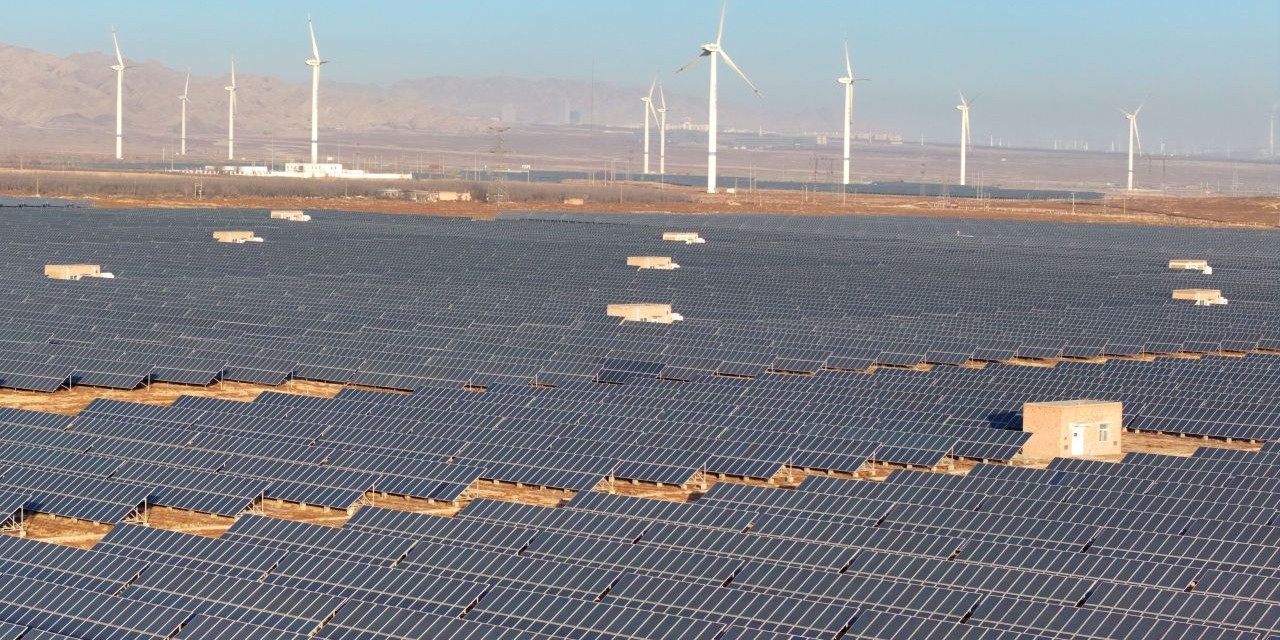
Image: Clean energy production, Shizuishan, China, December 2025 (Costfoto/NurPhoto/Shutterstock)
The US–Israel war on Iran, which erupted at the end of February, triggered a global energy crisis. More than a hundred days in, the parties signed an interim deal and markets have reacted positively, with oil and gas prices falling sharply. Lingering doubts about the deal’s durability, fuelled by continued exchanges of strikes and threats, combined with damage to gas production infrastructure, shipping uncertainty, elevated insurance costs, and the time needed to clear mines from the Strait will keep prices volatile and importers on edge.
However, the far more significant consequence of this war, coming only four years after the last energy crisis, is the loss of trust in the reliable flow of oil and gas. Importing countries are reckoning with this dependency, increasingly questioning the economic and national security logic of fossil fuel imports. Narratives and policies have shifted decisively in favour of renewables. The timing of this energy crisis matters as much as the crisis itself. It is happening at a uniquely pivotal moment, when the conditions for an energy transition are more favourable than during any previous energy shock. Three reasons explain why the Iran war marks an inflection point in the global energy transition:
Fossil fuel dependency seen as a national security and economic risk
First and foremost, the world is fast realising that dependency on fossil fuels, highly concentrated geographically and transported through geopolitically vulnerable transit routes, constitutes both a national security and an economic risk. Two major supply shocks in four years have driven this home: supply disruptions of Russian gas since 2022 and the Gulf oil and gas in 2026 have shattered importing countries’ confidence in the reliable, uninterrupted flow of fossil fuels. The costs of such dependency are no longer deniable. Leaders of fossil fuel-importing nations, which account for around 75 per cent of the world’s population, have acknowledged these vulnerabilities. The business community is following: a new poll finds that business leaders expect their operations to be largely electrified by 2035, with an overwhelming majority citing energy security and competitiveness as their primary motivation. The narrative has shifted. Energy security is no longer synonymous with oil and gas; increasingly, it is associated with homegrown renewables.
Policy is catching up with narrative. In response to the Iran war, dozens of countries have introduced short- and long-term measures that, by and large, favour clean technologies and the transition away from fossil fuels. These include electrification, simplified renewables permitting and grid connections, waiving duties or offering incentives on electric vehicles, and energy efficiency measures. The European Union has introduced its AccelerateEU package of 44 measures with the aim of accelerating electrification, improving grid infrastructure, and boosting investment in renewables. The responses reveal more structural shifts this time around than during past energy crises. Europe’s response to the 2022 energy crisis, for instance, is widely criticised as replacing one dependency with another, swapping Russian pipeline gas for American liquefied natural gas (LNG). The current crisis has focused attention on the energy source itself, the volatility of fossil fuels, and the vulnerability of transit chokepoints.
Availability of cheap renewable energy alternatives
Second, the past decade has seen renewable energy technologies mature into cost-competitive alternatives to coal and gas. Solar and wind, combined with battery storage, today offer competitive energy in most markets. The cost of solar, for instance, has fallen by over 90 per cent in a decade, largely due to large-scale manufacturing and production improvements. The International Renewable Energy Agency (IRENA) expects that improvements in supply chains, technological learning, and economies of scale will reduce costs by a further 30 per cent by 2030 and 40 per cent by 2035 for solar-plus-battery configurations that can provide firm electricity.
Investment in clean energy and its deployment are both reaching record levels. According to the International Energy Agency, clean energy investment is on track to reach $2.2 trillion in 2026, double the amount flowing into fossil fuels. On the deployment side, 50 countries recorded all-time high monthly solar imports from China in March following the closure of the Strait of Hormuz, with 60 more recording their highest import volumes in six months. Though below March’s records, Chinese solar exports in April were 60 per cent higher year-on-year. EU electric vehicle registrations in March rose 49 per cent compared to the previous year. BloombergNEF projects global electric vehicle sales will top 23 million this year, an 11 per cent increase on 2025.
Legal and political pressures as climate impacts mount
Third, calls for decarbonisation have grown louder as the impacts of the climate crisis mount. The scientific consensus linking fossil fuels to climate change has been established for decades. Politically, however, it was not until COP28 in Dubai in 2023 that the language of “transitioning away from fossil fuels” appeared for the first time in a COP final agreement. Momentum has been building since: this April, Santa Marta, Colombia hosted the first dedicated international conference on Transitioning Away from Fossil Fuels (TAFF), drawing representatives from around 60 countries. The incoming COP31 presidency, jointly held by Australia and Turkey, has announced the first-ever global electrification target in a COP action agenda: 35 per cent by 2035.
The pressure is not only political. In 2025, the International Court of Justice delivered its landmark advisory opinion on the obligation of States in the fight against climate change under international law. In May, the United Nations (UN) General Assembly adopted a resolution with a commanding majority backing the findings of the advisory opinion and calling on member states to reduce emissions to stay within the 1.5°C of warming. The UN Chief, in a statement, declared that “fossil fuels are the principal driver of the climate crisis. The path to climate justice runs through a rapid, just, and equitable transition away from fossil fuels towards renewable energy.” While neither the advisory opinion nor the resolution is binding, they will be referenced in court decisions over a growing number of climate-related lawsuits.
What next
To secure a smooth transition away from fossil fuels and reduce the economic and security risks of import dependency, countries have a broad suite of measures at their disposal. These include capping fossil fuel imports, bringing forward targets for peak fossil fuel consumption, and fast-tracking investment in grid stability and expansion, alongside the critical minerals needed for clean technology production. Governments can also use their purchasing power and financial tools to speed the shift: aligning public procurement with clean energy deployment targets, and de-risking investment in technologies such as storage, heat pumps, and industrial electrification.
While the interim deal between the US and Iran has partially calmed the markets, this crisis has struck at a moment that will only turbocharge the global energy transition. It has validated concerns about the reliability of fossil fuel imports and their inherent national security and economic risks, driving countries towards structural shifts in favour of renewables as political, legal, and human pressures converge. Ironically, this may be the greatest contribution to transitioning away from fossil fuels and it comes from Donald Trump who has pulled the US out of the Paris Agreement twice, spent years trying to undermine clean energy, and rejects the science of climate change.
Related articles:
‘Silent Victim’? Interrogating the Ecological Implications of War (3-minute read)
Fossil Fuel Expansion or Pacific Security? Albanese Is Learning Australia Can’t Have Both (3-minute read)
Failure of US–Iran Talks Was All Too Predictable — But Turning to Military Strikes Creates Dangerous Unknowns (3-minute read)
Hormuz After the Pause: US–Iran Escalation Returns (3-minute read)
