Climate Security Is Coming to UK Foreign Policy: The Question Is What Kind
Janani Vivekananda
November 12, 2026

Image: repic / Shutterstock
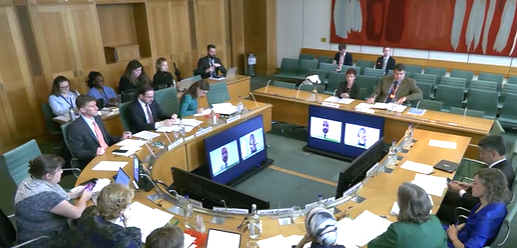
Last month I gave evidence to the UK House of Commons Foreign Affairs Committee’s inquiry into climate diplomacy. The session was shaped, in part, by a claim the Foreign Secretary Ed Milliband has made increasingly explicitly over the past year: that climate change and nature loss are not peripheral environmental concerns but core national security risks, on a par with the threats that have traditionally occupied the Foreign, Commonwealth and Development Office and the Ministry of Defence.
In principle, I agree with that claim. But a label is only as good as what follows it. Calling climate and nature loss a security risk only does real work if it is backed by clear, sustained investment in adaptation, mitigation, and loss and damage finance, and by serious attention to the human security and equity dimensions that climate change compounds, both within the UK and abroad. Without that backing, the framing risks becoming rhetoric rather than policy, or being read, and acted on, as an invitation to use excessively hard instruments.
Security is not a neutral word. Once a government labels a risk a security threat, a predictable set of instruments tends to follow: more defence spending, more border control, more contingency planning for disorder. Those instruments are the wrong primary response to climate and nature risk, which is fundamentally about food systems, water systems, health systems and livelihoods. The overwhelming majority of the evidence on climate-related displacement shows that it drives people from the countryside to their own nearest city, not across oceans into someone else’s. If the security label is left unaccompanied by visible investment in the human security response it implies, the public and policy imagination will fill the gap with the wrong instruments: fences rather than food systems; garrisons instead of governance support.
I put this to the Committee as a perception risk, distinct from but related to a resourcing risk (i.e. of resourcing militarised responses to climate impacts): the framing alone does not drive militarisation, but without clear and sustained action to the contrary, it could be perceived to. The corrective is to pair it, consistently and visibly, with investment in non-traditional, preventative security: mitigation, adaptation, and adequate funding for loss and damage, delivered both domestically and internationally. If the only visible government action attached to climate security is a line in a National Security Strategy, the framing could harm the UK’s international relationships, particularly with the Global South, where it will read as exactly what sceptics already fear: a wealthy, historically high emitting country securitising a crisis it did the most to cause, and then building walls rather than sharing the cost of fixing it.
There is a more constructive version of this agenda, and it rests on three re-framings I set out in my evidence to the Foreign Affairs Committee.
First, critical ecosystems should be treated as security infrastructure, not environmental nice-to-haves. Mangroves for example prevent an estimated 65 billion dollars in flood damage every year, globally, simply by existing. To share another example, New York City chose to spend a fraction of the cost of a water filtration plant protecting the forest that does the same job for free.
Second, international climate and nature finance should be understood as an investment in UK resilience, not charity. West African cocoa farms are thousands of miles from Britain, but when heat and erratic rainfall hit them, the price of UK Christmas chocolates rise with it. Degradation abroad is not a distant tragedy; it is a transmission mechanism into UK supply chains and household bills.
Third, institutions like the World Bank and the IMF, where the UK still carries real influence, should treat nature-related risk with the same rigour they already apply to climate risk in debt sustainability analysis and macroeconomic surveillance. Nature is already doing fiscal and security work. Policy has simply not caught up with that fact.
None of this is abstract for the UK’s own exposure to climate risk. Outside the EU, Britain faces a global food shock without the bloc level bargaining power or crisis redistribution mechanisms it once had access to, at a moment when its food and drink trade deficit has reached a 25 year high.
I would also gently push back on how much weight the climate security debate places on migration. It is not, in my view, the most pressing dimension of the climate security agenda, nor the one where UK attention and diplomatic capital are best spent. Far more pressing, and considerably more tractable, evidence based and diplomatically rewarding, is addressing the risk to human health from extreme heat. Wet bulb temperatures are becoming unliveable for outdoor workers and the poorest across South Asia, the Middle East, North Africa and sub-Saharan Africa, in a pattern of unequal exposure with real echoes of the global inequities COVID-19 exposed. Acting on heat risk now, through development cooperation on health system resilience, early warning systems, and labour standards in international supply chains, is both more grounded in evidence than speculative migration scenarios and a more deliverable diplomatic asset: it lets the UK respond to a concrete, present-day equity issue rather than managing a future it cannot fully predict. The cost of inaction is not only humanitarian; heat related morbidity and mortality carry economic and political costs that will compound quietly until they cannot be ignored, much as COVID-19’s unequal burden eventually became impossible to ignore.
The institutional test now facing the Foreign Office is whether it can translate this agenda into departmental mandates without either diluting it into incoherence or hardening it into militarisation. I shared both risks with the Committee. Make climate security everyone’s job in only general terms, and it becomes no department’s job in particular. The fix is specificity: critical mineral supply chain resilience for the department responsible for energy, basing resilience for defence, displacement readiness for the Home Office, each translated from the same underlying risk assessment rather than issued as a generic instruction to mainstream climate.
The UK is one of the few countries to send a head of state to the UN Conference on Climate Change (COP31) 9–20 November 2026 and holds the G20 presidency in 2027. Both are opportunities to show the world real leadership and a version of climate security built on coalition building, debt reform and anticipatory finance, rather than one built on borders and defence budgets. Which version the UK chooses to project will shape how the rest of the world reads British intentions for a long time to come.
Related articles:
Fragile Progress: How COP31 Can Advance Climate Security (3-minute read)
Climate Risk Is Forcing Multilateralism to Evolve (3-minute read)
Protecting a Way of Life: Keeping Community and Tāoga at the Heart of Niue’s First National Security Strategy (3-minute read)
