At Hammarskjöld’s Grave, Sixty-Five Years After Ndola
Jordan Ryan
September 6, 2026
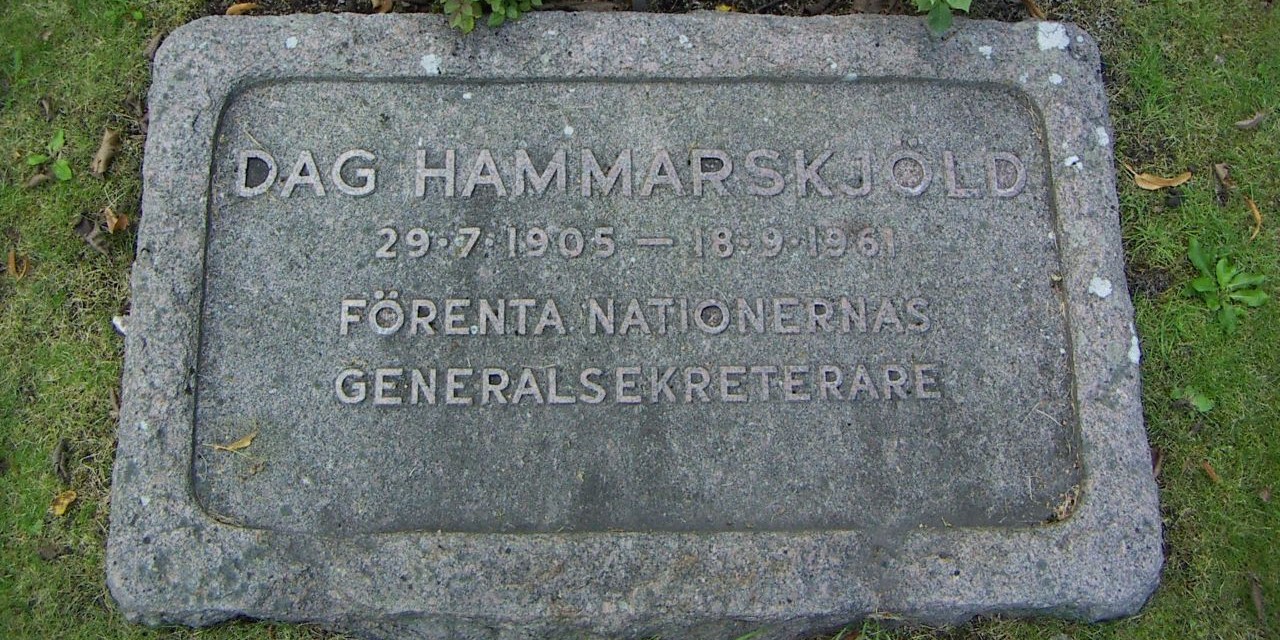
Image: Conny Odengrund / Wiki Commons
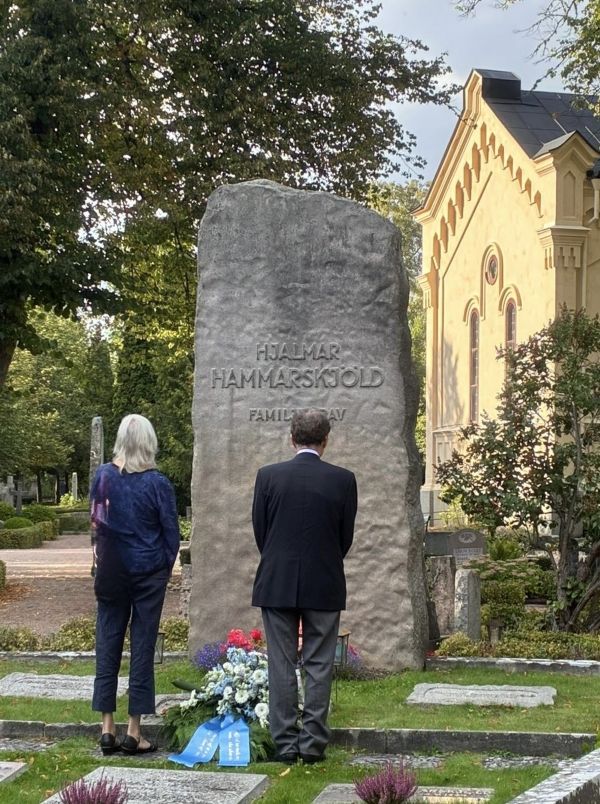
Late in August I stood at Dag Hammarskjöld’s grave in Uppsala. It is a quiet place, a long way from New York and from the wars the United Nations exists to prevent.
He died sixty-five years ago this month, on 18 September 1961, in an aircraft crash near Ndola, in what is now Zambia. He was fifty-six, on his way to seek a ceasefire in the Congo, where the secession of the mineral-rich province of Katanga had drawn a newly independent country into conflict and great-power rivalry.
Leaving the cemetery, I found myself thinking about the office he held and about a practice he helped build that the organisation has praised ever since but never fully sustained.
Hammarskjöld treated preventive diplomacy as a working method. He travelled repeatedly into crises, used the Secretary-General’s office when local conflicts threatened to become arenas of great-power rivalry, and kept an independent United Nations presence where member states could not or would not go. He negotiated before positions hardened and violence became harder to stop.
Suez, Lebanon and the Congo were very different crises, but he approached them as exercises of the same craft. He did not always succeed. The point was not that prevention always worked. It was that he regarded it as part of the job.
Preventive diplomacy has been restated as a priority many times since. Boutros Boutros-Ghali gave it a doctrine in An Agenda for Peace. Kofi Annan strengthened early-warning and mediation capacity. Ban Ki-moon issued the first Secretary-General’s report devoted to preventive diplomacy in 2011. António Guterres made the case again in A New Agenda for Peace. Member states restated it in the Pact for the Future, and the UN80 Initiative is reviewing how mandates are designed, implemented and assessed.
Doctrine is not what is missing.
Prevention remains politically difficult because success is hard to prove. A crisis that does not happen leaves no ruins, no displaced population and no peacekeeping budget against which the cost of prevention can be measured. Governments that will pay heavily once violence has escalated are often reluctant to fund the diplomacy that might have kept it from escalating.
The problem is also institutional. The United Nations is often better at identifying risk than at acting on it early. Sudan, eastern Democratic Republic of the Congo, the Sahel, Myanmar and Gaza all illustrate, in different ways, how warning signs can accumulate while political space for preventive action narrows. Information moves through the system, but knowledge does not create an obligation to respond.
That is the problem the next Secretary-General will inherit.
Member states choosing António Guterres’s successor have asked useful questions about gender, regional representation, management and reform. They have also asked about prevention. Candidates have described it as a central responsibility of the office, proposed stronger mediation capacity and invoked Article 99 of the Charter, which allows the Secretary-General to bring to the Security Council’s attention any matter that may threaten international peace and security.
The harder question is what the office will do when warning signs are mounting, information is moving through the United Nations system, and the Security Council is unable or unwilling to act.
Hammarskjöld confronted that problem in a different era. In 1960, during the Congo crisis, Soviet Premier Nikita Khrushchev demanded his resignation and proposed replacing the Secretary-General with a three-person ‘troika’ representing competing political blocs.
Hammarskjöld refused.
“It is very easy to resign; it is not so easy to stay on,” he told the General Assembly on 3 October 1960. “It is very easy to bow to the wish of a big Power. It is another matter to resist.”
Earlier in the same statement he had explained whom the United Nations was for.
“It is not the Soviet Union or indeed any other big Powers who need the United Nations for their protection,” he said. “It is all the others.”
That remains the strongest argument for an independent Secretary-General.
The major powers possess other instruments. Smaller and middle powers have fewer. When the Security Council works, the Secretary-General is one actor among several. When it does not, the office may still provide a channel for mediation, bring neglected crises into international view and give political weight to countries that cannot command attention through military or economic power.
That is why Hammarskjöld’s example matters now. He answered Khrushchev in public, and he could do so because of what he had already done in Suez, in Lebanon and in the Congo. His authority came from judgement, discretion and a willingness to keep working when powerful governments wanted him to stop.
Nor should prevention depend on finding another exceptional individual.
Sixty-five years after Ndola, the better tribute is to finish some of the work Hammarskjöld left behind: choose a Secretary-General prepared to exercise the office’s independence while prevention still has a chance to work, and give that office the political and institutional support to do so.
The great powers can still look after themselves.
The United Nations still matters most to “all the others.”
Related articles:
A Hundred Dollars for War, One for Peace (3-minute read)
Governing the Ungovernable (3-minute read)
When Destruction Becomes Policy: What the Munich Security Report Reveals About the Future of Global Governance (3-minute read)