Beijing’s Perspectives on a UN-Centred Global Order
Rosemary Foot
June 16, 2026
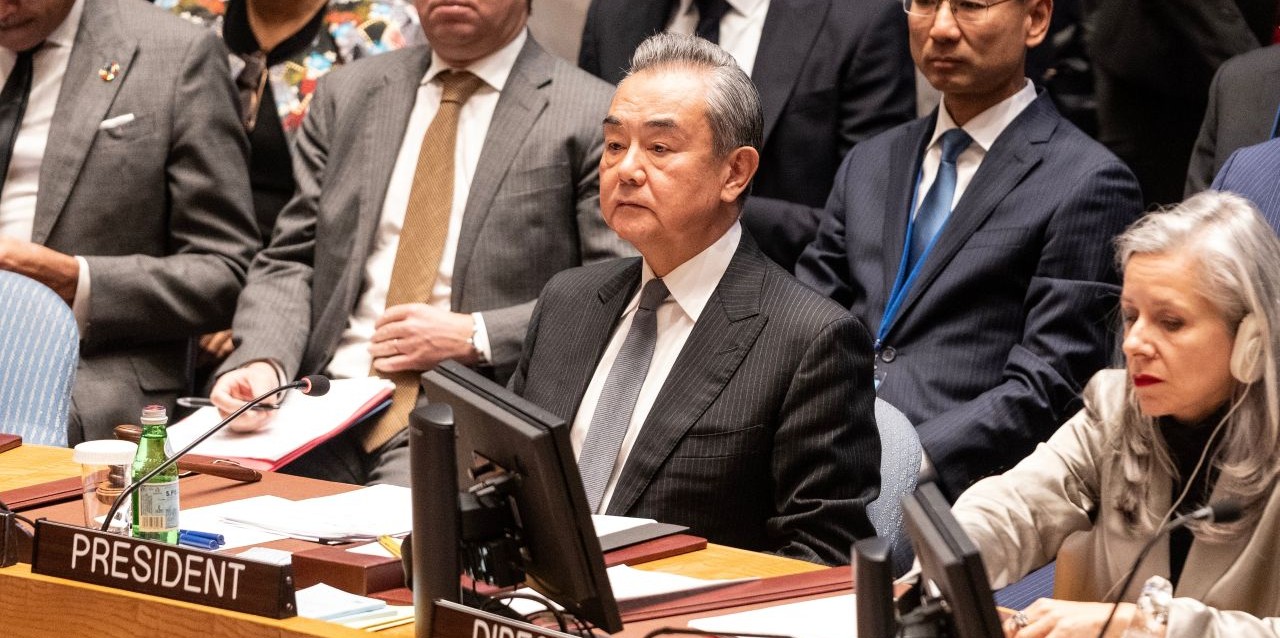
Image: Foreign Minister of China Wang Yi presides over a Security Council meeting, November 29, 2023 │Lev Radin / shutterstock.com
The rotating one-month presidency of the UN Security Council fell to China once again in May 2026. As it had during its presidencies in 2015, 2018, 2021, and 2025, Beijing chose to focus on the UN Charter or to urge more general support for multilateralism. At the meeting convened in 2026, the high-level gathering operated under the remit of “Upholding the Purposes and Principles of the UN Charter and Strengthening the UN-Centered International System.”
With representatives from over 100 countries in attendance, and in 20 or more cases at foreign minister level, China’s own Foreign Minister, Wang Yi, made use of the occasion to reiterate that the world had entered a period of turbulence and transformation to which the United Nations (UN) system needed to respond. More concretely, Wang reprised many of the central themes developed in China’s foreign policy discourse designed to illustrate the congruence between its foreign policy aims and its support for a UN-led order. Without naming the United States directly, Wang also used the occasion to contrast its efforts with those of a United States that he implied ignores the rule of law, engages in selective application of UN-Charter rules, and practices double standards.
Beyond Beijing’s obvious if veiled criticisms of the United States, Wang’s five-point statement set out to couch a China-centric vision of the UN system within a broader set of ideas deemed relevant to the UN as it navigates a period of enforced change and radical reform.
China’s Foreign Minister:
- Underlined his government’s view that there is a founding and unchanged vision of what the UN Charter was meant to achieve—predominantly support for sovereign equality, non-interference in international affairs, the peaceful settlement of disputes—that had either been breached or re-interpretated in ways unhelpful to international order. As Wang put it: “The root cause of the chaos in today’s world is not that the Charter’s spirit is outdated, but that the international order and the basic norms governing international relations, both set out in the Charter, are not being effectively upheld and observed.”
- Stressed that taking Security Council responsibilities seriously requires that permanent members of the Council earn the authority they enjoy. This means they needed to act in ways that build consensus and avoid the introduction of contentious proposals.
- Advocated a strengthening of the UN’s development pillar and provision to the Global South of “more funding, technological and intellectual support in key areas such as poverty reduction.” Wang also recommended strengthening dialogue with BRICS countries and its New Development Bank, the G20, and the Asian Infrastructure Investment Bank.
- Offered to help build the “sense of a community with a shared future” and to promote inter-civilizational dialogue to reach, through a bottom-up process, the discovery of the “common values of humanity.”
- Urged prompt fulfilment of countries’ financial obligations (despite his country’s delaying full payment of its own assessed contributions) within a UN that has been streamlined, together with respect for the “ownership” of member states, address of the aspirations of developing countries, and the advancement of the UN’s three pillars of security, development, and human rights in a balanced manner.
What does this statement tell us about China’s reasons for presenting the UN as so central to its multilateral diplomacy, and what kind of UN is it hoping to see? Across these five areas and in general terms, China is predominantly approaching the UN as an intergovernmental platform that accords an implementation rather than a relatively autonomous policy-making or aspirational role to the UN Secretariat and UN staff more broadly. It wants to secure a UN that promotes state primacy, protects political regimes against UN-authorised interference in domestic affairs, and prioritizes development. Where China itself is concerned, it projects a vision of the UN where its status and role are both strengthened.
In its stress on consensus and the avoidance of contention, it seeks to limit the range of issues that come before the UN Security Council, returning it to China’s preferred more traditional state-based security focus. The emphasis on the development pillar and poverty reduction, together with direct reference to several development-related organizations of which China has been a founding member, reinforces Beijing’s leadership position in this sphere of activity. Universality is replaced by a narrower conception of common values arising from differing civilizational histories and cultures that it sees as leading to different roads to and understandings of human rights protections.
More specific evidence in support of this vision had already been made available when China’s ambassador outlined his country’s approach to the UN reform initiative (UN80 Initiative) in October 2025. Ambassador Fu Cong chose to emphasize that UN reform had to take place in the context of extensive consultations with member states to build “the broadest possible consensus.” With regard to the UN’s development pillar, the reform process needed to “strengthen the central role” of the UN’s Department of Economic and Social Affairs, which happens to have been headed by a Chinese national since 2007. Fu insisted that mandates in the peace and security field must derive from Security Council decisions and not from other UN entities such as UN resident coordinators. The matter of underrepresentation of developing countries in the UN Secretariat “must be given a high priority”—a goal that embraces China’s own desire to gain higher level executive positions.
In a final flourish, Ambassador Fu referenced China’s Global Governance Initiative (GGI), introduced by President Xi Jinping at a Shanghai Cooperation Organization summit meeting in 2025. Fu promised that, with this initiative providing a guiding role, China would work with other UN member states as well as the Secretariat to advance the UN80 reform initiative. And indeed, the GGI has now entered more formally into UN business following the establishment in December 2025 of a “Group of Friends of Global Governance” with 43 inaugural state members.
For state and non-state actors that wish to retain a fuller purchase for the liberal substance of UN multilateralism, these developments bear watching. They should prompt those who remain attentive to liberal universalism to engage with a range of state and non-state parties and geographical groupings within the UN system to explore which of these Chinese initiatives is generating concern, which could be countered by coalitions of like-minded states, and which could be the basis for joint action.
Related articles:
Governing the Ungovernable (3-minute read)
Trump‑Xi summit: Three Ways the US and China Can Compete Without Going to War (3-minute read)
A Defining Moment for the United Nations: The Global Stakes of U.S. Disengagement (3-minute read)
