Social Media, Technology and Peacebuilding Report No.282
The First Amendment Promise of Deliberative Technology : Reviving Assembly and Petition to Modernize the US Congress
Lorelei Kelly
March 01, 2026

This report examines a deep institutional problem exposed by the January 6, 2021 attack on the US Capitol: Congress lacks modern capacity to hear, process, and act on authentic civic voice. Drawing on more than 100 interviews with congressional staff, this paper examines how deliberative technologies can help modernize Congress. Distinguishing civic tech from deliberative tech, it highlights models which structure public testimony into usable legislative insight. The paper argues that Congress’ unresponsiveness is less a failure of will than of infrastructure. When aligned with modernization efforts, deliberative technology offers a practical path to revive assembly and petition as meaningful inputs to representative governing.
Contents
- Abstract
- Introduction
- Research methodology
- The need to modernize Congress
- Impact of the COVID-19 pandemic
- Restoring collective decision-making capacity
- Establishing an opening for deliberative technology
- Federalism 2.0: Congressional capacity devolves outward
- Connecting with constituents during volatile times
- Building a digital layer atop a centuries-old paper system
- Workflow models of assembly and petition
- Deliberative tools in the workflow of Congress
- Next steps
- Conclusion
Abstract
The January 6, 2021 attack on the US Capitol exposed a deeper institutional problem: Congress lacks modern capacity to hear, process, and act on authentic civic voice. Historically, assembly and petition provided structured channels for public grievances to shape lawmaking. Over time, however, these functions weakened as congressional capacity declined, petition processes shifted to administrative agencies, and digital media ecosystems rewarded performance over deliberation. Drawing on more than 100 interviews with congressional staff, this paper examines how deliberative technologies can help modernize Congress. Distinguishing civic tech from deliberative tech, it highlights models such as Civil Society Field Hearings and Cortico’s Fora platform, which structure public testimony into usable legislative insight. The paper argues that Congress’ unresponsiveness is less a failure of will than of infrastructure. When aligned with modernization efforts, deliberative technology offers a practical path to revive assembly and petition as meaningful inputs to representative governing.
Introduction
On January 6, 2021, the US Capitol was attacked by a violent mob incited to act on false claims of a stolen election. Many rioters later justified their actions as an exercise of First Amendment rights—the Right to Assemble and the Right to Petition. In reality, the attack underscored how far American democracy has drifted from its founding promise: that public grievances can be heard, processed, and addressed through representative institutions. This paper will explain how that drift happened, where things currently stand, progress being made, and what we should be doing to fix this problem.
Even before the Capitol siege, Congress was under acute strain. Checks and balances had tilted toward a far more powerful Executive, while the legislature confronted a contested election, widespread demands for racial and social justice, and a surging pandemic. These pressures collided with an institution still operating on a communications infrastructure better suited to the era of the Pony Express than the digital age. The practical exercise of First Amendment rights had long been constricted—by design as much as by neglect. In a rare twist of timing, Congress reauthorized the Select Committee on the Modernization of Congress in the same week as the siege. That action marked a pivotal step toward democratic renewal, signalling a moment of opportunity for Congress to harness data and digital tools for reform. This report builds on that momentum, offering case studies that illuminate a path forward.
Historically, Congress provided a systematic grievance process and redress channel. From the early republic through the 19th century, petitions submitted to Members of Congress were logged in the House Clerk’s office, debated, and often entered into the Congressional Record. Congress’ committee system was developed largely in response to the large number of petitions submitted by citizens seeking redress or relief. The petition process gave disenfranchised groups— women, Black Americans, Indigenous peoples and others—an avenue to demand abolition, suffrage, treaty rights, and other reforms long before they could vote. The right to assemble likewise prompted the rise of civic spaces—town halls, protests, demonstrations, and public forums—where grievances could be aired and ideas advanced. Together, these mechanisms reinforced a vital democratic norm: discontent was to be expected and ongoing—and processed through civic voice and lawmaking, not violence.
By the mid-20th century, however, Congress had outsourced its petition function to administrative agencies and allowed its grievance-processing capacity to atrophy. Instead of a claim and response process to identify and surface policy content in the national legislature, administrative bureaucracies took over. What began as soldiers petitioning for benefits evolved into the Department of Veterans Affairs, now the Veterans Administration. The Food and Drug Administration grew out of decades of petitions regarding fraud, complaints about dangerous food, and appeals to Congress. The Bureau of Indian Affairs emerged through persistent, collective petitioning by Native nations to Congress, often under conditions of extreme power imbalance, treaty violations and land seizures. A consolidation of institutional claim and response functions eliminated a critical collaborative link between citizens and government. This observation is not a criticism of well qualified, knowledgeable public servants and caseworkers in Congress and in the federal agencies. Indeed, that these individuals have accomplished so much despite the dereliction of government is testament to their faith and dedication. Yet in seeking to streamline and reduce its own administrative burden, Congress exchanged democratic representation for efficiency and never fully replaced a civic voice capacity in the workflow.
Civic voice channels have also been congested by professional lobbying, paid advocacy and purchased mobilization efforts (‘astro turf’ campaigns as opposed to grass roots). At the same time, institutional capacity to represent the public interest has diminished. From the mid-1970s until today, the number of committees in Congress has decreased. Correspondingly, fewer witnesses are testifying before committee hearings, shrinking Congress’ primary public facing civic channel in the deliberative workflow. Congressional capacity for governing has been hollowed out, with committee staffing levels 40 per cent smaller than in 1980. Further, much of Congress’ informal nonpartisan information sharing was shattered with the elimination of shared caucus staff in 1993–94. Caucuses provided pools of relevant and timely information on policy challenges facing Congress, especially important for issues like peacebuilding and other global public interests that do not have a competitive domestic constituency. Since then, information consolidation has concentrated power away from rank-and-file members into party leadership, and policy positions have been replaced by communications staff. The result of this top-heavy accumulation is today’s dysfunctional Congress—inundated with information, including toxic online content, yet poorly equipped to think deeply on long term, complex policy, or to sort, filter, and act on authentic civic voice.
The institutional breakdown that began in the mid 1990s accelerated more recently with the onset of ‘information disorder’, a media environment that incentivizes performative actions that play to a member’s political base over building coalitions, reaching across the aisle and governing. Most social media platforms use commercial advertising algorithms that reward outrage over understanding, explanation and deal making. Meanwhile, public-interest journalism and data rich non-profits struggle for sustainability. Congress lacks a clear, reliable way to receive civic input that is credible, well-timed, and structured to fit its actual work—especially the kinds of public tasks that require political tradeoffs, such as visioning, dialogue, deliberation, and decision-making. In the absence of such channels, incomplete information, purchased talking points, and advertising often fill the gap. Democratic institutions have struggled to compete in today’s information environment by offering open, accessible ways for the public to help produce knowledge, share information, and raise grievances. As a result, many people feel excluded and betrayed by the system. This vulnerability is then exploited by political leaders and media figures who redirect public frustration toward personal gain and political retaliation, rather than toward innovation and democratic reform.
Defining Terms, by Lisa Schirch
While GovTech helps governments improve public services, Civic tech helps people communicate with governments. These tools make it easier to report problems, sign petitions, get voting information, join public meetings, or contact officials. Civic tech focuses on access, participation, and transparency. It helps more people speak up, but it does not always help people listen to each other or think deeply together.
Deliberative tech is different. It is designed to help people think and decide together. These tools help groups slow down, listen across differences, examine evidence, and understand trade-offs. Deliberative tech focuses on the quality of conversation, not just how many people participate. It helps people learn from one another and make better, more legitimate decisions. In simple terms:
Civic tech asks, “How can people participate?”
Deliberative tech asks, “How can people think well and decide together?”
Both matter. Civic tech brings people into the process. Deliberative tech helps make sure that what happens next leads to understanding, learning, and better decisions—not just louder disagreement.
Research methodology
The research that informs this paper has been collected in over 100 interviews with congressional staff, both on Capitol Hill and in districts across the USA, including Minnesota, New Mexico, Arkansas, and Tennessee. These interviews began in 2010 to discover trusted information sources for policymaking.The most recent tranche of interviews occurred in collaboration with the Center for Constructive Communication at MIT, and the bulk of the following insights draw from a research sprint conducted during 2023–24. The sprint engaged four district offices in New England and included in-depth discussions with local congressional staff. Interviews queried how deliberative tools and AI could improve workflow efficiency and support implementation of Congress’s modernization recommendations.
The need to modernize Congress
You can’t turn on the news or social media without hearing someone say that Congress is broken, making it inert and unresponsive to the American people. But there's a simpler explanation: Congress is unresponsive to regular people because members can’t hear them.
In a small win for democracy, all of Congress finally got connected to House Wi-Fi in 2023. Thousands of staff in district offices across the country can now do their jobs without searching for a signal. Until 2025, some policy staff in congressional expert agencies still relied on the free version of Zoom. Like many institutions, Congress resists change, and before 2020 whiteboards, post-it notes, and interns with clipboards seeking signatures dominated the halls; only the pandemic pushed it to adopt online committee hearings and bill introductions. Electronic signatures arrived on Capitol Hill two decades after Congress passed the ESIGN Act to allow electronic signatures and records in commerce.
As a workplace, Congress has unusually broad demographics. Employee ages span from teenage Senate pages and college interns to Members in their eighties. As a result, technology adoption looks less like a smooth curve and more like a scatter plot shaped by intergenerational habits and compliance rules. Many staff still take handwritten notes in meetings, even as nearly everyone carries two smartphones—one personal and one issued by the House or Senate. Members often prefer printed hard copies to read on flights to and from Washington. Offices also vary widely in how they share information: some rely on brief verbal readouts in staff meetings that translate into action items, while others use shared drives maintained at the personal-office level. Constituent service data sharing is poised to improve systemwide with Case Compass, an internal platform designed to aggregate and analyze casework data. If implemented well, it could significantly strengthen evidence-based oversight of federal agency performance. This is no small undertaking, however, as each Member retains control over their own data, and most offices depend on staff exit memos to preserve institutional memory.
Congress existed unchanged for years, centuries even, regarding document formatting and communications standards, the cornerstones of effective information sharing. Internal reform finally began in earnest with the creation of the Select Committee on Modernization in 2020. Meanwhile, today’s individual member represents a constituency 280 times larger than the limit proposed when our government was established. It’s not just thick marble walls that inhibit connection, it is institutional incapacity.
While Congress still has significant constitutional challenges to overcome—like its limp response to the abuse of presidential power throughout 2025—this system-wide dereliction is improving. To illustrate, the Modernization Subcommittee in the House of Representatives convened a hearing on constituent engagement that revealed impressive progress as well as the need to press forward. Witnesses briefed Congress on prototypes to scale participation and build trust, lessons learned from other democratic legislatures, and advances in data architecture and access. They also described the promise of AI capabilities in helping deliver representative democracy, from broad listening to service delivery.
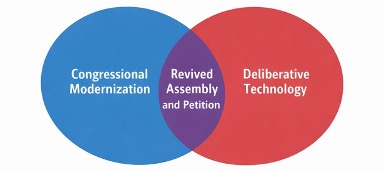
As depicted in the graphic, Congress has the mandate and society has the technology capacity to make use of deliberative platforms that integrate more participation into the policy process.
Impact of the COVID-19 pandemic
Between 2020 and 2022, the COVID-19 pandemic reshaped how congressional offices worked, and remote operations became the default in the House of Representatives. Drop-by visits from constituents—once a routine of daily office life—largely disappeared, replaced by digital communication and virtual meetings. For offices launched during this period, remote work was not just an adjustment but the foundation of their organizational culture.
This hybrid-first approach to organizing is now the standard for new Members moving forward. Staff teams continuously navigate the balance between remote, hybrid, and fully in-person work, adapting practices to the needs of their offices and constituents. Within this evolving environment, AI is emerging as an ongoing workflow experiment—particularly in the realm of public engagement—rather than a fixed or settled tool.
Since 2020, correspondence management systems (CMS) have become the backbone of modern casework and constituent communication. Most offices described these systems as adequate for retaining and organizing information, though some expressed frustration with the options provided by House vendors. Looking ahead, staff noted that it will be important to better understand the specific functionality of different CMS platforms. One team suggested integrating deliberative platforms into existing systems to prevent duplication and avoid the burden of additional ‘busy work’. Staff consistently remarked that any tool needs to add to current practice, and not require dramatic changes to the way an office works.
Seeking to be included in House modernization, organizations and individuals piloting deliberative technology wrote a letter to the Committee on House Administration in 2024, requesting revised vendor guidance. Their aim: broaden the pool of service providers to Congress as it adapts and evolves.
More recently, Congress has leaned into new technology, including AI, and made remarkable progress thanks to expert staff who are under-resourced, yet overperform. When it comes to communicating at scale with the outside world, the channels remain anchored in telephones, PDFs, newsletters, and email lists. Though highly promising, deliberative technology is still a glimmer on the horizon, and will require socialization with members and experimentation in districts to be fully realized. Members themselves must become champions of these technologies for the institution to incorporate and transform assembly and petition into community informed governing.Importantly, real-life human interaction remains the most critical communications method.
Restoring collective decision-making capacity
Against this backdrop, deliberative technology offers a practical path forward. These tools can synthesize large volumes of civic input, surface local and subject-matter expertise, identify shared concerns, and translate public discourse into credible, actionable information. In doing so, they modernize the First Amendment practices of assembly and petition by creating safe, constructive forums and producing verifiable records of collective public voice. Over time, this approach can strengthen trust in civic data among citizens, lawmakers, and public-serving media. When designed to align with congressional workflows and institutional norms, deliberative tools can also help Congress rebalance checks and balances among the three branches of government. In particular, they offer concrete support in the wake of the Supreme Court’s 2024 Loper Bright Enterprises v. Raimondo decision, which requires Congress to articulate clearer legislative intent rather than relying on agency interpretation. By systematically capturing and structuring public input, these tools can help lawmakers meet that higher standard of statutory clarity.
Establishing an opening for deliberative technology
Around the world, democracy is confronting a crisis of legitimacy, even as autocratic governance gains ground. This moment has sparked renewed efforts to reinforce democratic systems—through institutional modernization, technological innovation, and more inclusive forms of representation. Within this context, advocates of deliberative technology have a rare opportunity to demonstrate civic collaborations that not only improve decision-making, but also strengthen human relationships at a time of fragile public trust.
Yet elected leaders are understandably cautious about experimentation and public exposure. Before Members of Congress can emerge as visible champions of deliberative technology, they must have confidence that a credible and organized group of constituents will stand with them as they make the case to their colleagues.
Introducing deliberative tools through sustained outreach and education, and piloting them in ways that include Members and staff as learners alongside their communities, offers a constructive path forward. The following two examples illustrate how this progress can take shape.
Civil Society Field Hearings are a community listening model for collective sensemaking about the local impacts of policy. It is a spin-off of an institutional standard, the committee hearing, and revives the assembly and petition traditions by giving citizens and residents—especially marginalized or impacted groups—direct opportunities to testify for the record. These community hearings aim to produce a civic voice version of the Congressional Record, build muscles for data cooperatives, strengthen non-profit local news, and reconnect communities with representative institutions.
Cortico Fora is a deliberative technology platform co-developed by the MIT Media Lab’s Center for Constructive Communication. This listening platform takes diverse civic conversations and translates them into structured analysis and usable insights. By intentionally surfacing voices that are less often heard, the platform captures a broad cross-section of public input. This data does more than register opinions; it explains issues by providing context, examples, definitions, and restatements. Most importantly, this representative listening helps illuminate trade-offs, a core requirement of democratic decision-making. As a form of civic input, Fora strengthens modern assembly and petition functions by turning raw public voice into actionable knowledge for policymakers, journalists, and communities.
Federalism 2.0: Congressional capacity devolves outward
Political reporting often features Congress myopically, focused only on DC’s radiant Capitol Dome. Yet for assembly and petition, the most important congressional communication happens not in DC but in the 441 congressional districts spanning the geography of the USA. Over the past four decades, Congress has steadily shifted staff capacity away from Washington, DC, and into the states.
Between 1972 and 2016, district-based staff grew from 22.5 per cent to 47.3 per cent of Members’ personal office allotment, fundamentally changing where congressional work happens. On its face, this outward migration creates an ideal opportunity to introduce civic tech and deliberative platforms that can capture local knowledge, structure civic input, and connect district-level engagement to legislative work. Yet this geographic shift has not been matched by a corresponding expansion of systemwide tools or policies for collaborative lawmaking. As a result, much of the district-generated insight remains fragmented and informal, rather than integrated into shared processes that could strengthen policy development across Congress.
Each Member of Congress has 18 staff positions, often supplemented by fellows and interns. Research shows the internal division of labour varies widely by office, particularly in how assisting residents with federal agency issues (constituent casework) is coordinated with legislative work, such as policy development. Some offices intentionally connect these functions through regular meetings that surface district-level insights for policy consideration. Others maintain a strict separation between district and Washington, DC operations. There, district staff focus on constituent casework, leaving most policy development to DC-based staff.
This variation reveals an opportunity to strengthen policy capacity at the periphery of the institution. A district-level policy support system—aligned with the geographic distribution of House staff and Members’ goals of improving constituent service, increasing public access, and building trust—could better connect local knowledge to legislative work. A significant opportunity to build community-informed decision support now exists in district offices, made feasible by deliberative technologies and major advances in information sharing, synthesis, and data storage. What does a capable enterprise-level digital architecture look like for the world’s most complex democratic legislature?
Connecting with constituents during volatile times
Despite living in a time of stark inequality, the individuals who wrote the American Constitution recognized the importance of popular civic connection. Congress is the centrepiece of Article One and the right to peacefully assemble and petition the government for redress of grievances are First Amendment clauses. Collective conversation and forging a path to a shared future is a preeminent American value.
Fast forward to 2012, a contemporary turning point in how Congress engages the public. Tea Party activists began deliberately disrupting public gatherings, using hardball tactics to obstruct dialogue around health care reform. As a result, traditional town halls grew increasingly fractious and less productive. Almost 15 years later, members today often require security details in public. Threats and intimidation disrupt connections at every level of representation. Even phone calls count for less as staff don’t answer in person during volatile news cycles, allowing calls to go directly to voicemail.
Violence has become an ever-present concern shaping congressional engagement. Members and staff now curate public events more deliberately for specific audiences and purposes, balancing participation with heightened security needs amid a sharp rise in threats. These adaptations build on longstanding and increasing concerns about physical safety. In 2011, Representative Gabby Giffords was shot and seriously wounded at a “Congress on Your Corner” constituent event in Arizona, where seven people were killed. Since then, lethal threats and attacks against Members have continued to expand, culminating in the January 6 assault on the US Capitol. This erosion of the social cohesion undergirding democratic practice is reflected in threats against public officials nationwide as well as in Congress’ institutional responses: The Capitol Police budget is up more than 70 per cent since the January 6 attack.
Despite this adversity, members continue to find creative ways to connect with the public and enable constituent engagement. They convene advisory councils and feedback sessions, make use of secure federal buildings, conduct site visits, and attend community forums. Staff facilitate ‘pop-up’ sessions or kiosks to collect input on immediate issues such as disaster response, federal funding, or changes to public benefits—all while still organizing Town Halls. Increasing connection without increasing physical risk is another reason deliberative technology is an alluring prospect for constituent service that includes public deliberation.
Building a digital layer atop a centuries-old paper system
Similar to broader society’s technology adaptation journey, Congress is working to understand, embrace, and integrate change. AI is a timely example. Several staff had experimented at home, but no AI had been officially incorporated into workflows by the time research concluded. Congress’s history with new technology has always been cautious, slowed by multiple layers of requirements, rules, procedures, and security precautions. The first AI-assisted technology in Congress is a tool that shows the text impact of amendments and edits, like a ‘track changes’ for bills.
Even so, compared to earlier waves of innovation, Congress is moving more quickly this time. The Committee on House Administration, the House AI Center, and the Clerk’s office are developing guidance, internal tools, and tracking AI adoption. For example, in 2024, the Committee on House Administration released an official House AI policy and the House Chief Administrative Office (CAO) acquired ChatGPT Plus licenses for staff to begin experimenting within established guidelines. In 2025, the CAO published an AI House Use Case Inventory. In 2026, Congress will roll out Microsoft Copilot to the general staff. The House AI Center continues to manage and review House-authorized AI use cases and solutions. As the pace of AI adoption rushes headlong in the private sector, Congress’ challenge will be to balance caution and opportunity for its use in the legislative workflow.
Over the past decade, Congress has established methods to connect on the topic of technology with the outside world; the Congressional Hackathon and the Library of Congress legislative data feedback session are now annual events, while the Congressional Data Task Force meets quarterly. This group is a collaborative legislative branch working group dedicated to making congressional data more accessible, transparent, and useful.
Deliberative technology is not yet integrated into congressional systems, but the field is open to educate about the platforms and to demonstrate their potential benefits—a job for constituents.The House Digital Service is aware of the appetite for authentic connection as well as the desire to explore these technologies. Local civil society should develop educational outreach with pilot projects in districts across the country, as there is no better advocate for funding and capacity than members themselves. Moreover, Congressional modernization recommendations that directly concern civic engagement remain open. For example:
176. The House should study and present options for developing a platform for committees that want to solicit public comment and evidence on topics that might be coming before the committee.
The Select Committee’s Final Report provides an extensive explanation of the recommendations, which the present-day Subcommittee on Modernization continues to update.
Workflow models of assembly and petition
1. Civil Society Field Hearings are a deliberative model designed to create a credible public record of civic voice, inspired by the dramatic increase in witness diversity during the pandemic, when committee hearings moved to remote, online platforms. This model builds on second-track principles (unofficial processes led by non-governmental actors) with the aim of collective sense-making rather than formal decision-making. This model draws selectively from oppositional tactics like shadow and rump hearings, but its purpose is not protest. Rather, it is to supplement the official process and build capacity for community-informed lawmaking.
Official field hearings in the United States originated during the Civil War, when members of Congress sought firsthand testimony from the front lines. From the outset, field hearings represented a compromise between public demands for participation and institutional control. Civil society-led field hearings extend this tradition by using data-driven technology to increase access, share information, surface expertise, explore solutions, and build trust.
Ideally, modern expressions of First Amendment activity will take the form of community-organized forums—such as Civil Society Field Hearings—paired with deliberative tools that create a clear pipeline for gathering, structuring, and integrating local feedback into digital systems. In technical terms, this process resembles ETL
— Extract, Transform, and Load—where public input is systematically collected, organized, and made usable within machine-readable workflows that support decision-making in Congress’ oversight responsibilities.
A Civil Society Field Hearing models a structured public forum—organized outside formal government institutions—where community members can share testimony, experiences, and recommendations on issues.
They draw inspiration from congressional or governmental hearings, but are hosted by civil society rather than official bodies. The goal is to create a legitimate, visible, and inclusive process for public input and record, especially from voices that might otherwise be excluded from policymaking.
Key features can include:
- Testimony format: Individuals or groups provide prepared statements or stories, similar to witnesses in a government hearing, labelled for machine readable discovery.
- Facilitation by civil society: Non-profits, local community organizations, or academic institutions convene and document the event.
- Community-centred setting: Held in accessible venues such as schools, community centers, churches, or local non-profits.
- Deliberative purpose: Gatherings model deliberation by listening to the community describe the local impacts of federal or state policy. Testimony is recorded, analyzed, and shared with decision-makers (including government agencies, legislators, or media).
- Local data capacity: Structured and labelled civic voice builds a record either through a formal channel like Congress, a local data cooperative, or a trusted non-profit like the Internet Archive.
- Symbolic and practical value: By mirroring the formality of a hearing, these events convey seriousness while widening participation beyond official channels.
Civil Society Field Hearings strengthen local capacity for constructive, democratic governance. By devolving the power of knowledge production outward, they operate in a decentralized way while remaining connected through shared values, coordinated action, and institutional convention. This guide was written to assist in organizing Civil Society Field Hearings. It is intended to be a living resource—adapted, improved, and expanded over time—to support a pro-democracy movement working alongside institutions and building community capacity to participate in governing.
2. Fora by Cortico is a listening platform created by the non-profit organization Cortico in collaboration with the Center for Constructive Communication at Massachusetts Institute of Technology (MIT). With human participants at the center, the platform uses AI to surface information for sensemaking and civic purposes. It combines small group conversations—online or in person—with AI to identify themes and patterns from audio and transcripts.Cortico records (with consent) and then shares the resulting analysis as visualizations and audio clips of lived experience, available on an interactive repository of community voice. Here is a recent example that explores urban planning in New York.
During the course of district-based interviews, staff responded positively to Fora’s geographic visualization tools and short descriptive videos, noting that both made public input easier to understand and contextualize. For example, these clickable maps from a community engagement project in Durham, North Carolina show specific themes by location and feature participant voices. Staff also raised questions about data governance: how information is stored, who can access it, and what happens to it over time. These concerns reflect an urgent policy conversation about who should own democracy’s memory. Yet fear should not deter deliberative technology practitioners from pursuing demonstration projects with elected leaders. Public events produce public information, and are not subject to the same constraints as internal congressional communications or constituent casework data.
Many members of Congress hold Telephone Town Halls, a moderated method that allows a member to connect with thousands of constituents via a simultaneous phone call that includes facilitated Q and A. These remain an expensive but familiar way to scale participation—and have shown positive results for building legitimacy. Fora offers a different value proposition. It has demonstrated a capacity to bring diverse voices into collective problem-solving, as seen in its use by the New York City Public Health Corps during the COVID-19 pandemic and beyond. Initiated during a public health crisis, the ongoing use of this platform has created a network of engaged feedback channels and transparent actions within the community and from its leaders.
Offices that participated in the research likewise emphasized the importance of “lifting up unheard voices” and viewed the technology as a promising way to engage constituents who are often difficult to reach, including recent immigrants, rural residents, and low-income communities.
Deliberative tools in the workflow of Congress
Member offices also remarked how they were continually thinking about new ways to meet with constituents and surface unheard voices. Some officers informally pilot new technology-enabled methods. When asked about office priorities for constituent meetings, responses fell into one of two buckets:
- Building trust and district-level community relations; and
- Developing actionable information and public coalitions for legislative priorities.
During the interviews, staff actively brainstormed ways to integrate deliberative technologies such as Cortico Fora into their everyday workflows, with improving public engagement emerging as a consistent priority.
District offices convene a wide spectrum of gatherings—legislative roundtables, policy feedback sessions, emergency meetings, and informal community mixers—held both on and off the record. Developing clear approaches that apply a Fora-based method to each type of meeting would help standardize practice while improving the quality and usefulness of public input. Members vary widely in their comfort and skill as facilitators and often depend on staff to manage these interactions, underscoring the ongoing need for outside support and training for both staff and Members. Notably, as part of its broader modernization efforts, Congress revised its rules to expand opportunities for both conflict resolution training and for Members to share information about and collaborate with service oriented civil society in their districts. These changes create unprecedented openings to strengthen community-informed decision-making.
Staff noted different types of possibilities for Cortico Fora based on experience. At the White House's request, one congressional office organized what “felt like a hearing.” Framed as part of a task force on ending hunger, the event brought together panels of testifiers—“grouped… by providers, advocates, [and] local electeds”—convened in a local non-profit known for its community programming. As one staffer explained, “We took all the testimony.” The White House request gave the gathering a measure of official cachet, and technology was integrated to support wider access, using an app to enable live translation.
Another office offered this example of synchronous collaboration: “We host topical roundtables where it is focused on a particular issue and we are meeting with local stakeholders, as [member] is writing legislation.” Timing these discussions with specific policy debates—such as a Farm Bill listening session—creates a contemporary version of advisory councils that keep community voices aligned with congressional priorities.
Staff noted tools like Cortico Fora could further enhance this model: “Fora would be very useful… for a mental health roundtable, for example… with the Congressman. We could take notes for legislative feedback.” Such a session could involve a range of participants—social workers, teachers, and those directly affected by mental health crises—while providing a system to “pick out key topics” for the Member’s consideration. Noting that many constituents are not digital natives, they also suggested similar uses for “our elder council meetings, which need to be in person.”
District staff also described a convening model designed to gather community insights at the formative stages of lawmaking. They suggested this approach could be strengthened with deliberative tools, particularly if organized around a clear issue agenda at the start of a legislative session. As one staff member explained, “We held equity agendas at the beginning of the session. We brought in experts and then broke into small groups, each led by an expert, and rotated participants through them.” The intent was to invite the public into “the nuts and bolts of writing legislation,” with issue areas such as public safety and criminal justice reform as focal points. The format blended expert input with participatory engagement: a short panel—typically a 20-minute introduction—outlined practical, on-the-ground work, such as teen empowerment or reentry from prison, followed by a structured discussion that allowed participants to translate expertise into legislative insight.
Together, these approaches illustrate how traditional methods, town halls, advisory councils, and listening sessions can be reimagined for contemporary needs—combining in-person convenings, technology tools, and community expertise to feed directly into the legislative process.
Cortico Fora was demonstrated on Capitol Hill in a Member office in June 2024 through a pilot use case focused on an internal process: intern intake. Cortico provided a technical expert to support the demonstration, giving staff and interns firsthand experience with a live deliberative tool. This kind of low-stakes, hands-on exposure is critically important. Building familiarity and comfort among staff and Members will be essential to integrating deliberative technologies like Cortico Fora into the everyday workflows of Congress, both for internal office practices and for public-facing engagement.
Next steps
As noted, elected leaders will be the most critical champions for integrating deliberative technologies into Congress as a means of revitalizing the First Amendment rights of assembly and petition. Congress already has modernization recommendations that emphasize collaboration, but it lacks sufficient resources to act on them at scale.
Integrating deliberative technology into the congressional workflow is a compelling proposition; however, Members will need a visible, consistent, and supportive political constituency to prioritize and sustain such efforts. Because deliberative technology sits at the intersection of policy, governance, and the legislative branch, congressional modernization presents a timely opportunity to pursue reforms that are both legislatively feasible and operationally practical. With this window open, deliberative technology proponents can pose the following questions that are grounded in the realities of congressional operations:
- Could your local member be a champion for deliberative technology?
- If so, how can you make their job easier and provide value?
- What agencies/organizations already share expert data with the legislature? Is there any existing public feedback process?
- What technology and data systems exist? How much does your Member know about technology and data systems in Congress, how much do they know about ongoing modernization efforts? (Don’t assume they know.)
- Public testimony is data. Where might you be able to prototype a record for civic voice? Who is a credible information intermediary to store this data?
- Start with a civil society-led pilot. Invite legislators and staff to show up as community members with a story to tell. Let them be a participant, not just a target. Include local, non-profit news organizations.
Democracy advocates can pose questions that point to systems strengthening:
- Acknowledge the legitimacy crisis and the threat of violence. How do we reinvest the public’s trust in representative government?
- What can you see your legislator piloting or prototyping? Are they an early adopter? An activist? A business person?
- Let your elected leaders know about deliberative technology examples in legislatures in other places. Brazil keeps an online portal.
- Document and share pilots and prototypes. Follow up with your representative.
- If possible, conduct a technology assessment with the legislator’s staff.How do they get information? Who do they trust? What tools do they have?
- Let the elected leader be in the driver’s seat. Prioritize their issue needs and institutional responsibilities.
- Take a ‘whole of Congress’ approach. Let your Senators know about deliberative technology opportunities.
- If you pilot, share the content and results with a local non-profit news organization.
Conclusion
This paper has argued that the crisis facing Congress is not only political or procedural, but an inability to compete in the modern world. Specifically, the institution lacks the capacity to be informed, responsive and effective. Research shows Congress’ unresponsiveness is less a failure of will than a failure of infrastructure. The First Amendment promise of assembly and petition—designed to channel grievance, knowledge, and collective judgment into representative lawmaking—has eroded as Congress’s capacity to hear, process, and act on civic voice has diminished. When these channels weaken, public frustration does not disappear but is displaced and distorted. At worst, it is expressed through intimidation and violence rather than democratic participation.
Today’s Congress lacks modern, credible, and trusted mechanisms to absorb authentic public input at scale, particularly from outside Washington, DC. District offices, where most interaction between Congress and the public now occurs, are rich in local knowledge but poorly connected to legislative workflows. Assembly persists in fragmented, high-risk, or symbolic forms; petition survives largely as casework or mass email, stripped of deliberative depth and explanatory power.
When paired with community-centred practices, deliberative technologies offer a way to restore these First Amendment functions in forms compatible with contemporary governance. Civil Society Field Hearings revive assembly by creating inclusive spaces for testimony and collective sensemaking that remain structured while producing a durable public record. Platforms such as Cortico Fora modernize petition by aggregating and transforming diverse, qualitative public input into analyzable, shareable knowledge that can inform legislative drafting, oversight, and public explanation. Both demonstrate how assembly and petition can once again function as inputs to governing—not as performance, protest, or noise, but as components of a usable democratic process flow that provides credible data for decision making.
The findings from district-level research reinforce a central insight: Congress does not need to invent participation from scratch. Members and staff are already experimenting—through roundtables, advisory councils, listening sessions, and community convenings—but these efforts remain episodic and difficult to integrate into institutional memory. Deliberative tools can provide the connective tissue: aligning participation with workflow and improving efficiency for overburdened staff, all while reducing the physical and political risks associated with traditional public engagement.
Reviving assembly and petition is not about bypassing representative institutions; it is about strengthening them. As Congress faces increased responsibility for legislative clarity, institutional oversight, and democratic legitimacy, it must once again become a place where public grievances are processed into collective decisions.
The First Amendment was not written to guarantee expression alone, but also to sustain a system capable of listening. Deliberative technology, thoughtfully integrated and institutionally grounded, presents a remarkable opportunity for Congress to reclaim that constitutional role. The task ahead is not so much technical as civic: to rebuild the habits, infrastructures, and expectations that allow assembly and petition to function as engines of democratic vigour rather than symptoms of democratic breakdown.
The Author
LORELEI KELLY

Lorelei Kelly is a leading expert on Congress, democracy innovation, and public interest technology. She is a Principal at Public Good Group and recently led Georgetown University's congressional modernization portfolio, developing tools and practices to institutionalize democratic resilience, like integrating local knowledge and deliberation into representative decision making. Previously, she directed the Smart Congress Project at New America and also led Security for a New Century--a bipartisan study group in the House and Senate. A frequent speaker and writer, you can find her publications here.
Toda Peace Institute
The Toda Peace Institute is an independent, nonpartisan institute committed to advancing a more just and peaceful world through policy-oriented peace research and practice. The Institute commissions evidence-based research, convenes multi-track and multi-disciplinary problem-solving workshops and seminars, and promotes dialogue across ethnic, cultural, religious and political divides. It catalyses practical, policy-oriented conversations between theoretical experts, practitioners, policymakers and civil society leaders in order to discern innovative and creative solutions to the major problems confronting the world in the twenty-first century (see www.toda.org for more information).
Contact Us
Toda Peace Institute
Samon Eleven Bldg. 5thFloor
3-1 Samon-cho, Shinjuku-ku, Tokyo 160-0017, Japan
Email: contact@toda.org