Global Challenges to Democracy Report No.268
Modi’s Monopolists: Labour and Capital in a Broken Democracy
Debasish Roy Chowdhury
January 27, 2026

Countries where workers’ unions are hit the hardest by neoliberalism tend to offer the right-wing movements the most fertile ground. Look no further than India, where the balance between labour and capital has moved decisively against labour, breaking the back of one of the most potent forces of democratisation. India’s broken democracy now points to the emergence of authoritarian neoliberalism—a form of capitalism in which the state joins forces with capital and erodes labour power to fortify despotic rule.
Contents
- Dark days for India's powerless labour
- To market, to market
- Age of monopolists
- Labour–capital balance and democracy
- State of the union
- Authoritarian neoliberalism
Dark days for India's powerless labour
India’s gig workers on quick commerce platforms ended 2025 on a rebellious note. Over 200,000 ‘delivery partners’—as the poorly-paid, overworked, and precarious delivery workers ferrying food, groceries and almost everything else are euphemistically termed—called a strike on New Year’s Eve to press for fair pay, social security benefits, and safe work conditions.
It followed flash strikes by 40,000 app-based delivery workers on Christmas Day against falling incomes, excessive working hours, lack of job security, and unsafe delivery targets such as ‘10-minute delivery’ models that put the life of the ubiquitous two-wheeler-borne delivery workers negotiating India’s congested and deadly roads at grave risk.
The New Year’s Eve strike saw some success but platforms such as Swiggy and Zomato, which aggregate restaurants, managed to blunt the effect somewhat by offering more incentives to the workers. Zomato’s founder gloated at the high sales on the day despite the strike and thanked the local authorities for keeping the ‘miscreants’ in check. Social media and workers’ unions were aghast at this characterisation of peaceful strikers and the use of state violence to suppress union work.
The strike has triggered a debate on dignified work and capitalist greed, but these are dark days for India’s powerless labour up against a triumphant capital in India. The implications of this face-off extend beyond economic policymaking—they also explain the deeper undercurrents that are dragging down India’s democracy and its unmistakable passage to despotism. While democracy studies generally concentrate on executive overreach, institution capture and crumbling social foundations that delegitimise governing institutions and enable the rise of demagogues, the effect that the relationship between labour and capital has on democracy is far less understood.
This winter holiday season alone bore enough signs of a clear pattern of uneven contest between labour and capital in India, which is now not only considered an “electoral autocracy” by V-Dem Institute, it is also seen as “one of the worst autocratisers”.
It began with air travel across the country going into a tailspin early December as India’s leading airline, IndiGo, abruptly cancelled thousands of flights with nearly a million reservations, leaving air passengers stranded across the country. The chaos was triggered by IndiGo’s failure to implement new government rules mandating longer rest hours for pilots and fewer night landings. New rostering rules were meant to give pilots and cabin crew more weekly rest—48 hours instead of 36 for pilots—and two instead of six night landings, to protect them from fatigue. Aligning with the new regulation would require IndiGo to provide for more staff. It did not bother. Controlling about 65 per cent of the aviation market, IndiGo evidently inferred it was “too big to tame”.

Image: Ank Kumar / Wiiki Commons
It was right. Facing an unexpected aviation meltdown, Prime Minister Narendra Modi’s government buckled. One of its first actions to restore order was to suspend the new rules. The Airline Pilots Association of India called the climbdown a “dangerous precedent” reversing safe and equitable work rules for the sake of “commercial expediency”.
This has been happening a lot lately in India’s broken democracy, where the balance between labour and capital has moved decisively against labour, breaking the back of one of the most potent forces against authoritarianism. Just days before the aviation meltdown began, labour unions howled in protest against the rollout of new labour codes they say reverse hard-won worker rights since India’s independence in 1947. And, within days of the aviation crisis, the government introduced a bill in Parliament aimed at diluting an employment guarantee scheme that was conceived to empower rural labourers with the ‘right to work’.
Known popularly by its acronym MGNREGA (Mahatma Gandhi National Rural Employment Guarantee), the scheme enacted by the previous government made the state legally bound to provide at least 100 days of work to every rural household demanding it. With Modi’s amendments, the government will no longer be obliged to provide work on demand. The bill also pauses guaranteed work for two months during agricultural seasons, eroding the bargaining power of farm labourers vis-à-vis land holders in setting farm wages. The employment scheme has long been a bugbear of both landed elites and business leaders because it made it harder to prey on distressed labour. Its alteration is a major concession to capital.
To market, to market
The withering of labour power and the state’s privileging of capital have been the norm since a neoliberal consensus emerged in India in the early 1990s leading to economic reforms ending the prevailing dirigiste era. The logic of the market now undergirds public policy, with the state ceding more and more space to private business. The process has intensified since Modi’s rise to national power in 2014 set in motion India’s democratic backsliding.
A weaker labour and the growing dominance of capital have contributed to a weakening of democratic institutions and enabled elite capture and rise of authoritarianism. The neoliberal ethic is now morphing into a new kind of state capitalism that blurs the boundary between state and private capital in a new schema of authoritarian neoliberalism: a rapidly centralizing state showers chosen corporations with policy favours to help them dominate market segments as vectors of economic nationalism. The corporations, in turn, bankroll Modi’s ruling Bharatiya Janata Party (BJP) to make it India’s richest party, giving it the financial firepower to outspend the opposition and consolidate its programme of Hindu supremacism.
The BJP pulled in more than 85 per cent of corporate donations to political parties last year, 12 times the collection of the second-biggest opposition party, the Indian National Congress. IndiGo was a major contributor to an electoral trust fund of corporate donors that gave away 80 per cent of its collections to the BJP.
The result is a parallel concentration of power in politics and business. A handful of major companies and conglomerates dominate every market segment. While IndiGo rules the air, Gautam Adani—called ‘Modi’s Rockefeller’—rules the airports, for example; Adani’s growth trajectory has closely tracked Modi’s, having built a ports-to-solar empire in just a decade that Modi has been in power.
Age of monopolists
Such rapid ascent is enabled by a favourable regulatory environment that reduces capitalist competition, creating monopolists with enormous powers over both consumers and workers. IndiGo’s power play to ignore the directives for equitable work rules stemmed from the state’s indulgence that gives it a semi-monopoly status in an expanding market. The pilots association accuses IndiGo of “cartel-like behaviour”, adopting a hiring freeze despite increasing flights, and squeezing out profits through a rostering system that dangerously overworks pilots. Exploitative practices like these are of a piece with the government’s conscious weakening of labour power dressed as investment-friendly policymaking that fetishises capital through the rhetoric of ‘ease of doing business’.
The state’s neoliberal ethic of treating labour rights as a hindrance to investment and economic growth rather than a component of social justice contributes to this deepening inequality.
The unions are calling the new labour codes—the draft rules of which happened to be published the same day as the gig workers went on strike—an escalation in this ongoing exercise of eviscerating labour rights. Layoffs in 60-70 per cent of industrial units across India will no longer require prior government approval under the new codes, says the All India Trade Union Congress. The new codes also weaken state regulation of businesses by allowing companies to self-certify their labour and safety standards, make unionisation more difficult and industrial action almost impossible. It allows 12-hour workdays, in keeping with the suggestion of corporate leaders, and facilitates casualization of the workforce by encouraging more contract work.
The new measures, it is feared, will worsen the predatory labour practices that are already rife in India because of its giant informal sector, which generates 80 per cent of the jobs. Even state employees do not escape workplace deprivations. Following the aviation crisis over unfulfilled rest rules for pilots, train drivers have again been drawing attention to their own inhuman work conditions. The state-run Indian Railways recently rejected loco pilots’ longstanding demand for meal and toilet breaks while on duty, ruling that these elementary necessities of workers were “operationally unfeasible”.
Labour–capital balance and democracy
The rampant workplace exploitation is emblematic of the rising inequality as a consequence of an imbalance between labour and capital. Wages have been falling—salaried workers now earn less than in 2017—while corporate profits have shot up to a 15-year high. The top 1 per cent of India’s population holds 40 per cent of the wealth, making the country one of the most unequal in the world, according to the 2026 World Inequality Report. The richest 10 per cent hold about 65 per cent of the total wealth while the bottom 50 per cent only 6.4 per cent.
The state’s neoliberal ethic of treating labour rights as a hindrance to investment and economic growth rather than a component of social justice contributes to this deepening inequality. It has led to policies encouraging contractualization and casualization of work that has weakened the ability of workers to organize. The share of contract workers in India’s organised manufacturing sector has already doubled in the past couple of decades. Trade unions have been in a state of decline, with union density—percentage of employees who are trade union members—now at a lowly 6.3 per cent.
As labour power weakens, so does India’s democracy. Unions are thought to strengthen democracy as they force more redistributive policies, push back against organized business groups, lend support to democratic institutions, build social solidarity, limit the rise of right-wing populists by decreasing economic inequality in which populists thrive, and mitigate racial and ethnic divisions that populists prey on.
Despite a few instances of working class mobilization against democracy (Yugoslavia and Romania in 1991, for example), strong democratic unions are thus mostly linked to strong political democracy and seen as a bulwark against authoritarianism. The success of the Arab Spring in Tunisia is largely credited to the strikes and protests mobilized by its strong trade unions.
State of the union
The economist Kenneth Galbraith envisaged labour unions as central to the countervailing force against the market power and influence of large corporations, along with a strong regulatory state and consumer cooperatives. Strengthening the bargaining power of unions and supporting this countervailing force as part of the New Deal, to him, were “perhaps the major peacetime function of the Federal Government” for limiting economic concentration.
The West’s three decades of spectacular growth and unprecedented prosperity following the second world war was largely possible because a balance was struck between capital and labour to prevent such concentration. There is century-long evidence that unions reduce inequality, explaining a significant part of the dramatic fall in inequality in the US between the mid-1930s and late 1940s.
Countries where unions are hit the hardest by neoliberalism tend to offer the right-wing movements the most fertile ground.
Look no further than India.
This compromise between labour and capital began to unravel in the early 1970s as stagflation, oil shocks, wage disputes and falling profits triggered social and political turbulence and revived liberal market ideology and reforms. The onset of globalization and offshoring began to erode the bargaining power of labour vis-à-vis a globally mobile capital. As unions declined, wages began to stagnate and inequality rose. This has had far-reaching political consequences, in the form of voter apathy fuelling populist messages, culminating in the Trump phenomenon.
The decline in the strength of unions in the US between 1964 and 2004 contributed to a drop in overall voter turnout as the weakening of unions impacted the mobilization mechanism of political parties. When labour has strong organization and voice, it can help maintain democratic norms, empower citizens, and push for fairer economic conditions. When it does not, and capital dominates without robust labour representation, economic inequality rises, trust in democratic institutions is undermined, and demagogic forces rise on the back of social divisions unmediated by the cohesive and mobilizing capacity of unions. Countries where unions are hit the hardest by neoliberalism tend to offer the right-wing movements the most fertile ground. Look no further than India.
Authoritarian neoliberalism
India has witnessed a marked decline of trade unionism and erosion of worker rights in past decades. In a country where much of the economy operates in the shadows of informality and the trade unions have in any case represented a small, formal labour, rapid informalization of even the formal sectors of the economy in the name of making the labour market ‘flexible’ has rapidly diminished trade unionism.
Shrinking since the mid-1970s, union membership has waned precipitously since market liberalisation in the early 1990s, and with it, the power and influence of trade unions. From its peak of 35.8 per cent in 1989, the trade union density fell to just 6.3 per cent by 2021. The labour income share as a percentage of the GDP has fallen much more steeply than in the rest of the world, while the share of profits has increased dramatically.
The Indian state’s privileging of private enterprise and capital in national development has hardened in recent years as the state itself has become a facilitator of capital rather than an ombudsman. State power now serves capital, and capital in turn solidifies state power. An emaciated labour helps solidify both.
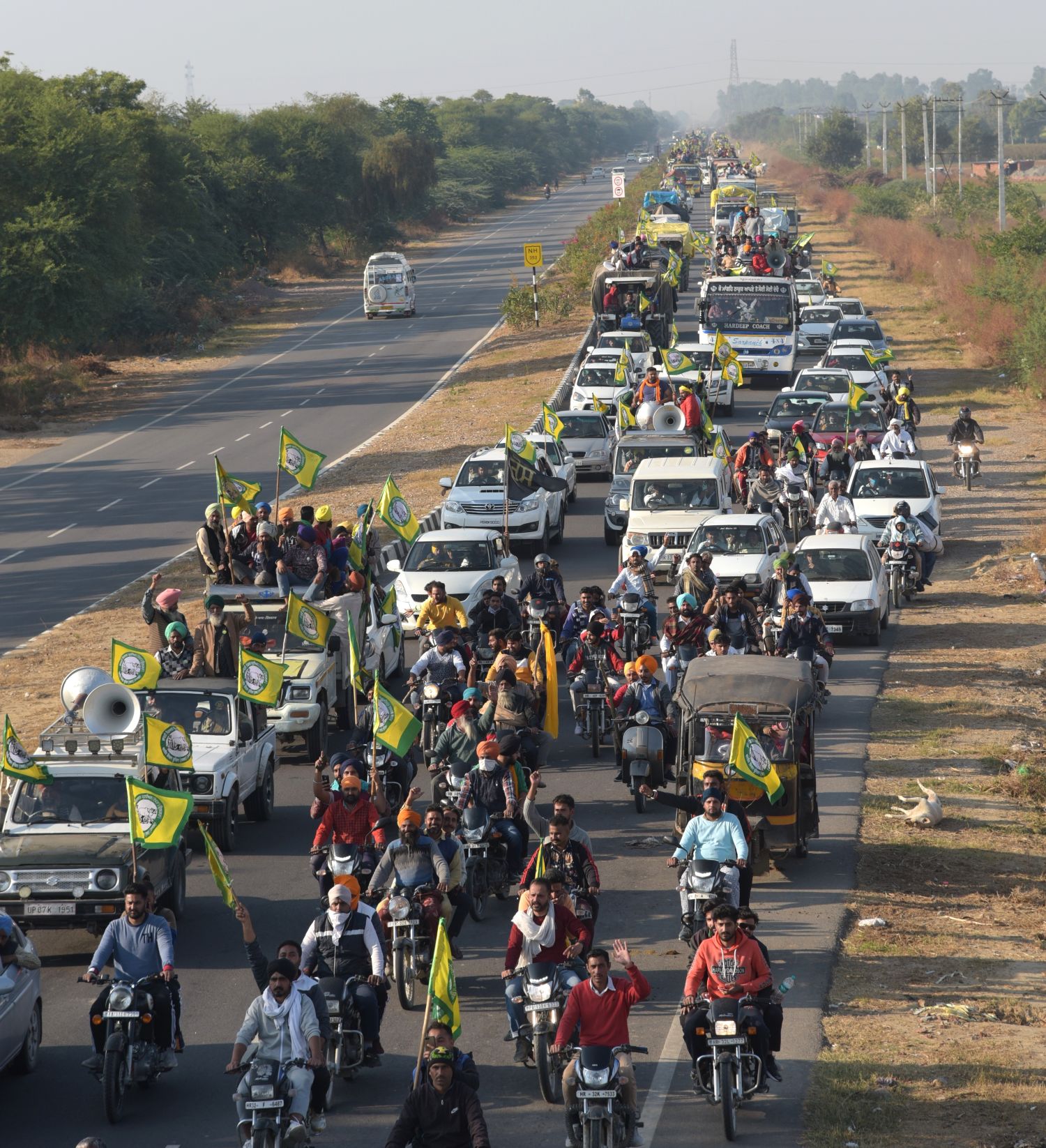
2020 Indian farmers’ protest
Image: Randeep Maddoke, Wiiki Commons
A weak labour helps minimise the risk of pushback to authoritarian power; the only time that Modi has been forced to roll back his own laws is when farmer unions mounted a year-long siege demanding the repeal of three controversial farm laws. Capital and the despot have a convergent stake in keeping labour weak.
This intertwining of state and capital shapes a new kind of neoliberalism that poses an existential threat to democracy. If the 2008 financial crisis signalled the fatal maladies of neoliberalism, Covid was widely understood to have sounded its death knell. Yet, the death of neoliberalism has been greatly exaggerated. The debate over what comes after neoliberalism notwithstanding, there is also a great deal of doubt whether ‘post-neolilberal’ is just hyper-neoliberal, yielding an intensified form of cronyism and state capitalism.
The pandering to monopoly capitalists points to a fusion of the two in India. As neoliberalism and authoritarianism entangle in a mutually reinforcing dynamic, the world’s fourth largest economy offers important lessons in the direction capitalism and democracy are heading as neoliberalism shifts shapes. If the experience of bike-ridden delivery workers, IndiGo pilots and train drivers in the world’s largest failing democracy is anything to go by, it’s going to be one rough ride.
The Author
DEBASISH ROY CHOWDHURY
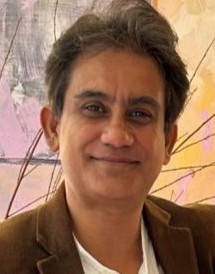
Debasish Roy Chowdhury is a journalist, researcher and author based in Hong Kong. With John Keane, he has co-authored To Kill A Democracy: India’s Passage to Despotism (OUP/Pan Macmillan). Apart from Hong Kong, he has lived and worked in Calcutta, Sao Paulo, Hua Hin, Bangkok and Beijing, and reported from Malaysia, Sri Lanka, the Philippines, Nepal and Qatar. He is a Jefferson Fellow and a recipient of multiple media prizes, including the Human Rights Press Award, the Society of Publishers in Asia (SOPA) award and the Hong Kong News Award. His recent writings are available at Muck Rack.
Toda Peace Institute
The Toda Peace Institute is an independent, nonpartisan institute committed to advancing a more just and peaceful world through policy-oriented peace research and practice. The Institute commissions evidence-based research, convenes multi-track and multi-disciplinary problem-solving workshops and seminars, and promotes dialogue across ethnic, cultural, religious and political divides. It catalyses practical, policy-oriented conversations between theoretical experts, practitioners, policymakers and civil society leaders in order to discern innovative and creative solutions to the major problems confronting the world in the twenty-first century (see www.toda.org for more information).
Contact Us
Toda Peace Institute
Samon Eleven Bldg. 5thFloor
3-1 Samon-cho, Shinjuku-ku, Tokyo 160-0017, Japan
Email: contact@toda.org