Trump’s ‘Board of Peace’: Reign of the Rich
Herbert Wulf
January 24, 2026
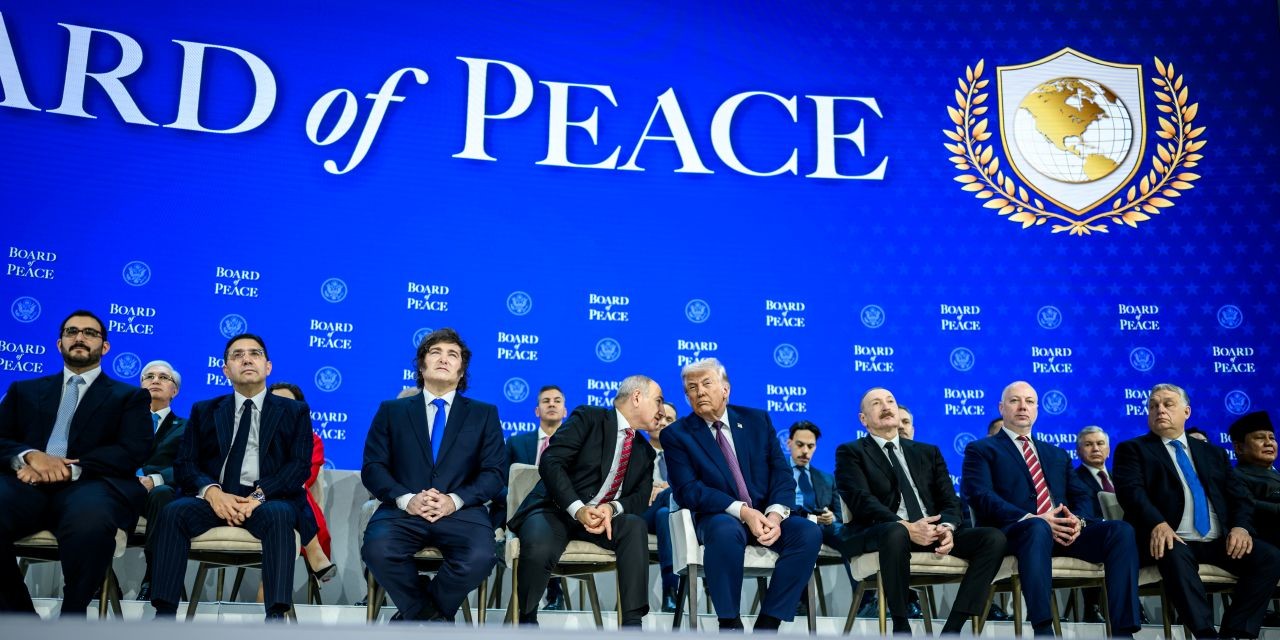
Image: The White House / Wiki Commons
Trump keeps the world on edge with military actions, fantasies of conquest and tariffs. Now, his latest idea: a Board of Peace that would marginalize the United Nations.
During the World Economic Forum in Davos, Trump presented his plan for a Board of Peace. Sixty governments have received an invitation. So far, around 35 countries have joined, including many autocracies: Argentina, Azerbaijan, Belarus, Egypt, Hungary, Pakistan, Saudi Arabia and Turkey. France, Norway, Slovenia and Sweden have declined. The remaining invitees have not yet committed, many of them are reluctant to join.
The new project of a global Board of Peace is intended to address conflicts around the world and organize a new form of peacekeeping. A charter already exists (see full text here). It states: “Each Member State shall serve a term of no more than three years from this Charter’s entry into force, subject to renewal by the Chairman. The three-year membership term shall not apply to Member States that contribute more than USD $1,000,000,000 in cash funds…“ Donald Trump will chair the board, possibly for his lifetime.
If the White House has its way, this US-dominated body will become an alternative to the United Nations, writes Jordan Ryan. The Charter declares ”that durable peace requires pragmatic judgment, common-sense solutions, and the courage to depart from approaches and institutions that have too often failed.” The invitation letter states in Trump’s usual bombastic style: “This board will be one of a kind, there has never been anything like it!” There are indeed good reasons to be dissatisfied with the United Nations’ peacekeeping operations. Peacekeeping is not popular. Many countries are reluctant to deploy soldiers, police, or financial resources on behalf of the United Nations. The UN Security Council, due to the veto power of its five permanent members, all too often blocks itself and fails to fulfil its obligations to maintain peace.
Trump’s Board of Peace looks like an alternative to the UN. It might even become a counter-UN. In future, according to the American president, who has little regard for international law, countries with deep pockets will decide when and where to intervene in the name of peace. Trump’s worldview is clearly illustrated by the countries that were not invited. From the entire African continent, only Egypt and Morocco were invited to membership, and from South America, only Argentina and Paraguay. Canada has been disinvited after Prime Minister Mark Carney’s critical speech in Davos. France declined membership and faces 200% tariffs on wine and champagne. Trump acts like a feudal king.
Trump’s mixed peace record
Aside from the legally problematic attempt to marginalize the UN and to personalize global peace policy, one wonders what qualifies the American president to demand such a central role in matters of wars, conflicts, and their resolution. Trump wants the Nobel Peace Prize and claims to have ended eight wars. Let’s take a closer look at some of these wars to see what Trump has got accomplished.
By putting pressure on Israel and Hamas, Trump succeeded in initiating a change in the seemingly hopeless Gaza situation of the previous two years. But now his peace plan is not progressing well since it is not fully accepted by the direct parties to the conflict. A ceasefire or a peace treaty requires the involvement of the opposing sides to the conflict. The Gaza peace plan, however, was largely implemented without the proper say of the Palestinians. Many Palestinians see the plan as a continuation of the occupation. Many questions remain unanswered: Will Hamas agree to be disarmed? Will Israeli troops withdraw? Who will assume police and security responsibilities? Whether the Gaza Board of Peace can achieve more in this complex situation than the United Nations has in recent decades remains to be seen. Whether Trump’s approach of quick deals will lead to a just and lasting peace is rather doubtful.
Negotiations to end the war in Ukraine are not progressing. Vladimir Putin has let Trump’s various ultimatums expire. Despite several ceasefire proposals, the end of the conflict seems far away. Irreconcilable positions of the main adversaries, Russia and Ukraine, such as territorial issues and security guarantees for Ukraine, remain unresolved. The US president disregarded fundamental insights of conflict mediation that readiness to negotiate is lacking as long as one or both sides to the conflict believe in military victory. Trump, despite announcements to the contrary, has so far failed to find a viable way to end the war. Whether a Board of Peace, tailored specifically to this president, would achieve better results remains to be seen.
A prime example of the overestimated expectations of a personalized peace policy, as Donald Trump likes to pursue it, is his failed attempt at three summits with Kim Jong-un, the North Korean dictator, in 2018 and 2019. The negotiations failed because the respective positions were too far apart. North Korea was supposed to immediately shut down its nuclear facilities; Kim demanded the instant lifting of sanctions. Meanwhile, North Korea continues to expand its nuclear program. Negotiations are not taking place. The government in Pyongyang sees its nuclear program as its life insurance. It is rather doubtful whether a financially powerful Board of Peace can discourage the North Korea from continuing to pursue its nuclear programme.
Trump’s Board of Peace: bluffs and blusters
The desire to resolve conflicts pragmatically, to have the courage to pursue common-sense solutions, and to replace institutions when they fail to fulfill their duties are commendable aims. But why are the United Nations’ hands often tied? The paralysis of the organization stems primarily from global antagonisms, reflected in many conflicts, and the competition between major powers, responsible for the deadlock in the Security Council. These antagonisms will not be resolved by creating a new US-led body. On the contrary, this board, headed by the American president, is by its very structure doomed to fail because it will be perceived as interest-driven.
Neutral and impartial third parties, committed to international law, can act as mediators in conflicts, thereby building trust. But Trump is not and does not want to be impartial; he wants to decide what happens.
Mr Trump, his claims notwithstanding, has not ended “8 Wars PLUS”. He has not even ended the one he promised to stop within 24 hours, Russia’s war in Ukraine. His record to date is not particularly impressive. His blatant disregard for international law, as recently seen in Venezuela and Greenland, is not only worrying. It disqualifies him from chairing a body that, according to the charter, is established to “promote stability, restore dependable and lawful governance, and secure enduring peace in areas affected or threatened by conflict” and to “undertake such peace-building functions in accordance with international law.”
Donald Trump’s erratic approach, his notoriously short attention span, his bluffs and blusters, accompanied by displays of power, threats, blackmail, and his military actions, such as in Iran, against the Houthis in Yemen, and in the Caribbean, do not provide a basis for sustaining peace agreements. His Board of Peace cannot be an alternative to the United Nations.
Related articles:
Commercialising Peace: A Strategic Risk (3-minute read)
The UN’s Withering Vine: A US Retreat from Global Governance (3-minute read)
Venezuela and the UN’s Proxy War Moment (3-minute read)
The Danger of a Transactional Worldview (3-minute read)
The ‘Donroe Doctrine’ (3-minute read)