Local Resilience Can Mitigate Climate Conflicts in the Pacific
Tobias Ide
January 31, 2026
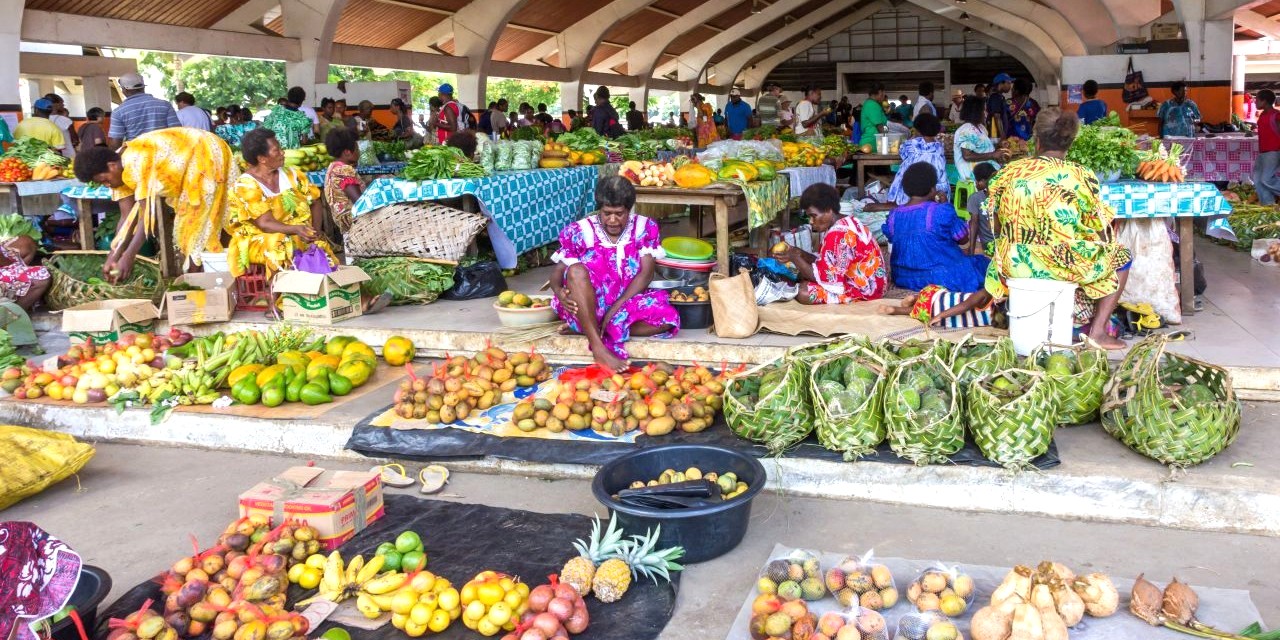
Image: Port Vila Market, Vanuatu – Kevin Hellon / shutterstock.com
The Pacific Island countries are at the frontline of climate change. Their territories mostly consist of small, low-lying islands, with long coastlines and vast ocean spaces between them. Many livelihoods are based on agriculture or fishing, and importing water or food is often infeasible or expensive. This makes those large ocean nations highly vulnerable to the impacts of climate change, such as storms, droughts, and rising sea levels. Analysts have expressed concerns that this can result in various forms of socio-political conflict.
However, the Pacific Island countries have received scarce attention in research on climate change and conflict. This is surprising given the Pacific Island countries’ high climate vulnerability and increasing geopolitical relevance. A few years back, a Nature article did not find a single peer-reviewed study on the climate-conflict nexus in the Pacific. And while recent work added important insights on potential pathways between climate and conflict in the Pacific Island countries, the region remains understudied.
A new study tackles this knowledge gap by systematically collecting data on conflict events (such as protests, riots, and communal violence) in Fiji, Solomon Islands, and Vanuatu. It then determines statistical associations between the occurrence of such conflicts—protests, riots, communal violence etc.—and climate extremes like storms, heatwaves, and floods. The results are surprising.
Climate extremes do not drive conflict risks
The researchers found that climate disasters are not a significant predictor of conflict events. This is true for both cities and rural areas. In cities, high values of (and competition for) land, immigration after disasters, and opportunities for political mobilisation have long been considered to make climate-related conflicts more likely, yet no such statistical signal was detected. Even when looking only at conflicts around natural resources like water or forests, climate extremes are not a good predictor.
These findings could nuance common wisdom about climate change and conflict. Experts from the Intergovernmental Panel on Climate Change (IPCC) have concluded that climate change increases conflict risks, even though other conflict drivers are more important. Such a linkage is particularly likely in climate vulnerable regions with a history of political instability, and it is also more applicable to low-intensity conflicts like protests (as compared to large-scale violence like civil wars). Yet, the study focuses on such smaller-scale conflict. Fiji, Solomon Island, and Vanuatu are also highly vulnerable to climate change and suffered through political instability (coups, civil war, and unrest) in the past.
How to make sense of the absence of conflict
As a starting point, it is important to clarify three things. First, the absence of conflict does not necessarily imply peace, particularly if those least responsible for climate change suffer most from its consequences. Second, the study focuses on visible and collective forms of conflict. Disasters, but also competition for disaster-related support schemes, might well result in lower-level, less visible forms of conflict, such as household and intimate partner violence or lower social cohesion within communities. Studying these forms of conflict is certainly a key task for future work. Third, evidence is not perfect. The new study, for instance, covers only the period 2012 to 2020, studies just three Pacific Island countries, and could not include rainfall anomalies due to a lack of data.
That said, the absence of a correlation between climate extremes and socio-political conflict events is still noteworthy. It indicates the Pacific Islands have significant levels of agency and resilience. This is not to romanticise local communities and national governments—as everywhere in the world, they have their share of tensions and shortcomings. But the Pacific Island countries possess well-established traditional institutions and, at least in some areas, strong community and civil society networks. Given their remote location, tropical climate, and oceanic geography, they have plenty of knowledge and experience in dealing with climate extremes like droughts, floods, and storms as well. These are important assets for coping peacefully with the impacts of climate change.
Consider the example of Vanuatu after cyclone Pam in 2015. Despite being one of the most intense storms to ever hit the South Pacific, the death toll was relatively low, and the country recovered rather quickly from its impacts. This was the case because local community structures and NGO-led Community Climate Change Committees coordinated well, and they thus played a key role in preparing for the storm and in delivering disaster relief and recovery. These activities did not just utilise but also strengthened traditional social networks. Furthermore, state institutions effectively utilised the inflow of international aid to deal with the cyclone’s impacts, thereby increasing trust in the government. Consequentially, no major conflicts erupted in the aftermath of Pam.
Avoid doomsday thinking – and provide tailored support
Which insights can decision makers draw from these findings?
It is important to avoid doomsday scenarios when thinking about climate change in the Pacific. For sure, the respective countries are highly exposed to and quite vulnerable to climate change. But if policy makers and media portray the Pacific Island countries as helpless victims of climate change and prone to conflict, the consequences are problematic: a lack of economic investment, external support mostly focussed on relocation, and an ignorance of local capacities.
By contrast, emphasising how Pacific communities successfully deal with and maintain peace in the context of climate change provides different perspectives. It highlights how local communities and state institutions (despite not being perfect) have significant capacities for climate change adaptation and bottom-up peacebuilding. National governments and international donors should utilise those capacities by providing tailored support, responding to the needs and priorities of those on the frontline of climate change. Rather than preliminary resignation or relocation, this can support the building of climate-resilient peace.
Related articles:
There Is No Security Without Development, Anything Else Is a Distraction (3-minute read)
Do We Need a Pacific Peace Index? (3-minute read)