Crisis in Venezuela: Three Scenarios
Robert R. Kaufman
January 9, 2026
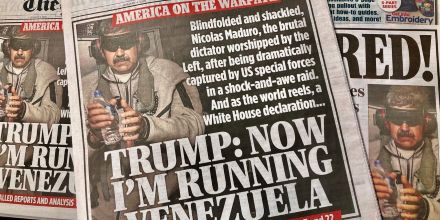
Image: Steve Travelguide / shutterstock.com
The US armed forces’ capture of Venezuelan president Nicolás Maduro and his wife, Cilia Flores, is the latest chapter in a very long history of United States military interventions in Latin America and throughout the world. And, as in almost all of the previous cases, this one has opened the way to a prolonged and costly commitment, with potentially very high impact on US treasure, on political stability in Venezuela, and on the lives and security of people throughout the region. It is relevant here to cite the famous ‘Pottery Barn’ rule articulated prior to the invasion of Iraq by Colin Powell, the Secretary of State under George W. Bush: “if you break it, you own it.” The Trump regime might ‘break’ Venezuela, but it will find that it is increasingly difficult to maintain full ‘ownership’ of the consequences.
In this brief note, I sketch three possible scenarios that might emerge out of this moment of profound uncertainty.
Prospects for a democratic transition? With Maduro in custody, his government deeply discredited, and substantial public support for opposition leader, María Corina Machado, we should not rule out this possibility entirely. Still, the odds against it are very high. One reason, of course, is that the Trump administration is indifferent at best, or at worst, opposed to a democratic transition. It has almost fully abandoned the democratic rhetoric that was so often deployed to rationalize previous interventions. By Trump’s own admission, the main concern is “seizing the oil,” and the United States is clearly willing to work with the autocratic leaders of the old regime to achieve that objective. At present, it should be noted, it appears unlikely that a large inflow of new private investment will be available to revive the depressed petroleum sector. But such investment, if it does materialize, is more likely to strengthen the incumbent rulers than to increase the leverage of the democratic opposition.
Trump’s economic imperialism, however, is not the only obstacle to a democratic transition. For one thing, although the current Venezuelan government is profoundly unpopular, the general public might be too impoverished and exhausted to engage in the type of sustained demonstrations that have often fueled other transitions. Even more important, the apparent intransigence of the Machado-led opposition is likely to be counter-productive, particularly in a situation where the leaders of the incumbent regime control virtually all of the economic and coercive power resources. In previous decades in Latin America, successful transitions (for example, Uruguay and Brazil in 1985, and Chile in 1990), have typically involved compromises and mutual-security guarantees between moderate factions of the ruling regime and opposition leaders. In Venezuela, in contrast, neither the opposition nor the government appear inclined to look for a middle ground.
The current leadership maintains power through tacit cooperation with the United States. This appears to be the most likely outcome, at least in the short run. Trump and his advisors seem willing to work with former Vice President and now Acting President Delcy Rodriguez to maintain order. In statements addressed to the domestic audience, Rodriguez has strongly defended Maduro and bitterly criticized the United States. But other public statements—as well, possibly, as private communications—have been much more conciliatory; and Trump has gone along “for now.”
Whether this arrangement is sustainable, however, is far from certain. This depends in part on the extent of Trump’s demands for concessions and control. Trump might well make demands that Rodriguez cannot—or will not—accept. Even if she does choose to cooperate, moreover, it remains to be seen whether she can bring along other high-ranking and quasi-independent members of the regime’s power elite. Interior Minister Diosdado Cabello, Defense Minister Vladimir Padrino, as well as others in the ruling elite, have their own bases of power—in the bureaucracy, the armed forces, and the ruling party. In the past, such power contenders found that they could gain more by collaborating with Maduro than they might achieve by challenging him (and each other) for full control; but with Maduro gone and Rodriguez under strong pressure to collaborate with Trump, this calculus might give way to destabilizing internal rivalries and the temptation to defect from the governing coalition.
Venezuela becomes a failed state; nobody rules. On the surface, the Venezuelan government controls all the major levers of power. Its ruling party dominates the legislature and the executive, and its elites control the military, the public bureaucracy, and key economic sectors. But these institutions lack internal cohesion, and they might well dissolve under pressure from internal struggles for resources among rent-seekers, ideological activists, and outright criminals. With the decline of the Venezuelan economy (and now, with the pressure from the United States), these pressures have become even more intense.
The threat of state collapse is most evident within the coercive apparatus. The revolutionary guard operates alongside the regular armed forces, and in recent decades, armed neighborhood ‘colectivos’ have become important instruments of political control. Institutional rivalries between and within these organizations were encouraged as a means of ‘coup proofing’ the regime, but the cost has been a lower military capacity to control the population or defend against external threats.
Institutional cohesion is weakened further by corruption associated with the drug trade and by criminal networks that penetrate both the armed forces and the civil bureaucracy. These networks have facilitated the entrenchment of power structures that can resist efforts at centralized control. Indeed, in areas dominated by Colombian rebel groups, the state is almost entirely absent.
The internal fragility of the Venezuelan state has been evident for decades—particularly after the decline of the oil sector. It is far from inconceivable that, under the economic and political pressure now being exerted by the United States, it will collapse entirely into decentralized pockets of power. The bottom line, if this occurs, is that we can expect profoundly destabilizing, region-wide, effects in terms of increased outmigration, economic disruption, and political instability.
Related articles:
Venezuela and the UN’s Proxy War Moment (3-minute read)
The US National Security Strategy Returns to the World of Power Politics (3-minute read)
The ‘Donroe Doctrine’ (3-minute read)