Seeking Peace For Kanaky Amid Deepening Injustices and Insecurities
Anna Naupa
December 17, 2025
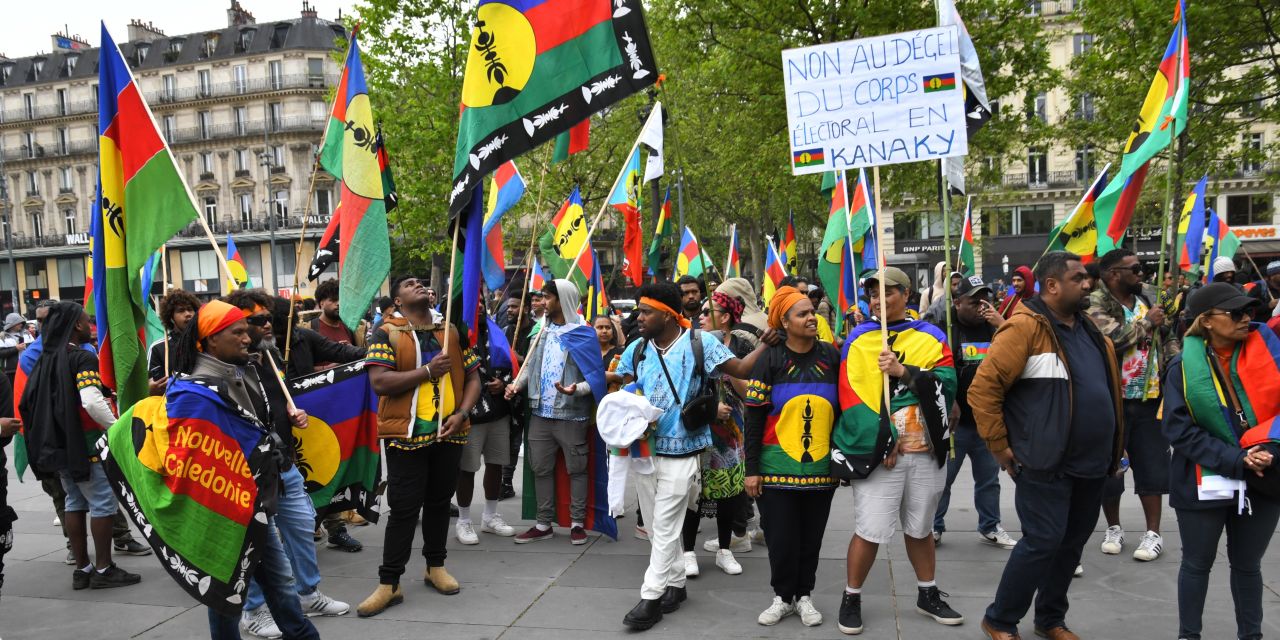
Image: Protestors in France on 1 May 2025 - pmvfoto / shutterstock.com
Image: Protestors in France on 1 May 2025 – pmvfoto / shutterstock.com
The 2025 Pacific Peoples’ Mission to New Caledonia reveals deepening injustices and insecurities
“Our generation wants more than words. We want the freedom to decide our own future,” said Punda Neudjen, a Kanak youth leader when asked about young people’s hopes for Kanaky New Caledonia in the aftermath of the tragic 13 May 2024 uprising in Kanaky New Caledonia.
The French Pacific territory is currently in the fourth decade of decolonising, and has been reeling from several years of often violent political turmoil between those supporting and opposing becoming independent from France.
When Pacific Islands Forum Leaders endorsed a Blue Pacific Ocean of Peace declaration in September 2025, they reaffirmed the Forum’s ongoing support to New Caledonia, and called for dialogue towards a peaceful political transition. However, a new report from the Pacific Network on Globalisation (PANG) reveals that peace is elusive in Kanaky New Caledonia.
Both the Forum and PANG were informed by their respective in-country missions in the aftermath of the events of May 2024. A Pacific Islands Forum High-Level Forum Troika Plus Mission met with both French and New Caledonian leaders, and a Pacific People’s Mission to Kanaky New Caledonia was invited for cultural exchange and pastoral visits with the groups most impacted by the May 2024 events.
The PANG Mission report spotlights persistent inequalities, systemic discrimination and political interference against the indigenous Kanaks under France’s administration.
It concludes that France’s role in Kanaky’s long-delayed decolonisation process had deepened mistrust and weakened the foundations of self-rule, contrary to the increased political power and autonomy promised by 1998’s Nouméa Accord.
From agreement to disillusionment: the planned pathway towards self-determination
The Nouméa Accord set a path for New Caledonia’s gradual transition away from colonial rule, giving greater political autonomy and self-determination for the Indigenous Kanak people.
But as successive referenda on self-determination have taken place in the three decades since, tensions have grown due to flaws in the decolonisation process.
In early 2024, France decided to “unfreeze” New Caledonia’s electoral roll, allowing recent settlers to vote in the third and final referendum on independence. France also ignored requests by pro-independence groups to defer the 2021 referendum during the COVID-19 pandemic and cultural mourning period for 300 deaths of predominantly Kanak members of the 270,000 population. Political actors accused France of manipulating Kanaky into a politics of managed dependency, creating a system that preserves deep economic, social, and institutional inequalities under the guise of stability.
By May 2024, tensions exploded in a youth-led civil uprising, with tragic consequences for communities and families of the many who lost their lives, were injured or became political prisoners during the unrest.
The Mission found broken trust, exclusion, inequality
Since the May 2024 unrest, an erosion of trust in France’s commitment to decolonisation continues to challenge aspirations for peace, justice, and self-determination, as New Caledonia searches for a common destiny.
When our mission visited Kanaky New Caledonia in April 2025, we met with Kanak customary, church, youth, women’s and civil society groups from all ethnic groups. We were repeatedly told that the promises of Nouméa Accord remain unfulfilled.
Many described a ‘politics of revenge’ enacted by institutions, with Kanak and Oceanian communities having increasingly limited state welfare for housing, food and education subsidies.
We identified four main areas of concern:
- France is not a neutral actor in the transition to independence. The state continues to breach commitments made under the Accords through election delays, political interference and the transfer of Kanak leaders to prisons in mainland France.
- Widening socioeconomic inequality. Land ownership, employment, and access to public resources remain heavily imbalanced. The 2024 unrest destroyed more than 800 businesses and left 20,000 people unemployed.
- A health system in decline. About 20 percent of medical professionals left after the 2024 crisis, leaving rural hospitals and clinics under-resourced and understaffed.
- Systemic bias in the justice system. Kanak youth now make up more than 80 percent of the prison population, a reflection of structural discrimination and the criminalisation of dissent.
The report details acute injustices, human rights violations, and socioeconomic concerns that demand immediate reform. As mission member Emele Duituturaga-Jale recalls, “The word we heard was ‘collective punishment’.”
In recognising these significant issues, the Mission report highlights the leadership by local communities, particularly women, youth, and faith groups, in sustaining hope and promoting recovery amid adversity.
Self-determination and decolonisation are central for sustainable peace
The Mission’s report underscores the urgency of renewed Pacific regional solidarity, including in supporting neutral mediation in Kanaky’s decolonisation. France has a conflict of interest in playing the part of both referee and participant in the process. Independent mediation––whether through the Pacific Islands Forum or the Melanesian Spearhead Group, and supported by the UN–– is critical. Customary leaders, faith-based organisations, and community institutions must be meaningfully included in the self-determination process.
Despite the initial promise of the July 2025 Bourgival Agreement to reset political relations, Paris has displayed a continued tendency to determining timeframes without letting the people of Kanaky New Caledonia set the decolonisation tempo.
To achieve a sustainable peace in Kanaky New Caledonia, its people must be supported to set the pace and rules of the political process towards self-determination, as the Noumea Accord promised. Collectively, the Pacific needs to regionally prioritise keeping Kanaky New Caledonia on the UN list for the decolonisation of Non-Self-Governing Territories.
Decolonisation is a process. It requires justice, equity, reparation, and institutions grounded in the consent and participation of Indigenous peoples. Without those foundations, peace will remain precarious, and conflict will persist.
“The world is already in the fourth international decade of decolonisation,” the report concludes. “Self-determination is an inalienable right of colonised peoples. Decolonisation is a universal issue —not a French internal matter.”
The Blue Pacific Ocean of Peace Declaration recognises that Pacific peoples are custodians of the Blue Pacific Continent and that peace is integral to the Pacific Way. For the Declaration to be fully realised, lasting peace must be brokered for Kanaky; a peace that includes self-determination.
*To read the Pacific Peoples’ Mission to Kanaky New Caledonia report in either English or French see here. The Pacific Islands Forum report on the High-Level Troika Plus Mission to New Caledonia is not publicly available, however reference can be found in the 54th Pacific Islands Forum Communiqué from September 2025, which also includes the Blue Pacific Ocean of Peace Declaration.
Other articles by this author:
There Is No Security Without Development, Anything Else Is a Distraction (3-minute read)
Do We Need a Pacific Peace Index? (3-minute read)