Is Europe Dreaming of Colonial Era Dominance?
Ramesh Thakur
December 4, 2025
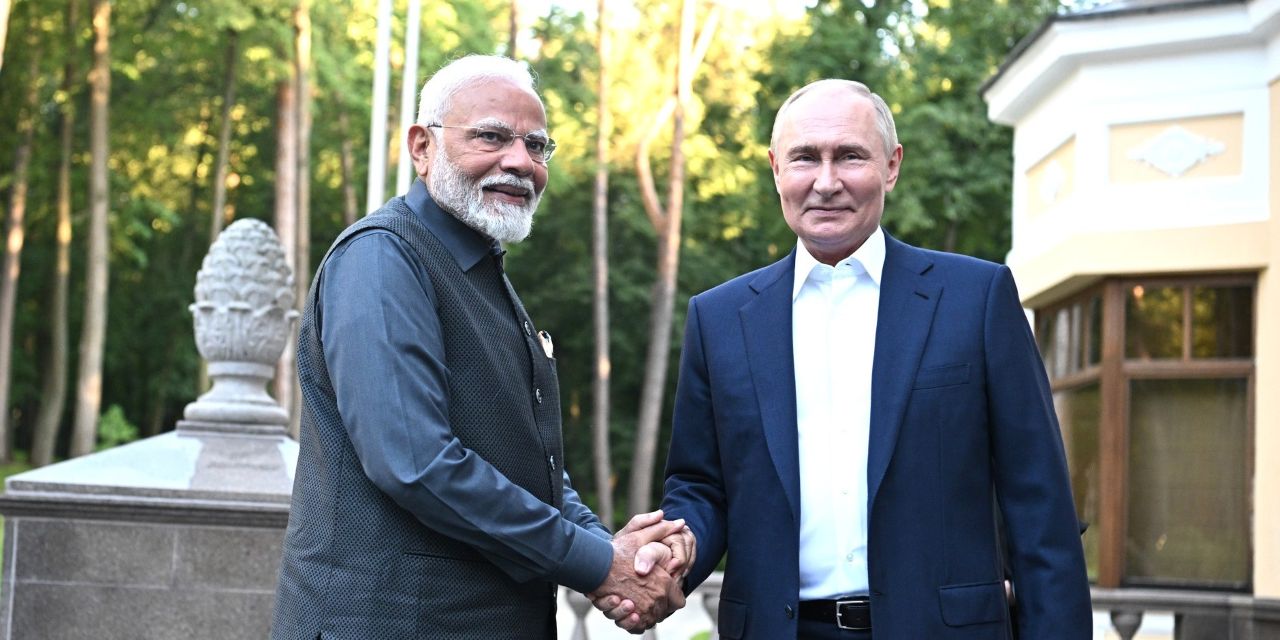
Image: Russian Presidential Press and Information Office / Wiki Commons
Russia’s President Vladimir Putin, despite being under international criminal indictment for war crimes, arrives today to begin a two-day official visit to India. In an extraordinary act of foreign interference in a friendly country’s bilateral relations with a third country, the French, German and British envoys published an op-ed in The Times of India on Monday that was highly critical of India’s continued close relations with Russia. Taking strong exception, former Foreign Secretary Kanwal Sibal attacked the ‘vicious’ op-ed in a post on X as “a diplomatic insult to India’ that ‘breaches diplomatic norms.” It amounts to “interference in our internal affairs as the purpose is to fuel anti- Russian sentiments.”
While I would not use such strong language, Sibal is not far wrong in the substance of his critique. An MEA official offered a milder but still pointed public rebuke: “It is not an acceptable diplomatic practice to advise India’s foreign relations with a third country.” Imagine if, on the eve of President Donald Trump’s visit to the UK on 16–18 September, PM Narendra Modi had published a joint op-ed in The Times (London) with presidents Cyril Ramaphosa and Luiz Inácio Lula da Silva, casting aspersions on the UK for hosting a president who has recklessly roiled the world’s multilateral and trade orders. Perhaps the Europeans are suffering from relevance deprivation syndrome with nostalgia for the lost world of colonialism?
Independence confers on former colonies both the right and the responsibility to set their own moral compass in foreign policy that strikes the best balance, in the context of their specific circumstances, between the interests of their people and that of foreigners, between the economic and geopolitical interests of their country and the principles that underpin world order, and between their recent past and desired future trajectory. They can no more outsource these calculations to Europeans than France, Germany and Britain would dream of outsourcing the delicate and sensitive task to Brazil, India, and South Africa. This includes assessments of conflicts in overseas jurisdictions, their implications for one’s own country, and the best policy response.
Looking back, Russia has been India’s most reliable, dependable, and friendly external great power since independence, bar none. US arms to Pakistan have been used in wars that killed Indian soldiers, never the other way round. No Russian arms have ever been used against India. Leading Western countries, not Russia, have imposed sanctions on India periodically for the refusal to bend its foreign policy to their will. China has fought episodic wars and run interference on behalf of Pakistan against India’s efforts to put Pakistan in the international doghouse for culpability in cross-border terrorism. Russia has been the mainstay of arms imports for decades and often had India’s back at the United Nations, including in 1971 when the West shamefully opposed India’s military intervention to end the genocide underway in what is now Bangladesh.
Looking ahead, however, the share of Russian arms in India’s imports have halved from their peak as India diversifies to the US, France, and Israel. But history cautions against dependence on Western imports while India’s economic future demands deepening engagement with Western markets, investors, and entrepreneurs.
More importantly, the global geopolitical and geo-economic tectonic plates are shifting. The liberal international order, which was established by the US-led West that dominated the world’s geopolitical, legal, financial, trade and technological architecture, is crumbling. With wealth and power shifting from the West to the East, the rising powers assert the right to a commensurate share in the design and control of global governance institutions. This has generated unease and discomfort in most Western countries, as reflected in the three envoys’ op-ed.
Source: Supplied by the author
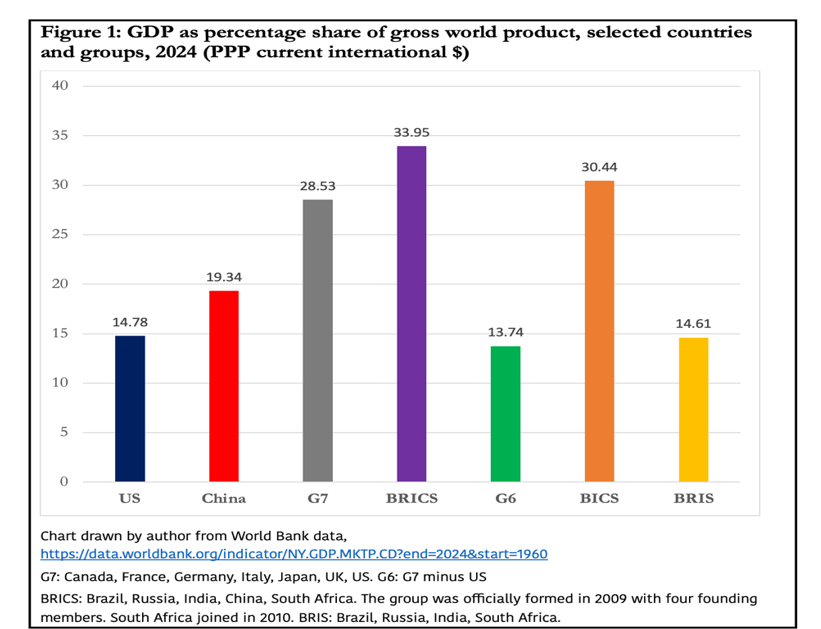
As shown in Figure 1, the BRICS grouping of emerging market economies (Brazil, Russia, India, China, South Africa) accounts for a larger share of the world’s economic output in purchasing power parity (PPP) dollars than the G7 group of industrialised countries (Canada, France, Germany, Italy, Japan, UK, USA). BRICS has now grown with the addition of Egypt, Ethiopia, Indonesia, and the UAE in 2025. As an article in the Financial Times put it: “This is the hour of the Global South.”
The dominance of the US in the decades after the Second World War was exceptional. In this period, the US accounted for between 35-40 per cent of global economic output. In the last fifty years, the US share has more or less held steady between 25-30 per cent of the world’s GDP. But this is not true of the rest of the major Western economies. That is, the decline in the G7 dominance of the world economy is due not so much to the US as to the other six. The BRICS-5 have a larger share (24.6 per cent) of global output than the G6 (18.1 per cent) even in market exchange rates.
Their rise is even more dramatic in purchasing power parity (PPP) dollars. On this measure the BRICS-5 are significantly ahead of the G7 (34-28.5 per cent) and 2.5 times that of the G6. Furthermore, if we take away China from the BRICS group, then the BRIS-4 still have a higher combined share than the G6 (14.6-13.7 per cent).
Of course, the major driver of the rest is the phenomenal economic performance of China. On market exchange rates, it has climbed from between 1.6 per cent and 3.5 per cent of world GDP in 1961–90 to 17 per cent in the 2020s as the world’s second biggest economy. The rise is even more startling in PPP dollars (Figure 1). On this measure, China’s share of world GDP is nearly five percent more than that of the US.
As economic giants, relations between China and the US structure the emerging world order and frame the nascent geopolitical contest. But the decline of Europe and the rise of the rest mean that the emerging contest as the world’s default mode shifts from multilateral cooperation to multipolar competition is likely to be triangular, between what Finland President Alexander Stubb in Foreign Affairs (2 December) dubs the global West (US, NATO), the global East (China, Russia, North Korea, Iran) and the global South. And because the parameters of the West–East competition are fixed, it is the global South’s choices that “will decide whether geopolitics in the next era leans toward cooperation, fragmentation, or domination.”
The global South’s framing and interpretation of the Russia–Ukraine conflict is fundamentally at variance with the West’s dominant narrative. In their perception, the US encouraged and facilitated the Maidan revolution in 2014 that ousted Ukraine’s elected president and replaced him with Washington’s choice. What Western leaders projected as a moral crusade cut across Russia’s vital geopolitical interests and directly threatened its strategic perimeter on land and in the Black Sea, while also shattering Ukraine’s delicate internal equilibrium between majority Ukrainian and the substantial Russian minority populations. This is why much of the global South rejects the West’s moral framing of the war as Russia the bad aggressor and Ukraine the heroic defender. The ambivalence over origins, causes and degrees of all-round culpability in turn frame policy responses that prioritise direct national interests over fidelity to so-called global norms that only the West gets to establish and enforce.
It is foolish therefore for three leading European countries to needle India needlessly by publicly criticising its relations with Russia on the eve of Putin’s visit.
Related articles:
Trump’s Attacks on BRICS Could Strengthen Its Cohesion (3-minute read)
Exclusive Geopolitics and Its Costs In Terms of Peace Policy (3-minute read)
Squaring the Circle (3-minute read)