Yemen: An Aborted Democratic Dream
Nabil Al-Bukairi
March 03, 2026
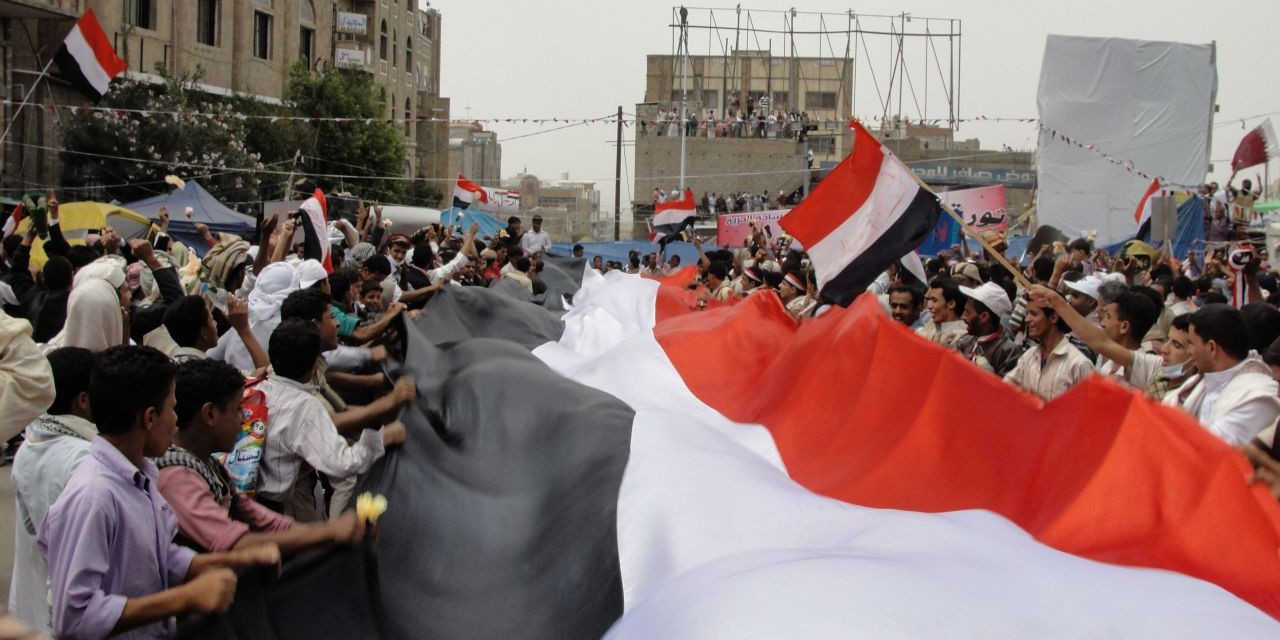
Image: akramalrasny/ shutterstock.com
This report analyses the challenges in Yemen which has for fourteen years suffered from the problem of aborted democratization. This is aggravated by acute and continuous state failure. After a discussion of state fragility since the popular uprising of 2011, the report outlines what is needed in Yemen. This includes a process of national reconciliation without which no democratization will be ever possible, to revive the National Dialogue begun in 2013-14, a strategy of stabilization, and a development and social justice vision to prevent further state collapse.
Contents
- Executive summary
- Introduction
- 1. Unification and fragile democratization (1990–2010)
- 2. The uprising and the aborted transition following the 2014 Coup (2011–14)
- 3. NDC failure and civil war
- Recommendations
- Conclusion
Executive summary
Since 2012, Yemen has followed in the footsteps of its neighbouring Arab Spring states. Like them, Yemen has for fourteen years suffered from the problem of aborted democratization. This is aggravated, in the case of Yemen, by acute and continuous state failure. Globally, there are many examples of regime collapse, and Yemen counts among them. This raises critical questions about:
a) The twin collapse of the 2012 transition process that followed Yemen’s popular 2011 uprising and of the unitary state.
b) That uprising was a catalyst for the resignation of President Ali Abdullah Saleh who had ruled the country for 32 years. In February 2012, a caretaker president was selected rather than elected: Abed Rabbo Mansour Hadi. Hadi assumed the presidency, backed by international recognition (UN, Arab League, the Gulf Cooperation Council (GCC), and the US and its allies).
c) In September 2014, the Houthi rebels and forces loyal to ousted President Ali Abdullah Saleh occupied the capital, Sanaa. This event was a turning point. For many Yemenis who were behind the 2011 uprising, it marked the abortion of the much-vaunted transition that launched in February 2012 when President Saleh was forced to resign and President Hadi succeeded him.
d) Neither President Hadi nor his international backers helped Yemen steer a sustainable transition process through the 2013–14 National Dialogue Conference (NDC) whose recommendations for a constitutional drafting committee and democratic elections never saw the light of the day. In this regard, the NDC’s deliberations produced no lasting peace as the civil war continued, causing one of MENA’s worst humanitarian crises. Moreover, the NDC was not able to realize a democratic transition (including the possibility of a federal political system). The civil war, the Houthis’ takeover of major cities by force, distrust and power struggles amongst various elites aggravated the North–South divide, and interventions by Western powers and Gulf states did not help the situation.
e) With the benefit of hindsight, it may be noted that the 2015 Saudi-led coalition made up of mostly GCC states, and backed by the US and its European allies (e.g. UK and France) which launched “Operation Decisive Storm” achieved close to nothing in terms of reconciling Yemenis, restoring the country’s unity or the transitional process begun in 2012. The Houthi [1] rebels have not been ousted, President Hadi remains powerless, the North-South divide is militarized and much worse than ever before, and the humanitarian crisis has not subsided.[2]
Firstly, Yemen desperately needs a process of national reconciliation without which no democratization will be ever possible. It is the only way to rebuild relationships between different elites, groups, sects, and regions to enable a secure future for all Yemenis. Secondly, Yemen needs to entrust national dialogue to its people, leaders, and elites, by reviving the National Dialogue begun in 2013-14. There are relevant international models, including South Africa’s reconciliation framework of 1990–94.[3] Thirdly, the 1998 Northern Ireland’s Good Friday Agreement’ presents war-torn Yemen with a practicable model for conflict resolution and mediation between opposing political actors. Fourthly, a strategy of stabilization must demobilize militias and / or integrate them into a post-conflict national army. International examples (e.g. the Democratic Republic of Congo) are encouraging.[4] Lastly, Yemen needs a development and social justice vision to prevent further state collapse. Social justice is a prerequisite for national reconciliation. It would also create a foundation for the resumption of democratization in the future. These measures must be sensitive to the Yemeni context and draw lessons from international examples.[5]
Introduction
For twelve years after a failed democratic transition, Yemen has suffered the risk of collapse. It remains intensely divided and plagued with violence, economic ruin, even famine, and extremely weakened governance owing to state fragility.[6] Following the 2011 Arab Spring, Yemen’s transition is not comparable to that of Egypt or Tunisia. Those of Egypt and Tunisia temporarily facilitated democratization processes (new constitutions, parliamentary and presidential elections). Yemen faced a different set of challenges owing to a number of factors: tribal, political, social, economic and security contexts. Yemen’s transition lacked elite cooperation, morphing into a civil war, a humanitarian crisis, and the ongoing risk of total state collapse.
As Kohr notes, collapse may be defined as a form of slow or rapid breakup of political institutions, coupled with social and economic instability.[7] Its features are a) absence of a centralized political authority, b) declining functional political and economic institutions, c) civil war and deepening North–South divisions, d) weak social cohesion, and e) increased foreign meddling. Yemen’s collapse has become more acute since 2014, following Houthi rebels’ takeover of Sanaa and resulting divisions and political struggles. The result is a spectre of uncertainty, none of which is amenable to democratization. The takeaway in the analysis is that Yemen never achieved a comprehensive democratization process to slide back from.
At the time of writing, the push for de-escalation and a peace process involving all warring sides in the country has so far resulted in no change in the festering situation. The Arab League of States and most states in the world recognize President Hadi to be the legitimate authority and the Houthis to be rebels forcibly controlling the capital and other cities in Yemen. The Yemeni delegate in the UN had this to say about the collapse of political authority and the Houthis back in August 2025. “Yemen today is at the threshold of a difficult era after 11 years of a war waged by the terrorist Houthi militia against the State and its constitutional bodies… they aim to drown Yemen in an unprecedented economic and humanitarian crisis”, pointing to the “flagrant interference by the Iranian regime in Yemeni affairs.”[8]
Challenging political events and heightened polarization have condemned Yemen to de-democratization on many fronts and dangerous bouts of strife and conflict. The ongoing North–South division is only one facet of such strife that continues to disrupt any return to normalcy, politically, socially, and economically. No country from the original Arab Spring ‘democratizers’ suffers nowadays worse civic and democratic erosion, not to mention vulnerability on many fronts.[9] Discussing de-democratization in the context of Yemen would be an understatement given the complexity of the strife experienced by Yemenis since their country plunged into civil war.
Yemen’s de-democratization can be argued to have been undermined by two systemic shifts in Yemen’s political history. The first was related to the 1990 unification and rising internal power struggles, a dominant-party system, and the subsequent 1994 military clashes between the forces allied with Ali Abdullah Saleh of the north (President of the unified Republic of Yemen), and Ali Salem al-Baidh of the south (who was at the time Prime Minister).[10] While there were early efforts to share power through the 1993 parliamentary elections, tensions between the newly-unified North and South disrupted that first attempted transition to unification and democratization. As a result of power struggles, the former Southern elites wanted to pursue secessionist politics, thus deepening political fragmentation. The country then evolved into a semi-authoritarian regime, and the ongoing civil war further fractured the state. The constitutional frameworks, which were established to create a form of parliamentary democracy, did not prevent secessionist tendencies and the 1994 war.
The second was the 2011 Arab Spring mass protests that created openings for democratic reforms, including the 2012 presidential elections, which sealed once and for all the fate of the ousted president. However, instead of democratization, the country found itself in the throes of polarization as sectarian politics reared its ugly head with the Houthi insurgents disrupting Yemen’ transition through use of force and occupation of the Sana’a, the capital city and seat of government bodies.
The first section details the process of dual transition (state-building and democratization) following the 1990 unification. Early institutional weaknesses, patronage politics, and exclusionary governance were key systemic weaknesses. This was aggravated by the 1994 civil war and its long-term consequences for political inclusion, social cohesion, functional institutions, and trust. The article then shifts focus to the Arab Spring and the Aborted Transition (2011–14), highlighting the 2011 short-lived mass-based movement for reform and democratization, following the uprising and the ouster of President Ali Abdullah Saleh. The last section briefly focuses on failed National Dialogue processes, plunging the country into more violence and systemic collapse.
1. Unification and fragile democratization (1990–2010)
One assumption guiding the analysis in this section rests on the idea that flaws in the original foundational design of unification may have limited democratic consolidation from the outset.
In 1990, a new Republic of Yemen was born. North and South Yemen unified, raising hope for a democratic system. The new constitution enshrined a multiparty democracy and even a market economy. This unification was influenced by the end of the Cold War, the discovery of oil, and the desire for a strong Yemen in the Gulf region.[11] Despite the 1992 new constitution[12] enshrining democratic rights, tensions between the former North and South and other factors eventually led to the 1994 civil war.[13] The failure of this first test in a long-awaited and promising project of unification undermined democratic transition in Yemen. The power struggle between the two partners of that project of Yemeni unification, the General People’s Congress (GPC) and the Yemeni Socialist Party (YSP), led to erosion of that initial democratic process and experiment. If Yemeni democracy was the main ‘victim’ of failed unification, the victor was then President Ali Abdullah Saleh. He sought to create a façade of democracy lacking many of the objective conditions necessary for credible democratization. Political forces found themselves divided and marginalized. Exclusion of major parties was coupled with fragmentation. The former Arab Socialist Ba’ath Party split into two factions, and the Nasserist Party divided into three factions after 1994. Saleh’s autocratic regime promoted party disintegration.[14] The Yemeni Rally for Reform (the Islah Party, close to the Muslim Brotherhood in ideology[15]), paid a price for its alliance with Saleh’s GPC. The Islah was at the time advocating Islam as the sole source of legislation, rather than the primary source. The main point here is that the Islah party’s alliance with Saleh contributed to the weakening of the entire democratic process, as the political scene deteriorated due to authoritarian politics and armed conflict. This conflict got worse with the Houthis’ takeover of power in 2014, which then led to a Saudi-led Gulf forces military intervention in 2015.[16]
The bright spot of this period remains the 1993 multiparty elections. They shook the entire political order in neighbouring GCC states, which had patrimonial systems with a single hereditary ruler. Only Kuwait already had its own parliament and periodic elections. The 1993 Yemeni election was, by any standard, one success story of the unification period. Three parties emerged as the key contenders for power-sharing: the dominant one was Saleh’s General People’s Congress (GPC): it won 122 seats of the 301 Council of Deputies (Majlis Al-Nuwwab), Yemen’s parliament. The Yemeni Alliance for Reform, Islah Party won 62 seats; and the Yemeni Socialist Party (YSP) came third with 56 deputies. Of the 48 independents who entered parliament, 21 joined the GPC and 12 allied with the YSP. One flaw of that early promising experiment was that “The three big parties have made it practically impossible for opponents to enter the Chamber of Deputies”.[17] In regional terms, the northern parties, the GPC and Islah, practically controlled the new state. This was to the detriment of unification[18] as the erstwhile partner of unification, the southern YSP, grew uneasy about its second-class status in the new unified republic. A political rift emerged after the 1993 elections and civil war in 1994, fuelled by the political and economic marginalization of southern communities. The rest is history: the 1994 civil war and the subsequent secessionist movement by the southern side, which lost militarily to the north.[19] In any case, as Detalle puts it, “The fact that elections were held constitutes in itself a victory for a process of democratization that started after unification. Whatever one might say about the manner in which the elections took place, everyone sees this as a first step. The coalition government constitutes the best solution to maintaining political stability in the country, despite the reticence of some of the Socialists.”[20]
THE 1997 PARLIAMENTARY ELECTIONS
The April 1997 elections, the second parliamentary elections in Yemen were held under dire political conditions following the repercussions of the 1994 summer war,[21] which severely damaged the democratic experiment of 1993. These elections highlighted the extent of the disruption to the political process and the regression of the democratic experiment. The absence of the southern YSP, one of Yemen’s three major parties and a key instigator and partner of the 1990 unification, along with several of its allies, allowed the GPC to dominate the elections and secure a larger share of parliamentary seats. In these elections, with the YSP’s boycott, the GPC won approximately 187 out of 301 seats, which is nearly 63 per cent of the votes. The Islah Party came in second with 53 seats, or 17.6 per cent, while independents secured 61 seats, or 20.3 per cent, most of whom later aligned with the GPC. A key issue was that the YSP’s boycott raised questions about the legitimacy of the electoral process in its entirety, due to the absence of a major party. Additionally, the Islah Party’s parliamentary share declined, and the state’s resources were heavily mobilized in favour of GPC candidates. This was viewed as a factor undermining the integrity and transparency of the 1997 elections and can be read as a form of initial democratic erosion. A more serious concern was that the YSP’s boycott was due to a new, general sense of grievance among the party and its southerner constituency. This further tarnished the image of Yemen’s second elections after the 1990 unification.[22] The patronage politics of Saleh and the GPC did not bode well for stability, much less democracy.
THE 2003 YEMENI PARLIAMENTARY ELECTIONS
The Yemeni opposition, through the formation of the Joint Meeting Parties (JMP) coalition, launched a cross-partisan initiative bringing together diverse political forces to revive the democratic process.[23] The JMP sought to form an electoral bloc in response to the dominance of the ruling GPC, but the GPC used state resources to maintain its status and ensure victory at the polls for its deputies. While the April 2003 elections represented an opportunity to confront the GPC and the JMP worked to produce electoral lists, the results were disappointing, as the GPC swept the board. This further undermined the democratic process and the agreement between the government and the JMP to pave the way for free and fair elections.[24] The GPC secured approximately 179 of the 301 parliamentary seats, while the JMP opposition alliance won 59 seats. These were distributed as follows: 43 seats for the Islah Party, eight for the Yemeni Socialist Party (YSP), and three for the Nasserist Popular Unity Organization. These were the last parliamentary elections held in Yemen to date.
2. The uprising and the aborted transition following the 2014 Coup (2011–14)
Spurred by uprisings in Tunisia, Egypt, and Libya, on February 11, 2011, Yemeni youth took to the streets, demanding the ousting of dynastic and corrupt ruling elites. The widespread participation of Yemenis across the country’s geography demonstrated a growing democratic consciousness. Yemeni women’s stature in the Arab Spring rose through their active participation in mass protests, social media activism, and their role in organizing and sustaining the hirak or anti-authoritarianism movement.[25] Those gains and others like unification and the promising democratization of the 2000–03 period were all undermined by subsequent political developments that led to setbacks for Yemeni defenders of good government, equality and human rights. Views of Yemeni society as being in a state of “permanent crisis”,[26] and tribalism did not prevent Yemenis from staging some of the most vibrant protests of the 2011 Arab Spring uprisings.[27] Women and men, students and civil society activists played key roles in demonstrations, using new technologies to represent widely diverse voices of dissent against injustice and autocracy. Today, many experience disappointment given the post-conflict political landscape, and the erosion of their dynamic activism and overall presence in government public life. Al-Sakkaf observes that “Yemen’s civil society has experienced a serious blow that erased two decades of effort and will continue to affect the post-conflict country for decades more.”[28] Such a blow is visible in the atrophy of the National Dialogue Conference (NDC) to advance public and youths’ demands for democratization. The 2011 uprising marked the start of a shaky two-year transitional period under President Abdu Rabbu Mansour Hadi. The NDC was a GCC and UN-backed instrument for managing the intense political instability peacefully whilst addressing the very grievances that triggered the uprising.
Yemen’s proximity to the GCC countries has had benefits (aid, employment for Yemeni workers) and drawbacks (a degree of control by the Kingdom of Saudi Arabia (KSA) over its domestic and international politics). The aftermath of the 2011 Yemeni uprising illustrates this complexity. The GCC led by KSA played a pivotal role in mediation of disagreements between the country’s political elites and the emerging forces, especially the youths whose uprising created dynamics of change unseen in Yemen and the Gulf region since the 1990 North–South unification. The mediation branded ‘the Gulf Initiative’ overtly sought to facilitate a peaceful transitional phase for Yemen. Its objectives seemed at the time achievable: a) find an agreeable modality for an honourable exit from power by President Ali Abdullah Saleh; b) avoid bloodshed amongst historically warring political forces; c) include Yemen’s newly empowered youths (including ‘The Youth Coordinating Council of the Revolution for Change’ and ‘The Homeland Party’ ) in negotiations and account for their demands for transitional justice and democratic reforms; and d) prevent state disintegration and institutional collapse. These points sum up the transitional agenda to map up Yemen’s protection of its sovereignty whilst preventing a return to authoritarianism, as was the case under the previous 32 years of rule under President Saleh.
Covertly, since its creation in 1981, the GCC was interested in security as one of its chief political values. Those values did not include democratization, in any shape of form, as mentioned above with the qualified exception of Kuwait. This has relevance for understanding four interrelated points.
- Firstly, Yemen’s transition did not arrive at the stage of elections and a new constitution. Both were still being planned through negotiations within the NDC, which eventually fizzled out despite a promising start in the 2013–14 period.
- Secondly, there were limits to the GCC Initiative and elite-negotiated arrangements, including elites dependent on GCC backing and funding (that includes President Hadi, the agreed replacement in 2012 for his predecessor, Ali Abdullah Saleh, and some Islamist actors whose Salafist ideology shared many ideas with Saudi Arabia’s Wahhabi doctrine of Islam, e.g. primacy of Islamic law). This is at the core of why the agenda of democratic reforms widely endorsed by Yemeni groups and factions never took off.
- The GCC had its own agenda: prioritizing short-term stability over accountability narrowed democratic possibilities for Yemen. This is in spite of the fact that the GCC Initiative must be credited with endorsement of the NDC as the right forum for Yemeni reconciliation and protection of national unity.
- Lastly, GCC concern with stability overrode the Yemeni youths’ democratization ambitions. Thus, it may be said that Yemen was charting two opposed routes for reconciling deep differences between the country’s political factions, for safeguarding the state from collapse, and for ending authoritarian rule. The youths and new forces represented in the NDC 2013–14 meetings, which aimed to end authoritarian rule, were partly headed on a course of collision with the ‘GCC Initiative’, which framed the transition process in security terms, indifferent to democratization.
The NDC’s civic and democratic spirit lay in its pluralist composition, which included forces with clashing agendas at times. For example, whilst the newly empowered youth reform movement shared with participants from the South or the Houthis (also known as ‘Ansar Allah’) the quest for a new social contract, they did not see eye to eye on the actual elements to be included in such a contract. When Al-Qaida, tribal and regional factors, and armed militias were added into the mix, the chances for accord diminished markedly. Nonetheless, the NDC forum embodied a democratic spirit, as demonstrated in unprecedented negotiations for ten months.[29]
Its convenor was President Hadi. Some of the plenary sessions resembled the ‘truth and reconciliation’ meetings of South Africa. Representatives were free to express criticisms of wrongs committed by the regime over three decades with total impunity. Injustices were vocalized by all kinds of groups, including the Houthis who fought ‘six wars’ with the ousted regime, the South with its own set of grievances and war with the state in 1994 after unification with the north, and other aggrieved parties from the youth movement and civil society.[30]
Thus, the hirak, or mass-based reform movement born out of the Yemeni youth uprising and the NDC, helped save the state from collapse and created democratic openings, but these were not seized upon to unify the country and advance democratization. [31]
One democratic feature present in the NDC was the pluralist representation drawn from eleven constituencies. The ‘Technical Committee’ adopted an inclusive formula that sought to ensure wide representation from three constituencies or sectors: women (30 per cent), youth (20 per cent) and the South (50 per cent)—this latter being an incentive to encourage the South to abandon ambitions to from its own state.[32] Political parties (including the former ruling party, the General People’s Congress, and its affiliate parties), among other political parties, had 263 seats. Independents had another 62, all of whom were appointed by President Hadi, the NDC’s convenor who sat in the Presidium of the conference.
Table 1. Representation in NDC for Marginal and / or New Forces
| Constituency | Number of seats |
|---|---|
| Women | 40 |
| Youth | 40 |
| Civil Society | 40 |
| Houthis | 35 |
| Peaceful Movement/Hirak of the South | 85 |
Moreover, it is worth pointing to the presence of youth, women, and the South in decision and consensus-making committees and working groups. For example, one woman sat in the nine-member ‘Presidium’ headed by the NDC’s convenor, the country’s new president. The same goes for another important NDC organ, ‘the Consensus Committee’ composed of the Presidium, the heads of each Working Group and six individuals sitting in the ‘Technical Committee’. The key point here is that as a newly empowered stratum of Yemeni civil and political societies, women and youth were represented at all levels of the NDC hierarchy and were even assigned roles as Working Groups’ chairs.
3. NDC failure and civil war
The NDC deliberations on Yemen’s transition relied on dialogue and pluralist representation. It failed, however, as its final document (endorsed by the UN’s envoy to Yemen) was not implemented. There were agreements but the disagreements were such that the final report remained as ink on paper: a “non-conclusion”, as put by the Foreign Policy’s Stephen Day.[33] The tasks assigned to the ‘Southern Issue Working Group’ and the ‘Sa’ada Issue Working Group’ proved tough and their problems insurmountable. Dozens of meetings did not deliver a formula for accommodating ambitions by the South for more autonomy, possibly in a federal system. The six-region federal formula pushed by President Hadi was not acceptable to several parties, including the Houthis and the South. Some rejected the principle altogether, some objected that the federal division proposed made them landlocked, and others criticized the maldistribution of resources. As articulated at the time by Ali Saif Hussain, a known Yemeni observer, “This reluctant consensus on a federal state, whether of two or several provinces, has remained unpopular in both the south and the north. Meanwhile, in this federal tug-of-war, southern and northern negotiators try to pull the rope as hard as they can in opposite directions – for something resembling the restoration the former southern state at one end, to something resembling a local government system at the other.”[34] The same goes for the ‘Sa’ada Issue Working Group’: the Houthis were not satisfied with any of the suggested plans for inclusivity articulated in principles for freedom of worship and conditions of disarming. These two major groups did not attend the last NDC meetings—an omen of worse things to come. As noted by Schmitz “A much more brutal struggle for physical dominance [was at the time] taking place outside the halls of the Movenpick Hotel [where the NDC held its meetings] that may have more to do with the future balance of power in Yemen.”[35]
The alliance between Saleh and his party with the Houthis was short-lived. Yemen descended into a devastating civil war triggered by the Houthi coup of 2014, supported by remnants of Saleh’s regime, which opposed the outcomes of the National Dialogue and the draft constitution. This alliance soon turned into an armed confrontation, during which the Iran-backed Houthis eliminated Saleh and seized control of the Yemeni capital, Sana’a, a control they maintain to this day. Yemen’s revolution and initial democratization process thus remains hijacked.
Recommendations
The Yemeni conflict is too complex to reduce it to a North–South or Sunni–Zaidi rivalry. What has unfolded since 1994 and again since 2012 results from the wide-ranging problems that preceded the 2012 GCC-brokered deal and the ouster of former president Saleh. Yemen does not exist today as a unified and sovereign state. While democracy can serve as a value framework to reconcile Yemenis across sectarian and regional divides, the country’s current vulnerability stems not from the politics of transition per se, but from the failure to achieve both national unity and a democratic system. A resolution to the Yemeni miasma, division, power struggles, secessionism, and instability necessitates a number of interconnected actions, as suggested in the following recommendations:
- As a conflict-affected country facing multidimensional challenges, Yemen requires national reconciliation alongside a parallel process for rebuilding state legitimacy, strong political institutions, and security as essential conditions for smooth and sustained democratic transition. Fragmentation and weak institutions have empowered regional and sectarian authorities at the expense of law-based institutional strength. In particular, fragmented power and weak state institutions that have fanned Yemen’s civil war and elite power struggles, causing devastation,[36] hundreds of thousands of deaths, starvation and foreign intervention.
- Public trust and support for state legitimacy must be reconstructed. Whilst external mediation and frameworks, including by the UN and the GCC, can play a role in peace-building, Yemenis’ endorsement of any framework for peace and reconciliation is a key condition. External meddling and intervention, via use of force (e.g. the Saudi-led Arab Gulf forces that failed to prevent the Houthis’ takeover of power and failed), diplomatic pressure (e.g. UN resolutions), or economic sanctions do not guarantee reconciliation or democratic transition. Nothing can replace local dialogue and knowledge of the specific conditions that preceded the events of 2014-15.
- Reconciliation, unification, and democratization should be modelled on processes such as the Irish ‘Good Friday’ formula of 2008.[37] Central to this approach is a vision of peaceful power sharing as inspired by the pragmatic centrism embodied by the Good Friday Agreement as well as Colombia’s peace process. Yemen’s future peace agreement does not have to mimic these efforts. It can, however, draw inspiration from their practical lessons in terms of popular input and referendums on the final peace draft’s concrete policies for ending the conflict. This could lead to inclusive negotiations involving all Yemenis, a general amnesty from legal persecution for warring parties and political elites, and UN–Arab League mediation with Riyadh or Oman serving as a capital for conducting negotiations. Such a process could ensure elite consensus for a transition out of the conflict and into re-unification, democratic power-sharing, and reconciliation.[38]
- Integration of individual militiamen or whole military units and security forces allied with regional and sectarian rulers into a national army would help restore stage legitimacy and guard peaceful transition in Yemen. Integration in this instance should be coupled with a larger security sector reform (SSR). Such a strategy could encourage disarmament and demobilization, steps which are vital for peacebuilding. Examples from Iraq and Syria can be examined for further guidance on this front.[39]
- Yemen’s economic crisis must be addressed, as it has undermined stability and public trust, and played a major role in the post-2014 political collapse. Scaling up a social justice and development programme must be anchored in state-led development short-term and long-term plans to revive the economy, resolve the food crisis, and kickstart economic development, with UN and international assistance. In this respect, realization of such plans must implement concrete measures from the UN’s Millennium Development Goals (MDGs), especially with regard to the goal of “eradicating extreme poverty and hunger”.[40]
Conclusion
The report has examined the nature of state dysfunction and collapse in Yemen. The aim was to pinpoint clues to understanding the context within which incipient democratization processes faltered and were eventually overtaken by dynamics of conflict, domestic and international. The tragedy of Yemen is that the ‘entrepreneurs’ of violence, domestic, regional, and international have drowned the voices of freedom and dignity of the courageous youths whose mass-based uprising and reform movement created unprecedented democratic openings.[41] Consideration of the different actors, divisions and struggles for power in Yemen has provided a means to address the important question of how de-democratization correlates with increased state dysfunction, instability, and, in the case at hand, of collapse. This collapse is today characterized by reduced centralized authority, caused by deep polarization, weak if not absent institutions, and humanitarian crises. A layer of complications stem from external involvement, including through use of force (the GCC 2015 war) or proxy violence enabled by a regional power (Iran’s arming of the Houthis). As a result, Yemen has for the past twelve years remained vulnerable to collapse, foreign control, authoritarian rule, and political stalemate. Against this backdrop, it is impossible for Yemenis to build democratic institutions and a participatory populace out of a collapsed and divided state. In a state where the central government has lost functional control and is failing to provide security to the people, resulting in widespread discord and a crisis of legitimacy, it is unrealistic to expect such collapse not to produce de-democratization, and overall systemic backsliding.
Notes
[1] The Houthis may be simply defined as a Zaydi Shia revivalist movement. However, it shares many similarities in jurisprudence with the Sunni Hanafi school. At times, the Houthis formed coalitions with various Sunni tribes and individuals who opposed corruption, foreign intervention (despite themselves getting support and arms from Iran) and economic and political marginalization. Many Sunnis accuse the Houthis of persecuting Sunni institutions, such as schools, and some hardline Houthis have expressed critique of key Sunni historical figures, fuelling sectarian tension between them and Sunnis in Yemen.
[2] Council on Foreign Relations, “Conflict in Yemen and the Red Sea,” 12 November 2025 in: https://www.cfr.org/global-conflict-tracker/conflict/war-yemen, [Accessed: 28 January 2026]
[3] National Economic Development and Labour Council/NEDLAC (South Africa), 5TH NEDLAC ANNUAL REPORT 2009/2010, “Social Dialogue A Catalyst For Social and Economic Development.” Johannesburg: NEDLAC, 2010. See, https://nedlac.org.za/wp-content/uploads/2020/12/Nedlac-2010.pdf, [Retrieved: 12 July 2025]
[4] Nat J. Colletta, “Interim stabilisation in fragile security situations.” In Stability, International Journal of Security and Development, Vol 1, No.1, (2012), pp.45–51.
[5] Eileen Babbit & Ellen Lutz (eds.), Human Rights and Conflict Resolution in Context: Colombia, Sierra Leone, and Northern Ireland. Syracuse, New York: Syracuse University Press, 2009.
[6] Larbi Sadiki, “The Crucible of Yemen,” Aljazeera, 22 May 2011. See: https://www.aljazeera.com/opinions/2011/5/22/the-crucible-of-yemen, [Retrieved: 21 October 2025]
[7] Leopold Kohr, The Breakdown of Nations. Cambridge: Green Books, 2001.
[8] United Nation Security Council, “Situation in Yemen ‘Deeply Fragile’ amid Ongoing Regional Turmoil, Special Envoy Warns, Urging Security Council to Support De-Escalation Efforts towards National Ceasefire.” Security Council – SC/16143, 12 August 2025, in: https://press.un.org/en/2025/sc16143.doc.htm, [Accessed: 28 January 2025]
[9] Giulia Soffiantini, “Food Insecurity and Political Instability during the Arab Spring.” Global Food Security, 2020. doi:10.1016/J.GFS.2020.100400.
[10] Marcus Montgomery, “A Timeline of the Yemen Crisis, from the 1990s to the Present,” 19 February 2021, Arab Centre Washington DC, https://arabcenterdc.org/resource/a-timeline-of-the-yemen-crisis-from-the-1990s-to-the-present/ [Retrieved: 15 July 2025]
[11] Charles Dunbar, “The Unification of Yemen: Process, Politics, and Progress”. In Middle East Journal Vol. 46, No. 3 (Summer 1992), pp. 456–76..
[12] WIPO, Constitution of the Republic of Yemen 1992 (Amended 2015), https://www.wipo.int/wipolex/en/legislation/details/19992, [Retrieved: 12 July 2025]
[13] Fred Halliday, “The third Inter-Yemeni War and its consequences.” Asian Affairs, Vol. 26, No. 2. (1995), pp. 131–40.
[14] Robert Burrowes & Catherine, M. Kasper, “The Salih Regime and the Need for a Credible Opposition,” Middle East Journal Vol. 61, No. 2 (Spring 2007), pp. 263–80..
[15] Jillian Schwedler, Faith in Moderation: Islamist Parties in Jordan and Yemen. New York: Cambridge University Press 2007.
[16] Kali Robinson, “Yemen’s Tragedy: War, Stalemate, and Suffering,” Council of Foreign Relations, 1 May 2023, See: https://www.cfr.org/backgrounder/yemen-crisis, [Retrieved: 28 September 2025]
[17] Renaud Detalle, “The Yemeni Elections Up Close,” MERIP, 20 November 1993, in: https://www.merip.org/1993/11/the-y emeni-elections-up-close/, [Retrieved: 21 September 2025]
[18] Stephen W. Day, Regionalism and Rebellion in Yemen: A Troubled National Union, Cambridge: Cambridge University Press, 2012.
[19] Sheila Carapico, “Yemen: Between Civility and Civil War,” in Augustus Richard Norton (ed.), Civil Society in the Middle East, Volume Two, New York, NY: E. J. Brill, 1996, pp. 287–316.
[20] Renaud Detalle, “The Yemeni Elections Up Close,” MERIP, 20 November 1993, in: https://www.merip.org/1993/11/the-y emeni-elections-up-close/, [Retrieved: 21 September 2025]
[21] The Summer War of 1994, as referred to in Yemeni political literature, or the War of Apostasy and Secession, as termed by the adversaries of the Yemeni Socialist Party (YSP) at the time, was a conflict that erupted following the 1993 elections in protest of their results and due to systematic assassinations targeting YSP cadres in the capital, Sana’a. The war lasted approximately two months, resulting in the defeat of the YSP, whose leader, Ali Salem Al-Baidh, announced secession and a return to the pre-unity state, though his forces had already lost the battle.
[22] Sarah Phillips, Yemen’s Democracy Experience in a Regional Perspective: Patronage and Pluralized Authoritarianism, London: Palgrave Macmillan, 2008.
[23] Michaelle Browers, “Origins and architects of Yemen’s Joint Meeting Parties”, International Journal of Middle Eastern Studies, Vol. 39, No. 4 (2007), pp. 565–86.
[24] Prior to the parliamentary elections and following the formation of the Joint Meeting Parties (JMP) on February 6, 2003, an agreement was signed between the Yemeni authorities and the opposition, represented by the JMP, to pave the way for free and fair elections under the supervision of the Supreme Elections Committee. The agreement, signed in mid-February, included provisions for enhancing transparency.
[25] BBC, “How women played a major role in Yemen’s Arab Spring,” BBC News, 30 January 2021, See: https://www.y outube.com/watch?v=N-6cYx3OBSo#:~:text=Yemen%20was%20one%20of%20the%20first%20countries,ruler%20Ali%20Abdullah%20Saleh%20to ppled%20from%20power, [Retrieved: 20 October 2025]
[26] Sarah Phillips, “Yemen and the Politics of Permanent Crisis, London: The Adelphi Series” (an International Institute for Strategic Studies publication), Number 420, July 2011.
[27] Laura Silvia Battaglia, “‘Yemen’s uprising was magical, spiritual, powerful,” Aljazeera, 27 April 2021, see: https://www.aljazeera.com/features/2021/4/27/yemens-uprising-was-magical-spiritual-powerful, [Retrieved: 21 September 2025]
[28] Nadia al-Sakkaf, “The Tragedy of Yemen’s Civil Society,” 19 February 2016, see: https://www.washingtoninstitute.org/policy -analy sis/tragedy -yemens-civil-society #:~:text=During%20this%20period%2C%20the%20diversity %20of%20civil,rights’%20based%20approach%20and%20a%20political%20focus, [Retrieved: 21 September 2025]
[29] The NDC negotiations lasted for 10 months, longer that the six months originally planned for the forum. It officially opened up on the 18th of March 2013 and concluded on the 25 January 2014. The timeline was extended to give the delegates extra time to resolve major differences such as the status of Southern Yemen (which wanted secession and this was rejected including by Gulf and International sponsors, namely, the US), state structure and the question of federalism, the terms of political transition and disagreements with the Houthis regarding past wars with the state.
[30] Ali Saif Hassan, “Yemen: National Dialogue Conference, Managing Peaceful Change,” in Accord, Issue 25, April 2014. See: https://www.c-r.org/accord/legitimacy -and-peace-processes/national-dialogue-and-legitimate-change/yemen-national#:~:text=The%20NDC%20has%20encountered%20major,did%20not%20make%20things%20easier, [Retrieved: 28 January 2026]
[31] Tobias Thiel, “Yemen’s Arab Spring: From Youth Revolution to Fragile Political Transition, LSE papers, 2012, in: https://www.academia.edu/1539006/Yemen_s_Arab_Spring_From_Youth_Revolution_to_Fragile_Political_Transition, [Retrieved: 28 January 2026]
[32] Charles Schmitz, “Yemen’s National Dialogue,” 10 March 2014, Middle East Institute, in: https://mei.edu/publication/yemens-national-dialogue/, [Retrieved: 28 January 2026]
[33] Stephen W. Day, “The Non-Conclusion of Yemen’s National Dialogue,” https://foreignpolicy .com/2014/01/27/the-non-conclusion-of-yemens-national-dialogue/, 27 January 2014, [Retrieved: 30 January 2026]
[34] Ali Saif Hassan, “Yemen: National Dialogue Conference, Managing Peaceful Change,” in Accord, Issue 25, April 2014. See: https://www.c-r.org/accord/legitimacy -and-peace-processes/national-dialogue-and-legitimate-change/yemen-national#:~:text=The%20NDC%20has%20encountered%20major,did%20not%20make%20things%20easier, [Retrieved: 28 January 2026]
[35] Charles Schmitz, “Yemen’s National Dialogue,” 10 March 2014, Middle East Institute, in: https://mei.edu/publication/yemens-national-dialogue/, [Retrieved: 28 January 2026]
[36] Asher Orkaby, “Saudi Arabia’s Other Yemen War: The Decades-Long Assault on the Yemeni Economy,” 3 November 2021, https://www.foreignaffairs.com/articles/saudi-arabia/2021-11-03/saudi-arabias-other-yemen-war, [Retrieved: 20 October 2025]
[37] Peter Gaber, “Belfast, Bogotá, and Beyond: The Good Friday Agreement as a Model for Conflict Resolution? .” Belfer Center for Science and International Affairs, Harvard Kennedy School, April 7, 2023.
[38] Volker Boege, Anne Brown, Kevin Clements, Anna Nolan, “Building peace and political community in hybrid political orders,” International Peacekeeping, Vol. 16, No. 5 (2009), pp. 599–615.
[39] Hamidreza Azizi, “Integration of Iran-backed armed groups into the Iraqi and Syrian armed forces: implications for stability in Iraq and Syria’, Small Wars & Insurgencies, Vol. 33, No. 3, (2022), pp. 499–527.
[40] United Nations, The Millennium Development Goals Report, New York: UN, 2015.
[41] Giorgio Cafiero, “Fighting recedes, but peace in Yemen remains distant,” Aljazeera, 7 July 2023, https://www.aljazeera.com/news/2023/7/7/analy sis-peace-yemen-remains-distant [Retrieved: 2 October 2025]

The Author

Toda Peace Institute
The Toda Peace Institute is an independent, nonpartisan institute committed to advancing a more just and peaceful world through policy-oriented peace research and practice. The Institute commissions evidence-based research, convenes multi-track and multi-disciplinary problem-solving workshops and seminars, and promotes dialogue across ethnic, cultural, religious and political divides. It catalyses practical, policy-oriented conversations between theoretical experts, practitioners, policymakers and civil society leaders in order to discern innovative and creative solutions to the major problems confronting the world in the twenty-first century (see www.toda.org for more information).
Contact Us
Toda Peace Institute
Samon Eleven Bldg. 5thFloor
3-1 Samon-cho, Shinjuku-ku, Tokyo 160-0017, Japan
Email: contact@toda.org