Why China Insists on the “Existing International Order”: The Politics of UN Centrality and Reform
Hao Wu
June 19, 2026
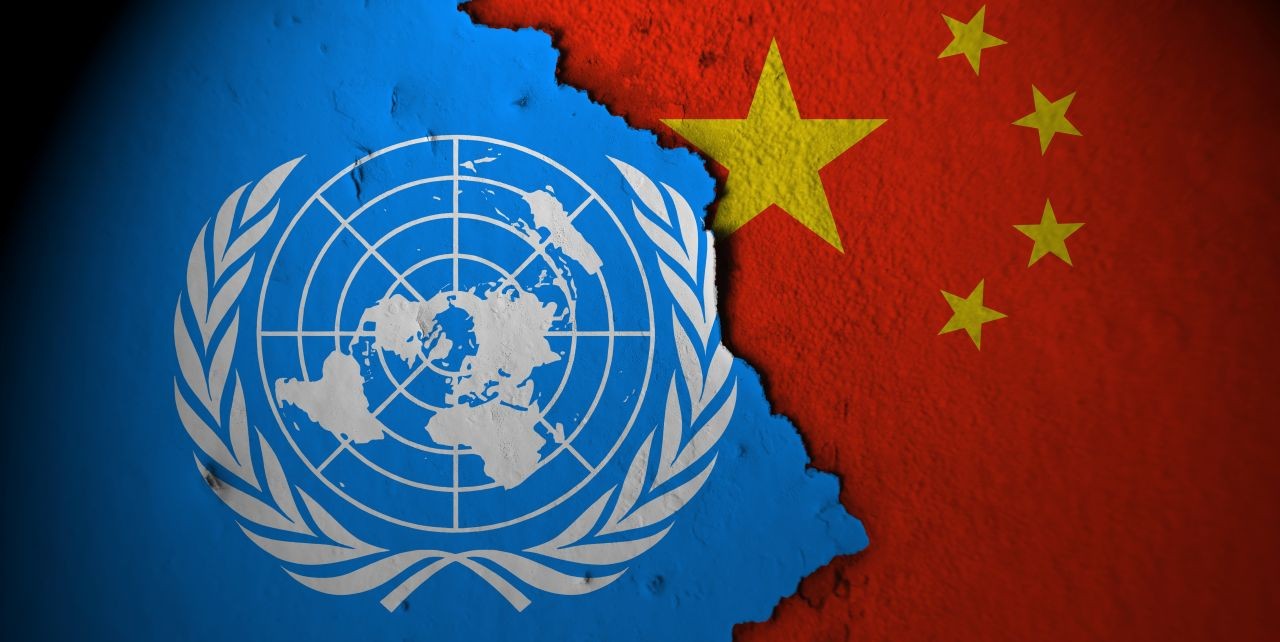
Image: Hapelinium / shutterstock.com
In May 2026, China held the rotating presidency of the UN Security Council, and Foreign Minister Wang Yi flew to New York to chair its centrepiece debate in person—a high-level meeting pointedly titled “Upholding the Purposes and Principles of the UN Charter and Strengthening the UN-centred International System”—before convening a “Group of Friends of Global Governance” two days later. Ministerial appearances of this kind are not unusual in themselves, especially for elected members of the Security Council. What is newer is China’s own embrace of the practice. Wang Yi, arguably one of the world’s busiest foreign ministers, was presiding in person for the second consecutive year, having long delegated such presidency months to China’s UN ambassador. The personal investment reads as advance work for a larger moment: Xi Jinping’s anticipated appearance at the UN during his scheduled September trip to meet Trump—his first state visit to the United States since 2015—and the rollout of the Global Governance Initiative (GGI), the newest of Beijing’s four flagship initiatives, which is still seeking wider international traction.
All this energy—the personal diplomacy, the Charter-defending language, the new initiatives—might sit awkwardly with an increasingly prevalent and, to Beijing, concerning discourse in the West: that China is revisionist to what the West calls the liberal international order, or rules-based international order, eroding the very system Wang Yi came to champion. There is something to the charge: divergence has been widening—over the South China Sea, over Beijing’s ever-closer relationship with Russia, and across a lengthening list of normative gaps. And yet China’s own perspective points the other way. Xi Jinping—in strong continuity with his predecessors since the reform-and-opening-up era—has consistently cast China as “a participant, builder, and contributor” and, more importantly, “a beneficiary” of the order: a stakeholder with every reason to defend and strengthen it rather than overturn it. This contrast is not cognitive dissonance, and it is not mere rhetoric. It turns on a nuanced distinction that is crucial to understanding China’s worldview.
Chinese leaders speak, with striking consistency, of the “existing international order” (现行国际秩序)—and never of the “liberal/rules-based international order.” The word choice matters. China and the West do not, in fact, inhabit two wholly separate orders: globalisation is too deep for that, and no genuine alternative order exists for either side to retreat into. What they inhabit instead is a single institutional landscape whose core bodies, rules and practices are deeply overlapping, but whose normative ordering is contested. For many Western governments, the same institutions are often embedded in a liberal or rules-based vocabulary that gives greater weight to democracy, human rights and the authority of like-minded coalitions. For Beijing, the vocabulary is deliberately thinner and more state-centred: sovereignty, non-intervention and developmental peace take precedence. Rhetorically, the difference turns on a single dropped adjective. By invoking the “existing” rather than the “liberal” order, Beijing sets aside liberalism—political liberalism above all—and is left with an order that appears ideologically neutral. And once liberalism is set aside, what sits at the centre of that shared, pared-down order is the United Nations, which Xi Jinping himself calls the “core” of the international order. Consequently, the UN is the largest common denominator between China and the West—the central pillar of the international order each can still recognise, even if they rank its norms differently.
That is why strengthening UN centrality has become one of the main objectives of contemporary Chinese foreign policy. Wang Yi’s five propositions in May—to revitalise the spirit of the Charter, the authority of the Security Council, development cooperation, the platforms of global governance, and the efficiency of the UN system—amount to a defence of the institution at the order’s core. To strengthen the UN’s authority and broaden its functions, China has sharply increased its financial contribution over the past decade: its assessed share of the regular budget rose from around five per cent in 2013 to roughly 20 per cent in 2025, making it the second-largest contributor after the United States. That its share has climbed even as its own economy slows—and even as the United States, under the Trump administration, has cut back its UN contributions—is a notable show of commitment, and gives real weight to Beijing’s support for UN centrality. In turn, China has sought to leverage its growing weight to nudge norms and agendas toward its own preferences. But influence has not scaled with its contribution: Beijing’s role in shaping outcomes and norms—in the Security Council and across the wider UN system—still lags well behind its formal status as a P5 member and one of the organisation’s most important contributors. This is especially evident in forms of informal institutional power: Chinese diplomats hold the pen on no Security Council files and remain underrepresented in key Secretariat posts.
This gap explains the second theme: reform, another of Wang Yi’s main emphases on his New York visit. In his speeches, he repeatedly called for reform of the Security Council, peacekeeping, and the General Assembly’s role. Reform, which China presents as amplifying the voice of the Global South, is therefore also a strategy for expanding Chinese influence—and the GGI is its newest instrument. However, the obstacles are formidable. The Council is arguably at its most polarised since the end of the Cold War, and Western resistance to any potential Chinese-led reform is correspondingly high. Another difficulty lies on Beijing’s own side: it is still on the learning curve toward becoming a norm entrepreneur. China has yet to articulate norms with the universal resonance needed to command broad acceptance beyond the Global South, and its four flagship initiatives—the GDI, GSI, GCI and now the GGI—would still benefit from greater substance: a vocabulary unevenly entering parts of the UN system rather than a settled body of norms.

One last issue stands out as both live and revealing: the choice of the next Secretary-General, as António Guterres’s term ends this year. As a permanent member China has a strong interest—the next incumbent will bear on both of its goals: strengthening UN centrality and reshaping the institution toward its own preferences. Yet this time it is expected to tread carefully. The recent bitter experience with Tedros, the candidate China championed to victory against strong opposition nearly a decade ago at the WHO, is still fresh, because Tedros later proved far less aligned with Beijing’s preferences than China may have expected. Beijing has so far given little away about whom it might support. The larger point, however, is not simply whom China ultimately backs. The succession will test how Beijing translates its UN-centred language into institutional practice: whether it seeks a Secretary-General who protects the autonomy and universality of the UN system, or one more receptive to China’s priorities on sovereignty, development, and global governance reform. UN centrality is at once a principle, a platform, and a field of influence. Beijing is not trying to step outside the existing international order; it is trying to preserve its institutional core while reshaping its normative and political balance from within.
Related articles:
Beijing’s Perspectives on a UN-Centred Global Order (3-minute read)
Governing the Ungovernable (3-minute read)
A Defining Moment for the United Nations: The Global Stakes of U.S. Disengagement (3-minute read)