A White Supremacist’s Passage to Modi’s India
Debasish Roy Chowdhury
April 14, 2026
Image: typoindia by amol / shutterstock.com
This report examines transnational far-right alliances which are exacerbating existing challenges to democracy by creating a networked infrastructure that amplifies extremist ideologies, creates replicable authoritarian playbooks, and normalizes democratic erosion and hateful rhetoric. The report focuses on celebrity MAGA influencer and conspiracy theorist Laura Loomer who, despite issuing slurs and rants against India and Indians on social media, has masterfully recast herself as an advocate for “Hindu people” against the “brutalities of Islam.” Prominent right-wing personalities like Loomer with proximity to power increasingly provide new connections of parallel diplomacy—geopolitical pathways that are seldom studied or discussed by think-tanks and foreign policy pundits.
Contents
- White and brown supremacists find love: what could possibly go wrong?
- The geopolitics of Hindutva
- Fascisms, old and new
- Modi’s world
- Internal contradictions
Celebrity MAGA influencer Laura Loomer makes an uncomfortable trip to India that points both to the power of new global far-right solidarities threatening democracy and shaping geopolitics, as well as the contradictions stemming from their racist politics
White and brown supremacists find love: what could possibly go wrong?
A celebrity MAGA influencer and conspiracy theorist walked into a conclave in India under fire for mocking Indians as “third-world invaders” with low IQ and bad hygiene, but may have walked out as a new mascot for India’s Islamophobes.
Framing herself as a “proud Islamophobe”, Laura Loomer recently delivered a heady cocktail of rants on “Islamic terrorism” and Pakistan’s “jihad export”, garnished with a message of affection from President Donald Trump for India and Prime Minister Narendra Modi, enough to win over an audience primed to forgive racism if it comes wrapped in anti-Muslim fervour.
Loomer’s passage to India points both to the power of an emerging pattern of global far-right networks of anti-democratic politics shaping today’s geopolitics, as well as the limitations of such transnational solidarities because of the contradictions engendered in these movements’ racist core.
Transnational far-right alliances are exacerbating existing challenges to democracy by creating a networked infrastructure that amplifies extremist ideologies, creates replicable authoritarian playbooks, and normalizes democratic erosion and hateful rhetoric. Once focused on nationalism, these movements now collaborate across geographies to target democratic institutions, marginalized groups, liberal values, and pluralist ethos, turning local nativism into a coordinated global force of illiberalism. They exchange tactics amplifying hate and turbocharging democratic decline in multiple countries simultaneouslythrough shared resources and know-how. Disinformation, especially provocative online content, is an integral part of these cross-border forces of polarization.
Loomer is an accomplished practitioner of the trade. Her incendiary social media posts have thrust the unabashed white supremacist into Donald Trump’s orbit and given her considerable influence over the US president. They also landed her in a raging fireball of outrage over her invitation to India Today magazine’s conclave in Delhi last month, given her record of slurs and rants against India and Indians.
To an Indian-origin Congress member’s recent tweet on immigration justice, for example, her rejoinder was: “Please go back to India.” In another tweet responding to a post on the role of Indian skilled workers in America’s tech innovations, she wrote, “Our country was built by white Europeans, actually. Not third world invaders from India.” As if that wasn’t bad enough, she added, “PS: why are people in India still shitting in the water they bathe and drink from?”
But once in India, Loomer turned over a new leaf. She apologised for her past indiscretions and masterfully recast herself as an advocate for “Hindu people” against the “brutalities of Islam.”To a journalist at the conclave confronting her on her “brazenly racist and Islamophobic remarks” in the past, she fired back, “How can you sit back and watch the Islamic massacre and raping of Hindus?” Music to the ears of the country’s ruling Hindu supremacists, at whose behest the Modi-friendly publication had laid out the red carpet for her despite her deeply problematic record, her pull with the president of the United States being the other reason.
Prominent right-wing personalities like Loomer with proximity to power increasingly provide new connections of parallel diplomacy—geopolitical pathways that are seldom studied or discussed by think-tanks and foreign policy pundits. Famouslyaverse to interviews, Modi last year sat down with podcaster Lex Fridman, known for his popularity with the MAGA crowd. Trump later posted a YouTube link of Modi’s three-hour chat with Fridman on his social media platform, Truth Social.
The geopolitics of Hindutva
These co-options are of a piece with the global strategy of ‘Hindutva’, the political ideology of Hindu supremacism. It has spent decades embedding itself in the West with the help of a network of charities, think-tanks and influential public figures. While white supremacists have been increasingly speaking out on Hindutva causes and attacking Islam, the Hindutva ecosystem echoes their anxieties about Muslim immigrants. Indian social media is crawling with posts on the supposed Islamisation of Europe, framing Europe as a cautionary tale of rising Muslim population—a pet trope of Hindutva propaganda. In the mainstream polity, Hindutva networks have been cultivating and funding right-wing American leaders, most famously Tulsi Gabbard, currently the director of national intelligence.
Connections like these contributed to a particularly strong bonding between Modi and Trump in the latter’s first term. They hosted each other with lavish public rallies affirming their friendship. Unusually for a foreign leader, Modi publicly rooted for a Trump re-election, even coining a Hindi election slogan for his campaign aimed at rallying Indian-origin voters and donors behind Trump’s campaign. Even at the beginning of Trump 2.0, when Modi rushed to Washington for a meeting with Trump with hopes of a quick trade deal and tariff respite, he tried invoking the old warmth, saying at a joint media briefing: “MAGA plus MIGA (Make India Great Again) is a mega partnership for prosperity.”
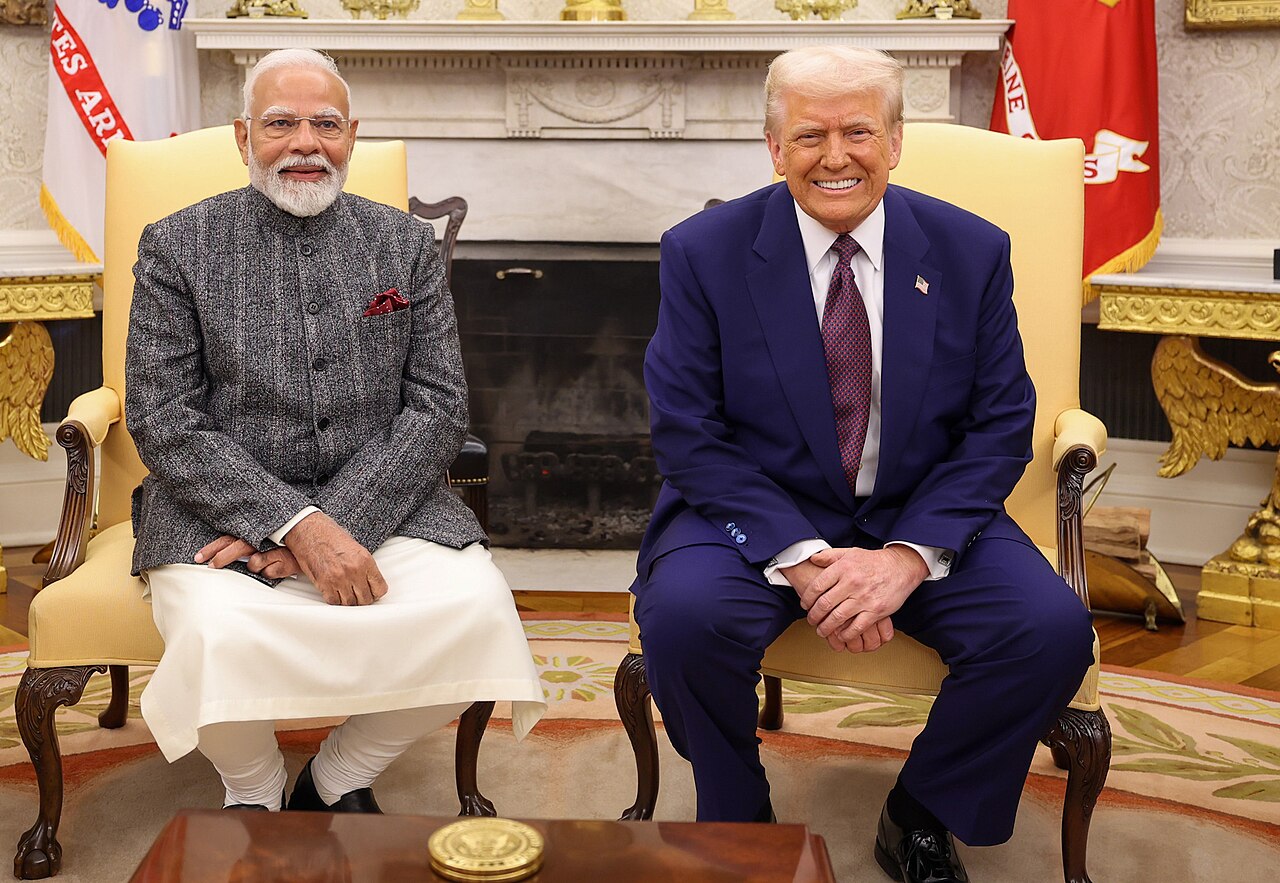
Source: Prime Minister’s Office, Government of India – Wiki Commons
But Trump’s second term has been a different beast. The much-touted Trump-Modi ‘bromance’ of the past and his popularity with Modi’s base have offered India little protection from Trump’s tariff tantrums. He has repeatedly singled out India as a particularly nasty trading partner that uses high tariff barriers and profits off cheap Russian oil, his administration picking only on India for buying Russian oil. Pressure from Trump has forced India to limit its energy purchases from Russia and quietly fall in line with the attack on Iran, India’s old geopolitical ally with which it shares millennia-old civilizational bonds.
Modi has faced criticism at home for his muted reaction to the war and a visit to Israel right before the Iran offensive started. He announced that India stood with Israel, elevated bilateral ties to “special strategic partnership”, and even addressed the Knesset on the trip, giving Netanyahu a much-needed diplomatic boost at a time when the Israeli leader with an International Criminal Court (ICC) arrest warrant on his head is increasingly isolated globally. India and Israel have denied his trip was related to the war on Iran but Arab media and many at home see it as Modi’s conscious signalling of throwing India’s lot behind Israel in this conflict.
India’s stance on the ongoing Gaza conflict has already been markedly different from the past, and from the rest of the Global South. Though it has maintained its traditional support for a two-state solution, India has abstained on UN resolutions for Gaza ceasefire, lifting of blockade, or probes into Israeli human rights practices, indicating its reluctance to condemn Israeli actions outright.
At home, the Indian government has become hypersensitive about Gaza. While the government turns a blind eye to expressions of support for Israel and hardline Hindu supremacists regularly publicise their cheerleading for Israel, commiseration with Palestinians in any form, by way of protests or even social media posts, is criminalised. The country’s film censor board has stalled the theatrical release of the Oscar-nominated ‘The Voice of Hind Rajab’—on the five-year-old Palestinian girl who was killed after being trapped inside a car attacked by Israeli forces in Gaza. It finds the film “very sensitive”.
Diplomatic and military ties between India and Israel have deepened in recent years, in part driven by a convergence of Indian and Israeli right-wing ideologies. India’s backing on Palestine, once rooted in anti-imperialist solidarities, has simultaneously waned. Hindu supremacists, animated by Israel’s example of a majoritarian ethnostate that they want to create for India by replacing its equal citizenship with a Hindu-first order, look up to Israel for its battles with the Muslim world. Vinayak Savarkar, the primary formulator of Hindutva, wrote in the 1920s: “If the Zionists’ dreams are ever realized – if Palestine becomes a Jewish state – it will gladden us almost as much as our Jewish friends.”
With Hindutva becoming the dominant political ideology in India, the Indian state’s support for Zionism and Israel has simultaneously risen and mainstreamed. Diaspora Hindu supremacist groups have looked to American Jewish groups like AIPAC as role models for advancing India’s interests in the US and copied Israel’s lobbying vocabulary and techniques, such as framing and wielding ‘Hinduphobia’, modelled after ‘antisemitism’, to shut down any attack on the Indian government and its discriminatory agenda.
India has also correctly read the extent of Israel’s influence on America’s foreign policy and begun to use its ties with Israel to lean on the US. The ideologically induced strategic convergence is shaping a new India–US–Israel alignment with far-reaching geopolitical consequences.
Fascisms, old and new
In her speech at the Delhi conclave, Loomer, who is also Jewish, spoke effusively about the potential of this three-way alliance in battling Islamist terrorism, drawing India into a vision of what many see as a new form of fascism emerging in the US.
India has been here before.
Source; Wiki Commons
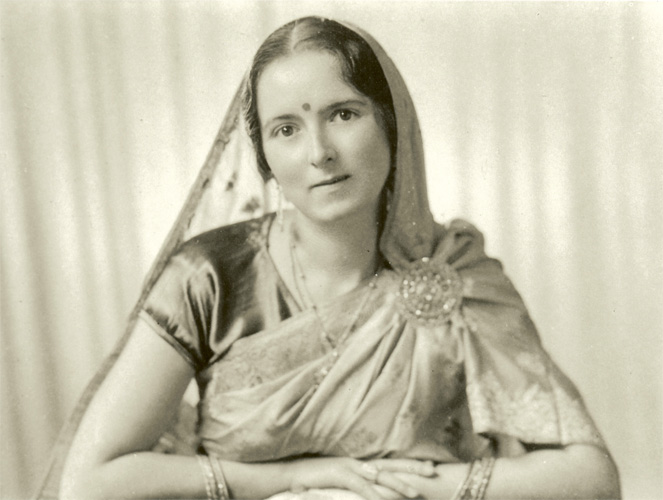
There is a long history of India’s connection to such transnational linkages of exclusionary ideologies, going all the way back to the days of the old fascism. The ideology and organization of the Hindutva movement was itself inspired by European ethnonationalism of the early 20th century. Another ‘influencer’, of her age, French-born Greek fascist Maximiani Julia Portas travelled to India in search of a living pagan Aryan culture in the early 1930s. She became famous as Savitri Devi Mukherji and espoused a synthesis of Hinduism and Nazism, proclaiming Adolf Hitler as an avatar of the Hindu god Vishnu.
She popularized the notion of the Aryan connection between India and Germany and developed the mystical interpretation that linked Nazi ideology to Hindu symbols. The ‘swastika’, a common Hindu religious sign that was adopted by the Nazis in early 20th century Germany to represent the racial superiority of ‘Aryans’, derives from the Sanskrit ‘svastika’, meaning ‘well-being’.
Portas is claimed by some to have pioneered Holocaust denial and was a key figure in the creation in 1962 of the World Union of National Socialists (WUNS), an umbrella group for neo-Nazis across the globe. She died while travelling to the US to deliver a lecture and her ashes were shipped to the headquarters of the American Nazi Party in Arlington, Virginia, where they were placed next to those of its leader George Lincoln Rockwell. The National Socialist White People’s Party (NSWPP), formed later as a rebrand of the American Nazi Party, is a foundational pillar of the modern US white nationalist movement that has spawned the likes of Loomer.
Though antisemitism continues to motivate sections of these far-right groups, 9/11 and rising anxieties over Muslim immigration in Europe have partly pivoted today’s politics of hate away from Jews as foundational targets towards Muslims. And this is where the extremely well-resourced Hindu far right finds common ground with Western hate groups. Its own historical resentments against Islam have found an ally in the centuries-long demonization of Muslims and Islam in Christian Europe that paved the way for the modern politics of Islamophobia following the ‘war on terror’ in 2001.
Flush with funds derived from their control over the reins of the world’s fourth largest economy, the sophisticated propaganda ecosystems of the Indian far right have made India a major source of Islamophobic content on social media platforms globally. A growing convergence of Hindu supremacism with Western far-right extremists and misogynistic online subcultures of Manosphere creates a border-less vocabulary and logic of hate with mutually reinforcing spirals of misogyny, religious bigotry, and anti-democratic messaging.
When Portas reimagined India as part of a pan-Aryan Nazi world, the country had no agency as a poor British colony, not just in global polity but even in its own destiny. A hundred years on, as one of the fastest growing major economies with the second biggest military in the world, India is an unfortunate exemplar of slow-burn authoritarianism fuelled by neoliberal capitalism and cloaked in electoral legitimacy. A rare postcolonial democracy, it is now slowly sliding into a new strain of fascism that unfolds not with jackboots and torches, but through the stultifying grip of a repressive majoritarian machinery on institutions and the civil society, and, through vigilante violence, state-driven radicalization against the country’s minorities, and a media muzzled into sycophancy.
Modi’s India bears eerie parallels to Nazism in its ever-expanding curbs on civic rights, cult of personality around a strongman leader, glorification of a mythicized glorious past, and a violently exclusionary ethno-nationalism. The minorities, in particular the country’s 200 million Muslims, are being disenfranchised, dispossessed, and dehumanized by being subjected to discriminatory policies, media propaganda, political messaging, open calls for genocide, and Judenboykott-style economic boycotts.
Genocide Watch is sounding the alarm for India. The United States Holocaust Museum considers its chances of mass atrocities high. But genocides are not just about mass deaths. Modern genocidal campaigns can also focus on mass trauma, as has been seen in Myanmar, and can last years, even generations, incrementally normalizing a community’s destruction. The international Convention on the Prevention and Punishment of the Crime of Genocide and various international treaties on crimes against humanity recognises these larger aspects of genocidal campaigns. Many of these aspects—such as systematic attacks on civilian population, persecution, segregation, and organized atrocities tolerated or condoned by the government—fit the description of Modi’s India.
Democracy trackers now classify India as an ‘electoral autocracy’. But it is clearly much more than that; some argue that Hindu supremacism is a global case study in 21st century fascism. It also comes kitted out with an incredible global outreach mechanism that reveals a movement that is not simply reshaping India but also influencing and shaping global far-right politics.
Modi's world
Norwegian mass shooter Anders Behring Breivik in his manifesto praised Hindutva as a key ally in a global struggle to bring down democratic regimes across the world. Dutch far-right leader Geert Wilders defended a BJP politician’s derogatory remarks against the Prophet that triggered a backlash from the Arab world forcing her expulsion from the party. European right-wing MPs have helped to whitewash Modi’s controversial policy of stripping the statehood and bifurcation of what was India’s only Muslim-majority state, Kashmir. Hindutva groups have lobbied British MPs and spread disinformation targeting Labour candidates critical of Modi.
UK police intelligence reports have noted the trend of British Hindu extremists forming alliances with far-right groups over their common hatred of Muslims, threatening community relationships between Hindus and other faith groups, and interfering in elections by telling Hindus who to vote for. The UK Home Office now considers Hindutva as an “extremism of concern” that played a role in the violent clashes between Hindus and Muslims in Leicester in 2022.
Hindu Right leaders have been attending the National Conservatism, or NatCon, conferences that bring together conservative thinkers in the US and Europe. India’s 100-year-old Hindu far-right fountainhead, the Rashtriya Swayamsevak Sangh (RSS)—of which Modi’s Bharatiya Janata Party (BJP) is an offshoot—has been lobbying for congressional influence in the US. Last year it hired US lobbying firm Squire Patton Boggs, paying it $330,000 for lobbying officials in the US Senate and House of Representatives. It has more than 200 affiliates operating outside India. There are many others that claim to have no formal links to the RSS but actually work for it and its affiliates.
RSS is among the organizations the US Commission on International Religious Freedom (USCIRF) has requested the State Department to sanction this year. Its lobbying exercise was terminated soon after it came to light, but Hindutva activity in America has been unceasing, from ‘Yogathons’ to training camps, leveraging the reach and resources of the Indian diaspora, the country’s top-earning ethnic group.
A watershed moment in the Indo-American far-right solidarity came when former Trump strategist Steve Bannon became an honorary chairman of the Republican Hindu Coalition. Bannon, who once called Modi “a Trump before Trump”, is among the many on the American right impressed by Hindutva’s stamina, spread, success, and sophistication. Few far-right movements globally can after all claim Hindutva’s century-old endurance or the reach of its thousands of organizations comprising the world’s largest far-right network in history. Hindutva’s creeping capture of the state and incremental dismantling of a constitutionally mandated liberal democracy is a model for Western far-right groups that similarly aspire to build ethno-religious states, and look at it with envy.
Internal contradictions
But transnational alliance of political groupings that draw sustenance from xenophobia is inherently ridden with contradictions, especially when such exclusionary politics is racially coded. While Portas was imagining India as a pagan bastion of the Aryan master race central to the Nazi worldview, Hitler held Indians in deep contempt as an inferior race as a result of what he considered miscegenation between the racially superior, white Aryan invaders and the inferior dark-skinned original inhabitants.
Despite the early Hindutva ideologues’ admiration for the Nazis and Nazi attempts to woo India’s then budding ethno-nationalist elements through the trope of Aryanism to stir up trouble against the British, Hitler was openly dismissive of the Indian anti-colonial movement. He, in fact, admired the British empire, without which, he said, in a 1936 speech in Munich, “Indians could not even walk.”
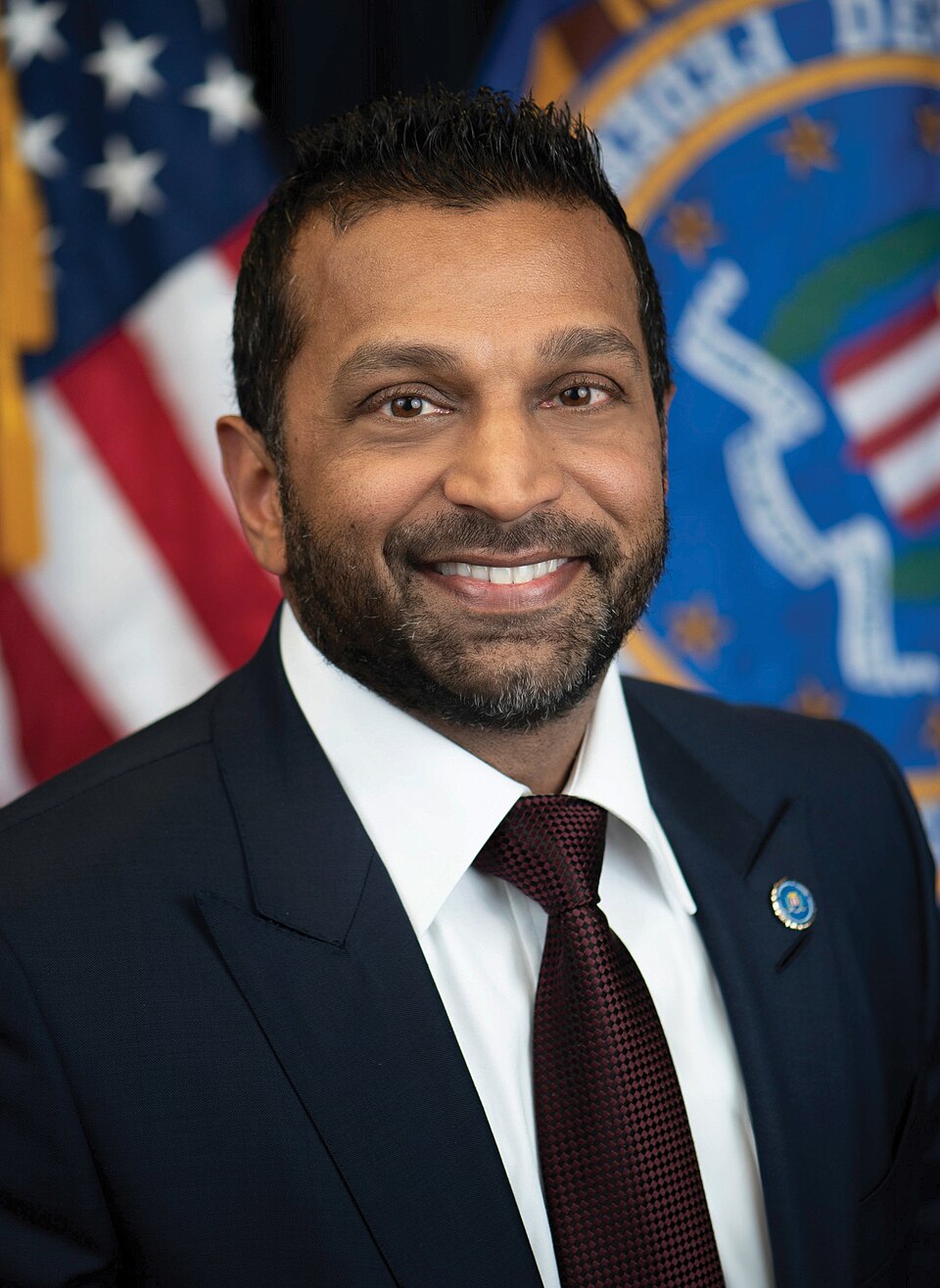
Today’s white supremacism in the US is similarly fraught with internal paradoxes. Contrary to what could be expected of its racist ideology, it has actually created a space for non-white groups, like South Americans and some Asians. MAGA ranks are dotted by figures like Vivek Ramaswamy, a presidential candidate in the last election, and Kash Patel, director of the Federal Bureau of Investigation. But the given in this accommodation is that these communities and their representatives accept subordination to white supremacy. The far-right logic of geopolitical fraternity is similarly premised on the acceptance of this colour-coded hierarchy; the kind with which India seems increasingly comfortable, ditching its earlier, post-colonial assertiveness. But even that implied submission is no protection from a political culture steeped in racism.
Source: FBI – Wiki Commons
Last year, Patel got into MAGA hot water for merely posting a tweet marking Diwali. He immediately faced a torrent of online hate, including calls to go back to India. Ramaswamy has similarly been subject to in-house slurs, as revealed by hundreds of leaked texts of group chats. Usha Vance, the Indian-born Second Lady, continues to be the butt of MAGA hate.
Soon after Trump won his second term, the MAGA community turned on itself following an Indian-origin venture capitalist’s nomination as policy advisor for artificial intelligence. It escalated into a bruising battle over race and immigration. Loomer took the leading role in trashing the appointment, bristling at the nominee’s past advocacy for removing country caps on green cards, which would allow in more skilled workers from countries like India. “The average IQ in India is 76,” she tweeted in the course of the debate to make her case for keeping Indians out and giving policy preference to American workers.
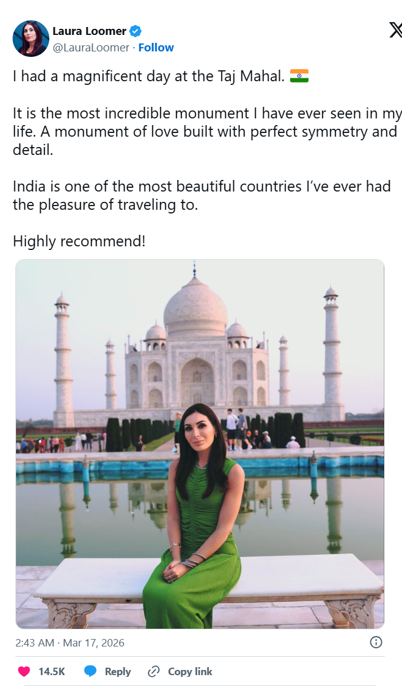
From a cheerleader at home for expelling Indians to defender of Hindus in India, Loomer’s U-turn has been a masterclass in political doublespeak. The “proud Islamophobe” rounded off the India trip with a gushing post on the beauty of Taj Mahal, the monument to love built by a Muslim king to his dead queen in the 17th century. “It is the most incredible monument I have ever seen in my life…India is one of the most beautiful countries I’ve ever had the pleasure of traveling to. Highly recommend!” she signed off.
Back home, Taj inspired other ideas among her ilk. The US Department of Homeland Security (DHS) released a social media post promoting a ‘self-deportation’ scheme for undocumented migrants using the imagery of Taj Mahal, causing outrage in India. “You can go home with a fresh start! Receive a FREE flight home and a $2,600 exit bonus when you use Customs and Border Protection (CBP) Home to self-deport,” read its cheerfully worded polite boot.
The irony is difficult to miss—like that of the love between white and brown supremacists. Despite the shared hate for Islam that enables it, the racially fraught caveat looms large in the relationship. In the West, Islamophobia has been widely constituted as a form of racism for centuries, making it such a potent anti-democratic force threatening plurality and peace. This racialized meaning of Islamophobia, accentuated by the politics of xenophobia targeted at migrants, provides an emotional glue for Western far‑right groups seeing themselves as part of a transnational civilizational struggle. This is what makes it easy for Trump’s followers to find common cause with the likes of Hungary’s Viktor Orbán, who also frames migrants—predominantly Muslim—as existential threats to the white Christian civilization. But the racial undertone also puts a strain on the solidarities between the Indian and American right, with implications for their geopolitical affinities, highlighting the limits of global far-right consolidations. The crack shows every time MAGA has a meltdown over H-1B visas, which mainly go to Indians. Even the magic of the Taj would not be enough to disappear these fault lines.

The Author
Toda Peace Institute
The Toda Peace Institute is an independent, nonpartisan institute committed to advancing a more just and peaceful world through policy-oriented peace research and practice. The Institute commissions evidence-based research, convenes multi-track and multi-disciplinary problem-solving workshops and seminars, and promotes dialogue across ethnic, cultural, religious and political divides. It catalyses practical, policy-oriented conversations between theoretical experts, practitioners, policymakers and civil society leaders in order to discern innovative and creative solutions to the major problems confronting the world in the twenty-first century (see www.toda.org for more information).
Contact Us
Toda Peace Institute
Samon Eleven Bldg. 5thFloor
3-1 Samon-cho, Shinjuku-ku, Tokyo 160-0017, Japan
Email: contact@toda.org