Can Middle Powers Save the Rules-Based International Order When the US Violates Its Principles?
Mark Beeson
March 23, 2026
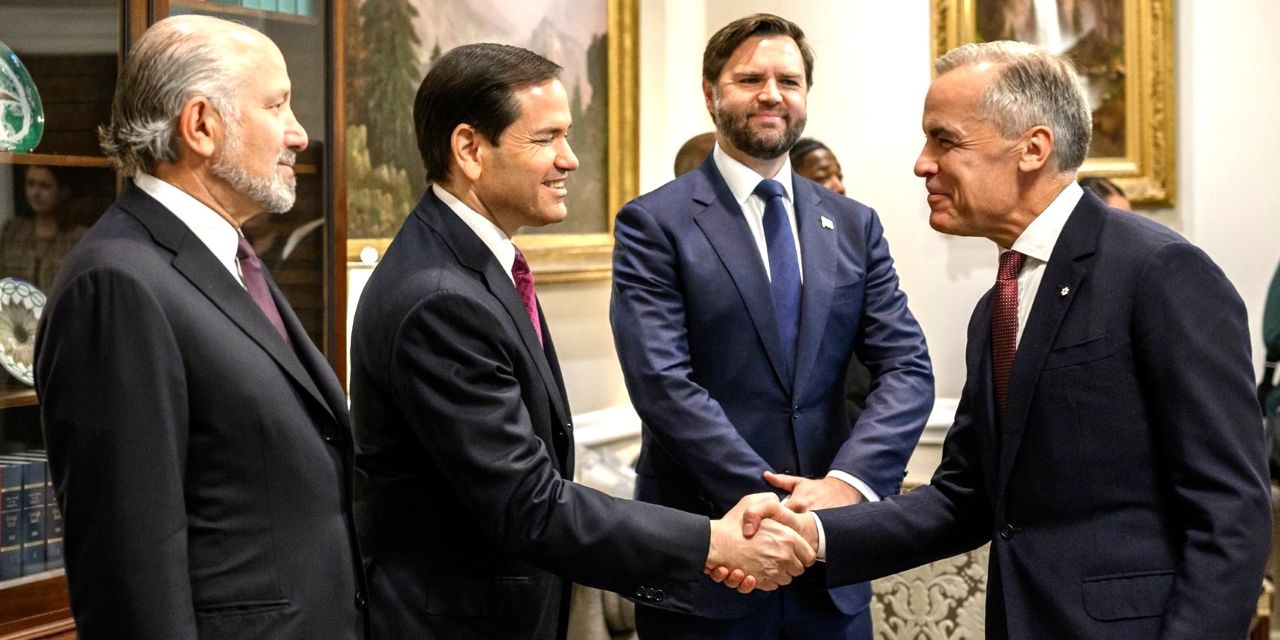
Image: The White House / Wiki Commons
This policy brief argues that middle powers should collaborate to protect their distinctive interests at a time of profound change and uncertainty in the international order. After outlining some of the key changes, it explains the different ways in which the current order is viewed by the United States, and by states like Canada, which has been subjected to increasing levels of pressure and interference by its more powerful neighbour. Mark Carney has recently provided an important and actionable analysis of the situation confronting middle powers as they seek to navigate a world in which the United States appears to have abandoned its role as system stabiliser.
Contents
- Abstract
- Interpreting the present moment
- The old new order
- Carney dazzles Davos
- Making the best of a bad situation
- Policy recommendations
- Conclusion
Abstract
At a time of profound change and uncertainty in the international order, this policy brief argues that middle powers should collaborate to protect their distinctive interests. After outlining some of the key changes, it explains the different ways in which the current order is viewed by the United States, and by states like Canada, which has been subjected to increasing levels of pressure and interference by its more powerful neighbour. Mark Carney has recently provided an important and actionable analysis of the situation confronting middle powers as they seek to navigate a world in which the United States appears to have abandoned its role as system stabiliser.
Interpreting the present moment
Making national or international policy at the best of times is challenging, especially for so-called ‘middle powers’ that lack the economic weight and strategic might of their ‘great’ counterparts. Deciding quite how to respond to economic pressure or even outbreaks of real conflict remains a major challenge, especially when the principal architect of instability has hitherto been seen as its bedrock.[1]
Donald Trump’s decision to attack Iran for the second time in less than a year not only violated international law, but it occurred in the middle of negotiations to deal with Iran’s potential development of nuclear weapons. Whatever the outcome of this conflict may be, the unilateral application of overwhelming force marks yet another blow to the so-called ‘rules based international order’ upon which middle powers and failing states alike depended.[2]
Trump’s actions are especially ironic and arguably ill-conceived as they will inevitably further undermine the old order that the United States did so much to create in the aftermath of World War 2. Although many in what we now call the Global South rightly thought that the principal beneficiaries of this order were the Global North in general and the United States in particular, it did provide a framework for a remarkable period of economic development in much of the world.
Equally remarkably, America’s post-war dominance also created the political space and momentum for the creation of the European Union, which—for all its current problems—remains the most consequential example of institutionalised cooperation across national borders the world has ever seen. For a continent that has been the source of two world wars and the site of genocidal slaughter on an industrial scale, this is no small achievement.
All this undoubted progress is now in doubt and the subject of outright ridicule by an American administration that has little patience with diplomacy and is intent on asserting economic pressure and, when that fails, outright force. The US is not alone either. Israel, which joined the American attack on Iran, and Russia, which launched its own illegal and disastrous invasion of Ukraine four years ago, are exponents of the principle that ‘might makes right’.
These developments are especially difficult for countries that are either formal allies of the US, or vulnerable to the erratically deployed tariff regimes that are one of Trump’s preferred mechanisms of influence. While the Supreme Court has ruled that Trump’s use of tariffs is illegal, there are a number of ways the administration can work around the ruling, meaning that “the court decision is likely to be a temporary break in the president’s ongoing trade wars.”[3]
At least tariffs are closer to the ‘soft power’ end of the spectrum, perhaps, rather than the increasingly arbitrary and destructive application of America’s still overwhelming hard power capacity. Secretary of War, Pete Hesgeth, made it abundantly clear that the illegal American attacks on Iran will not be bound by “stupid rules of engagement,” nor does the US want to be involved in a “nation building quagmire [a] democracy building exercise [or] politically correct wars.”[4] In other words, the Trump administration has no interest in abiding by the rules and norms of the system it did so much to create, or defending democratic principles abroad or at home, for that matter.[5]
Little wonder, perhaps, that middle powers are reassessing the international system they have relied on and taken for granted. Indeed, thanks to Mark Carney and a clearly unsettled European Union, some states are showing welcome signs of independence of thought and action. But American unilateralism is a painful reminder of the possible limits of their influence in a world where even the architect of the familiar international order no longer seems to believe in it.
The rest of the world has had plenty of warning about the Trump administration’s thinking and possible policy trajectory, even if many, like Australia and the European Union, chose not to believe it. That response may be understandable, but it’s no longer credible, not least because the Trump administration is unambiguously and unapologetically spelling out precisely what its goals are and the mechanisms with which they will pursue them.
The recent National Security Strategy clearly indicated the assumptions underpinning America’s evolving policy doctrine and the sorts of actions that might flow from it. Controlling migration, enhanced military capabilities and unashamedly prioritising ‘America first’ are predictably central concerns of its evolving grand strategy,[6] even if its application against Iran is inconsistent and demonstrates little understanding of the latter’s likely response.[7]
What is more remarkable and troubling for America’s traditional allies, however, is the amount of space dedicated to criticising Europe, which is seen as facing self-inflicted ‘civilisational erasure’. It is a theme that senior members of the Trump administration have been keen to develop as Europe represents many of the qualities they despise and are keen to eliminate domestically.
The old new order
Being from the most powerful country on Earth no doubt influences the world view of its policymakers. Believing that the United States is fulfilling a possibly divinely-inspired historical mission helps to explain some of the more grandiose ideas of American leaders. It may explain why Donald Trump thinks God is “very proud” of him.[8] It doesn’t explain why those around Trump don’t disabuse him of this idea, however, and go along with his every impulse, no matter how implausible or potentially damaging.
Secretary of State Rubio really ought to know better. After all, when he competed against Trump for the Republican presidential nomination in 2016, he described his current boss as a “vulgar con artist.” Now, however, as he told a relieved audience at the recent Munich Security Conference, Rubio regards Trump as the leader of a process of civilizational renewal in which the United States and Europe have “intertwined destinies.”[9]
At one level this speech may have been Rubio playing ‘good cop’ to J.D. Vance’s ‘bad cop’. The Vice President had excoriated a stunned audience of European leaders at the same venue a year earlier. But where Vance criticised European leaders for failing to secure their borders and address the ‘threat from within’, Rubio stressed the common Christian heritage and culture that united American and Europe.
The challenge, according to Rubio, was to restore political and economic sovereignty, while resisting the “climate cult” that was “impoverishing” the populations of Europe and America. One of the key failures of leaders in both regions was to ignore human nature and the “lessons of 5,000 years of history” by outsourcing sovereignty and decision-making to international institutions. In this reading of history, a rules-based international order, even one supposedly underpinned by American power and principles, could not replace the national interest as the key concern of policymakers, no matter where they came from.
But the European Union is based on the assumption that institutionalised international cooperation is not only possible, but a necessary part of progress and the active creation of a new form of ‘human nature’ that reflects and cultivates collective values. Rubio’s speech was, therefore, not exactly a ringing endorsement of what is, for all its well-known contemporary problems, the most successful and enduring example of institutionalised cooperation the world has yet seen.
A more credible alternative, Rubio suggested, was to follow Trump’s lead in rejecting the “abstractions of international law” and recognise the enduring importance of power in avoiding civilizational decline. Bombing Iran, kidnapping Nicolás Maduro, and threatening friend and notional foe alike with economic punishment are some of the more noteworthy expressions of the new Trumpian world order.
Given middle powers reliance on the rule of law and accepted norms of behaviour to regulate the international system, it is no surprise that some middle power leaders, worried about the possible emergence of nineteenth century-style spheres of influence that would further constrain their limited influence, are taking the opportunity to speak out.
Carney dazzles Davos
Mark Carney’s speech to a gathering of the world’s plutocrats and political leaders at Davos caused something of a sensation because it famously spoke truth to power and identified the transformation that has been occurring in international politics during Trump’s second term.
It’s important to remember that during Trump’s first term even he appeared surprised that he was elected and was consequently unprepared and more reliant on the so-called ‘adults in the room’. The second term is very different. Not only did the right-leaning Heritage Foundation provide a blueprint for policy reform,[10] but Trump took great care to surround himself with sycophants, opportunists and fellow travellers in his pursuit of American greatness.[11]
Canada is especially exposed to a newly assertive Trump administration, which threatened to make it the 51st state of the United States. As it is, members of Trump’s administration have been encouraging far right politicians in Alberta to secede and align with the United States.[12]
It was against this backdrop that Carney suggested that the international order that had prevailed for the last eighty years or so was facing an epochal ‘rupture’, which signalled “the end of a nice story and the beginning of a brutal reality where geopolitics among the great powers is not subject to any constraints.”[13]
Although Carney was careful not to mention Trump by name and risk further inflaming an already tense relationship with a leader who is notoriously sensitive about any perceived slight, the message for risk-averse captains of industry and leaders of increasingly nervous middle powers could hardly have been clearer: “when we only negotiate bilaterally with a hegemon, we negotiate from weakness. We accept what’s offered…This is not sovereignty. It’s the performance of sovereignty while accepting subordination.”
This really should not have come as a surprise to an audience of political and business elites. The fact that it seemed to, speaks volumes about the complacency or inability of many people to recognise, much less deal with, a rapidly changing reality. Carney had some useful advice in this context, too.
The alternative to being bullied by hegemons, Carney suggested, was “building coalitions that work, issue by issue, with partners who share enough common ground to act together. In some cases, this will be the vast majority of nations…. Middle powers must act together because if we’re not at the table, we’re on the menu.”
While this might seem like an entirely rational response for similarly positioned states with much in common, it is hard to overstate what a challenge it is likely to prove for key American allies like Australia, the United Kingdom, and Japan. Japan’s newly elected prime minister, Sanae Takaichi, has gone so far as to upset the delicate regional balance of power by offering its support in defending Taiwan in the event of Chinese aggression.
Both the UK and Australia have been very careful not to criticise another illegal military intervention in the Middle East, despite America’s disastrous record of failure in the region and Trump previously promising that his newly elected government would “measure our success not only by the battles we win but also by the wars that we end – and perhaps most importantly, the wars we never get into.”[14]
If there is one thing that ought to be abundantly clear about the Trump administration that policymakers everywhere should recognise, it’s that America is not a reliable ally or trade partner. Trump apologists may argue that is part of his deal-making genius and ability to wrongfoot adversaries, but his impact on, and disdain for, even allied middle powers suggests old policy settings may need urgent updating.
Making the best of a bad situation
Less powerful states are not without options. Rather than simply going along with their great power counterparts out of fear, the prospect of short-term advantage, or simply because they can imagine nothing other than the now bankrupt policies of the past, middle powers can act with similarly positioned partners. Mark Carney has demonstrated what may be possible and effective in this regard, too.
Canada is actively seeking new trade partners despite, or because of, the threat of increasingly punitive tariffs from the US. Carney has negotiated a new trade agreement with China, which has led to dramatic reductions in tariffs on Canadian exports. Even more consequentially in the long-term, perhaps, Canada and China have agreed to “collaborate in energy, clean technology and climate competitiveness.” [15]
Given the Trump administration’s enthusiasm for developing fossil fuels and its dismissal of the imminent threat posed by climate change as a ‘hoax’, this is a potentially vital initiative. It is also an illustration of the inescapable need for cooperation in a policy area where no country, no matter how powerful, can solve what is arguably the greatest challenge facing humanity without unprecedented levels of international cooperation.
Carney has also demonstrated how extant institutions can be repurposed and realigned to put pressure on recalcitrant great powers. The proposal to ‘build a bridge’ between the Trans-Pacific and the EU would represent the most significant collection of middle powers yet assembled and have significant diplomatic weight as a consequence.
To be sure, forming coalitions with other states will not be easy given that they are only united by their status as non-great powers. Canada, after all, is home to massive deposits of ‘oilsands’, the extraction of which is destructive of the natural environment and highly polluting. Australia has similar problems as one of the world’s major coal exporters.
And yet opportunity is supposedly the other side of crisis; both countries could use the transformed geopolitical environment to override the wishes of domestic fossil fuel companies and act in the collective rather than the national interest.
Given that constructive examples of good international behaviour are currently in short supply, any examples of countries demonstrating that international cooperation is possible, and that there may be ways of resisting pressure from more powerful states to act against their own long-term interests should be welcome.
The strategic arena will no doubt prove the hardest to navigate. In Australia’s case, it may prove impossible for policymakers to imagine any other situation other than fealty to the US no matter who is in the White House. But Europe is continuing to support Ukraine in its existential struggle with another rogue—albeit diminished—great power, when the US appears to have lost interest, or is actually facilitating Russia’s ambitions. [16] President Emmanuel Macron has suggested expanding France’s nuclear arsenal and extending its deterrence capability and deepening cooperation with neighbours as one way less powerful states can respond to the Trump regime. [17]
Ironically enough, American criticism of Europe’s supposed strategic free-riding has had the desired effect, and Europeans are ramping up defence spending and considering ways of becoming more collectively self-reliant. There is no in principle reason why such collective arrangements could not extend between continents; after all, this has been the basis of the North Atlantic Treaty Organisation since 1949.
As Carney points out, consistency is vital, as is “applying the same standards to allies and rivals.” Living in the past is not an option. On the contrary, “rather than waiting for the old order to be restored, it means creating institutions and agreements that function as described.” Whether middle powers will have either the capacity or the will to do this is an open question. If they don’t, though, the world faces an uncertain, zero-sum future in which a few powerful states dictate terms to the rest.
Policy recommendations
FOR THE MIDDLE POWERS
- Middle powers should actively look for ways of institutionalising political, economic, and even strategic cooperation in response to a rapidly changing international order.
- Cooperating with other like-minded and similarly positioned states is the best way of achieving this.
- Creating new institutions or combining and repurposing existing organisations may be the best way of doing this, but it will require considerable political will.
- Collaborating with other middle powers to take more responsibility for their own security rather than relying on unpredictable and unreliable great powers intent on pursuing their own national interest looks essential.
FOR CIVIL SOCIETY ORGANISATIONS
- Sustained ‘pressure from below’ may be one of the only ways of reining in the autocratic impulses of populist leaders, even in the United States.
- Key policy issues such as environmental sustainability and the promotion of peace will need the active support of independent organisations if governments are to be persuaded to change course.
- Democratic states should be held to account for their actions and encouraged to adopt a more cooperative attitude with their democratic counterparts, and even with autocratic regimes like China if they are making a practical contribution to addressing vital issues like climate change.
- Cooperate with NGOs in other countries and offer collective support for international organisations such as the United Nations that are trying to defend human rights and curb great power competition and unilateralism.
Conclusion
If middle powers can’t create a new international order for themselves, it is clear that by definition no great power is going to do it for them. Great and middle powers have different capabilities, but that doesn’t make might right, no matter who is in power. On the contrary, with Donald Trump wielding autocratic, illegitimate power primarily for what he perceives as America’s national interest, it is incumbent upon middle powers to push back. Recognising that the old international order no longer exists is the first step in this process.
Notes
[1] Allison, G., & Winnefeld, J. A. (2025, Nov 24). The end of the longest peace? Foreign Affairs. Retrieved from https://www.foreignaffairs.com/united-states/end-longest-peace
[2] Acemoglu, D. (2025, Jan 9). What Now for the “Rules-Based Order”? Project Syndicate. Retrieved from https://www.project-syndicate.org/commentary /trump-venezuela-rules-based-order-must-be-built-anew-by -daron-acemoglu-2026-01?utm_source=project-syndicate.org&utm_medium=email&utm_campaign=authnote&
[3] Manak, I. (2026, February 20). How Trump’s Tariffs Could Survive the Supreme Court Ruling. Council on Foreign Relations. Retrieved from https://www.cfr.org/articles/how-trumps-tariffs-could-survive-the-supreme-court-ruling
[4] Roth, A., & Gedeon, J. (2026, Mar 3). Hegseth says US won’t get ‘bogged down’ in Iran – but doesn’t rule out sending troops. The Guardian. Retrieved from https://www.theguardian.com/world/2026/mar/02/hegseth-iran-war-first-remarks
[5] Levitsky, S., & Way, L. A. (2025). The path to American authoritarianism. Foreign Affairs, 104(2), 36-51.
[6] Trump, D. (2025) National Security Strategy of the United States of America, (Washington).
[7] Mazzetti, M., Pager, T., & Wong, E. (2026, March 10). How Trump and His Advisers Miscalculated Iran’s Response to War. New York Times. Retrieved from https://www.nytimes.com/2026/03/10/us/politics/how-trump-miscalculated-iran-response.html?smid=nytcore-ios-share
[8] Broadwater, L. (2026, Jan. 20). ‘God is very proud’: Trump marks anniversary with a victory lap’. New York Times.
Retrieved from https://www.nytimes.com/2026/01/20/us/politics/trump-anniversary -briefing.html
[9] Rubio, M. (2026). Secretary of State Marco Rubio Remarks. Paper presented at the Munich Security Conference. https://www.state.gov/releases/office-of-the-spokesperson/2026/02/secretary -of-state-marco-rubio-at-the-munich-security -conference
[10] Dans, P., & Groves, S. (2023). Mandate for Leadership: The Conservative Promise, Heritage Foundation: Washington.
[11] Müller, J.-W. (2026, 8 Jan). ‘The Trump doctrine exposes the US as a mafia state’. The Guardian. Retrieved from https://www.theguardian.com/commentisfree/2026/jan/07/the-trump-doctrine-exposes-the-us-as-a-mafia-state?CMP=Share_iOSApp_Other
[12] Smith, A., & Williams, A. (2026, Feb. 12,). ‘Canadian separatists optimistic after meetings with Trump officials’. NBC News. Retrieved from https://www.nbcnews.com/politics/trump-administration/canadian-separatists-alberta-meetings-trump-officials-rcna258230
[13] Carney, M. (2025). Speech to World Economic Forum. CBC News. https://www.cbc.ca/news/politics/mark-carney – speech-davos-rules-based-order-9.7053350
[14] Trump, D, (2025) The Inaugural Address, (Washington: The White House). https://www.whitehouse.gov/remarks/2025/01/the-inaugural-address/
[15] Beeson, M. (2026) ‘ Mark Carney’s middle-power masterclass’, Asia Times, Feb 19, https://asiatimes.com/2026/02/mark-carneys-middle-power-masterclass/
[16] Muller-Heyndyk, R. (2025) ‘New US security strategy aligns with Russia’s vision, Moscow says’, BBC, Dec 7,https://www.bbc.com/news/articles/cpvd01g2kwwo
[17] Landler, M. (2026, March 2). Macron Expands French Nuclear Arsenal and Vows Protection for Neighbors. New York Times. Retrieved from https://www.nytimes.com/2026/03/02/world/europe/france-nuclear-arsenal-macron.html
The Author

Toda Peace Institute
The Toda Peace Institute is an independent, nonpartisan institute committed to advancing a more just and peaceful world through policy-oriented peace research and practice. The Institute commissions evidence-based research, convenes multi-track and multi-disciplinary problem-solving workshops and seminars, and promotes dialogue across ethnic, cultural, religious and political divides. It catalyses practical, policy-oriented conversations between theoretical experts, practitioners, policymakers and civil society leaders in order to discern innovative and creative solutions to the major problems confronting the world in the twenty-first century (see www.toda.org for more information).
Contact Us
Toda Peace Institute
Samon Eleven Bldg. 5thFloor
3-1 Samon-cho, Shinjuku-ku, Tokyo 160-0017, Japan
Email: contact@toda.org