Democratic Backsliding in Mauritania: Challenges and Trends
Ahmedou Menna
March 03, 2026
Image: GagoDesign / shutterstock.com
This report examines recent political developments in Mauritania which show signs of democratic backsliding, with increasing restrictions on political freedoms and declining public trust in political institutions. In recent years, the country has witnessed attempts to introduce constitutional amendments allowing the extension of presidential terms, changes to electoral laws that have restricted the participation of opposition parties, as well as restrictions on the media and suppression of civil society organizations. To halt this democratic regression in Mauritania, it is essential to implement a set of reform policies.
Contents
- Executive summary
- 1. Introduction
- 2. Current political situation
- 3. Indicators of democratic decline
- 4. Drivers of democratic backsliding
- 5. Effects of democratic decline
- 6. Case study: 2024 elections
- 7. Policy recommendations
- Conclusion
Executive summary
Mauritania has experienced various democratic transitions throughout its history, evolving from a single-party regime (1960–1978) to martial rule (1978–1991), and eventually to a multiparty electoral system (1991–present). However, recent political developments show signs of democratic backsliding, with increasing restrictions on political freedoms and declining public trust in political institutions.
In recent years, the country has witnessed attempts to introduce constitutional amendments allowing the extension of presidential terms, as well as changes to electoral laws that have restricted the participation of opposition parties. Furthermore, the authorities have increasingly imposed restrictions on the media and curtailed the activities of civil society organizations, aiming to suppress criticism and opposition.
Indicators of democratic backsliding are essential in measuring the extent of this deterioration and providing clear evidence of the current situation. International human rights reports (Human Rights Watch 2021) and international organizations such as Freedom House and V-Dem, confirm significant restrictions of press freedom, a decline in political participation, and a lack of transparency in elections.
Despite this, Mauritania continues to hold regular elections, with the most recent presidential election taking place on June 29, 2024, where the current president, Mohamed Ould Cheikh El Ghazouani, was re-elected for a second term with 56.12 per centof the vote. However, the most recent municipal, regional, and legislative elections in 2023 serve as a clear example of democratic decline, having been marred by numerous violations and irregularities.
To halt this democratic regression in Mauritania, it is essential to implement a set of reform policies, including:
- strengthening the integrity and transparency of elections,
- reforming the legal framework governing political parties and elections, [1]
- supporting independent institutions such as the Independent National Electoral Commission, which was partially reformed in 2022, [2]
- protecting civil rights and freedoms and expanding access to information,
- empowering civil society and NGOs to monitor government policies and promote transparency,
- promoting good governance and the rule of law, aiding civil groups in combating corruption and misuse of state resources, and reforming political financing systems,
- deepening cooperation between Mauritania’s Independent National Electoral Commission (CENI) with International Foundation for Electoral System and with the African branch of the International Institute for Democracy and Electoral Assistance (IDEA) to monitor elections and uphold democratic standards.
1. Introduction
Mauritania has undergone periods of political transition and institutional development, shifting from a single-party regime (1960–1978) to a period of martial law (1978–1991), and then to a multiparty democratic system (1991–present). Despite these transformations, the country is currently facing a wave of democratic regression. This is manifested in restrictions on political freedoms, excessive use of executive power, and constitutional amendments that have significantly disrupted the balance of power within the country.
Democratic backsliding is defined by the decline of freedoms, institutional weakness, and the erosion of respect for human rights. This erosion usually happens gradually (Haggard and Kaufman 2021). The description ‘defective’ comes to mind to assess governance in Mauritania (Merkel 2004). These are developments that threaten the stability of the state and its credibility on the international stage.
It is essential to understand the historical and political context of Mauritania, where economic challenges, identity-based conflicts, and regional and international influences all contribute to the trend of democratic decline.
The current challenges demand an immediate response and reform measures to reinforce democratic values and justice. Politically, several key features can be summarized:
- The legacy of military rule – The military has been the dominant force in political life since the first coup in 1978 (N’Diaye 2020). Most of the presidents since then have been either active-duty or retired military officers, weakening the principle of peaceful power transitions and hindering the establishment of a true civilian democracy.
- Weak oversight and legislative institutions – Elected bodies such as Parliament, the Court of Auditors, and the Constitutional Council lack independence and effectiveness. The permanent dissolution of the Senate (the upper chamber) in 2017, despite broad opposition, dealt a blow to institutional pluralism and further centralized power in the executive branch, especially the presidency. In particular, without the Senate, the President’s power significantly increased because the Senate’s key functions of providing an additional layer of oversight was not transferred to the legislature. This has resulted in an even less balanced governance in Mauritania.
- Restrictions on political pluralism and civil society – Political parties face serious challenges in meeting licensing requirements, and activists are subject to harassment and imprisonment, which limits free political participation.
- Domination by the ruling party – The El-Insaf party controls all levels of power and uses extensive networks and public resources to secure loyalty and suppress real political competition.
- Flaws in electoral mechanisms and supervision – The National Independent Electoral Commission is accused of bias, with its members appointed by or loyal to the president or ruling party, undermining election credibility and citizen trust.
- Constraints on public freedoms and the press – Although some margin for free expression exists compared to other countries, journalists, parliamentarians, and bloggers face censorship and legal prosecution, especially when addressing corruption or national symbols.
- Stagnation in rule–of–law reforms – Global governance and justice indicators show either deterioration or stagnation in judicial independence, anti-corruption efforts, and civil rights protections.
- Ethnic and social polarization – Divisions among the population affect political representation and are sometimes exploited to suppress dissent or weaken protest movements, exacerbating challenges to national cohesion and political stability.
- A history of slavery – Discussing democratization in Mauritania is problematic without reference to the issue of slavery. Social custom has resisted the legal reforms begun in 1981 (Decree No. 081-234) that formally abolished slavery. In 2007, the Act Law (Act No. 2007-048) criminalized slavery, but the lack of convictions suggests resistance to its abolition. In 2025, the government set up an anti-slavery court. It is early days to assess whether this will eliminate slavery for good or whether the custom will continue to affect overall democratization and equality in Mauritania.
2. Current political situation
The political situation in Mauritania shows clear signs of declining political freedoms and a growing lack of public trust in democratic institutions. In recent years the broader regional “search for Arab democracy” (Sadiki 2004) has regressed in a big way after the failed Arab uprisings of 2011. Mauritania’s own democratization has similarly worsened. The country has witnessed attempts to amend the constitution to allow the extension of presidential terms, along with changes to electoral laws that have restricted the participation of opposition parties. Additionally, the authorities have moved to impose restrictions on the media and curtail the activities of civil society organizations, with the aim of limiting criticism and dissent.
As further evidence of the decline of freedoms, the most recent elections, particularly the 2024 presidential election and the 2023 municipal, legislative, and regional elections, were surrounded by allegations of irregularities. Repeated accusations of electoral fraud, lack of transparency, and harassment of opposition figures have raised serious concerns. Furthermore, the judiciary is perceived as lacking independence, with claims of political interference in judicial decisions, which undermines the ability of institutions to hold the executive branch accountable.
These developments weaken democratic foundations, increase the risk of authoritarianism, and erode citizens’ trust in state institutions—posing a threat to the political stability of a regime rooted in a military coup that overthrew the first democratically elected civilian president in 1978.
3. Indicators of democratic decline
Assessments/rankings of Mauritania from human rights organizations and international bodies such as Freedom House, V-Dem, and others indicate a significant restriction of press freedom, a decline in political participation, and a lack of transparency in elections. Rule of law indicators also reflect weak judicial
independence, with political interference influencing court rulings.
There has also been a deterioration in civil rights, with authorities exerting pressure on civil society organizations and imposing restrictions on freedom of expression and assembly.
Regarding elections, there is strong evidence of serious irregularities and a widespread lack of transparency, which undermines the credibility of electoral outcomes. Data further shows that the decline is intensifying with constitutional amendments that expand executive power and weaken checks and balances, reflecting a sustained pattern of democratic deterioration—as illustrated in Table 1 below.
Table 1: Indicators of Democratic Governance and Rule of Law in Mauritania (2015–2024)
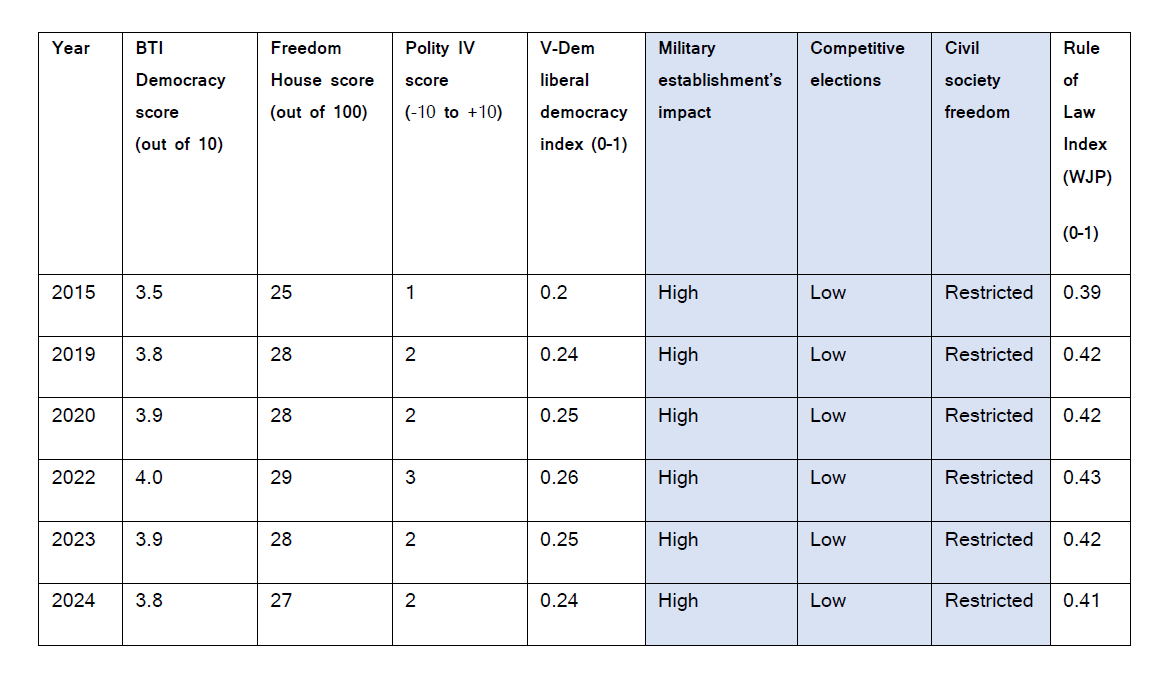
Between 2015 and 2024, democracy and rule of law indicators in Mauritania showed only marginal improvement, followed by stagnation or slight regression in recent years. Both the Polity IV and V–Dem indices continue to reflect consistently low levels of democratic quality, largely due to the dominance of the military (either in practice or by influence), poor electoral competitiveness, and restrictions on civil society.
Democratic institutions lack independence, and Mauritania’s ranking in press freedom indices has declined during the same period. Overall, the political landscape remains dominated by military-backed elites, with limited space for civilian engagement and minimal progress toward establishing a genuine democracy that ensures citizens’ rights.
4. Drivers of democratic backsliding
The causes of democratic backsliding in Mauritania can be attributed to several interrelated factors.
First, political motives of the ruling elites play a significant role. Those in power seek to consolidate their authority and preserve personal gains. They use constitutional amendments and laws that allow for extended presidential terms—such as the previous attempt by supporters of the former president to secure a third term, in violation of the constitution. This undermines political pluralism and peaceful power transitions.
Second, institutional weakness exacerbates the problem. The lack of independence and effectiveness of formal oversight bodies in Mauritania—such as Parliament, the judiciary, the Constitutional Council, and the Court of Auditors—as well as limited civic oversight from opposition parties and civil society organizations, have all enabled rulers to act without accountability.
Lastly, Mauritania’s new party licensing requirements (e.g., 5,000 endorsements from at least eight regions including 1,000 women) and the undermining of national dialogue have been designed more to tighten control than to deepen democratic practice. This is due to the fact that the last round of national dialogue was led by none other than the President Ghazouani. He claimed to use this process to foster unity and address national challenges through inclusive discussions between the government and social forces, including opposition parties. But the agenda and the process was controlled by the state.
5. Effects of democratic decline
The consequences of democratic regression are widespread: political instability, human rights abuses, economic corruption, and social polarization.
Politically, the erosion of trust in institutions undermines political stability and increases the risk of slipping into authoritarian rule—specifically, majority-led authoritarianism. [3]
In terms of human rights, civil liberties are deteriorating, with the suppression of opposition voices, restrictions on the press, and limitations on freedom of expression (notably through the ‘symbols law’) and peaceful assembly (e.g. Freedom House 2021). These measures weaken civil society and reduce citizens’ ability to engage meaningfully in political life. [4]
Economically, weak rule of law and lack of transparency deter investment, encourage youth emigration, fuel corruption, and erode public confidence in financial institutions.
Socially, democratic decline may exacerbate identity-based tensions and raises the likelihood of social and regional conflicts—especially if current policies continue to foster a sense of repression and marginalization despite the country’s abundant natural resources. Like, most multi-ethnic societies in the world, Mauritania has had its share of social tension and sometimes conflicts especially in the late 1980s due to identitarian issues revolving around equal citizenship rights. Mauritania has a mix of Arabs, Moors and non-Arab Africans. The Haratins or descendants of freed slaves as well as African Mauritanians have for decades suffered from discrimination but new legislation is attempting to stop racism and punish it. The country’s authoritarian power structure after independence aggravated ethnic conflicts, contributing to a form of ethnic hierarchies. Slavery added another layer of complexity to such hierarchies, in which some groups and even tribes lived on the margins of power, with regard to rights of culture, language, distributive justice and recognition (Ahmed 2020). These tensions and exclusionary and discriminatory actions festered for decades because of weak legal institutions.
Overall, democratic regression threatens national unity, undermines the prospects for sustainable development, tarnishes the country’s international image, and may lead to long-term instability.
6. Case study: 2024 elections
The eighth presidential election in Mauritania was held on June 29, 2024, with incumbent President Mohamed Ould Cheikh El Ghazouani winning a second term with 56.12 per cent of the vote.
Voter turnout reached 55 per cent, compared to 62 per cent in the 2019 election (see Table 2). For the most part, the campaign did not serve as a platform for candidates to present detailed programs to address the country’s pressing challenges. Instead, it focused heavily on the personalities of the candidates, often framed by subjective factors such as political affiliation, regional origin, tribal identity, and social status. Formal candidate debates have yet to become a feature of Mauritanian electoral practice.
Table 2: Decline of Opposition Parties’ Representation in the Political Arena

In the first round, the ruling party secured a majority of the votes with 56.12 per cent, followed by 22.1 per cent for candidate Biram Dah Abeid, and 12 per cent for the Islamist party Tewassoul. These three candidates accounted for 90 per cent of the total votes, while the remaining four candidates shared the other 10 per cent. Opposition parties managed to place observers at all polling stations to collect official voting records. Biram Dah Abeid was for a short time detained in 2018 but civil society, including the lawyers and the Bar Association, lobbied incessantly for his release, which took place in 2019. His association called the Foundation for Global Action is known for its anti-slavery stance. In 2013 he won the UN Human Rights award in recognition of his advocacy for equality of citizenship. However, despite his prominence and emergence as a runner-up candidate in 2014, 2019 and 2024, the Islamist Tewassoul party’s leader Hamadi Ould Sid’ El Moktar was equally positioned as a powerful opposition figure.
The most recent municipal, regional, and legislative elections in 2023, however, clearly demonstrated signs of democratic backsliding. Numerous reports highlighted serious violations, including fraud, interference by the executive branch, and lack of transparency in voter roll preparation, appointment of polling station officials, and the voting and vote-counting processes. The opposition accused the government of using illegal means to suppress dissenting voices, leading many parties to reject the election results.
The elections were also accompanied by security tensions, including internet shutdowns for several days. Additional concerns were raised about press restrictions and the absence of effective international observers, which further undermined the credibility of the electoral process
This case illustrates that the elections served not as a mechanism to strengthen democracy, but rather as a tool to entrench power and limit the possibility of peaceful change. The repetition of such practices deepens democratic regression, erodes trust in institutions, and increasingly threatens political stability.
Nevertheless, the elections were not without some contested aspects. Opposition parties called for a review of the results, and there were concerns about recurring violations. Yet, the state maintained that the process was generally successful and peaceful.
Overall, the 2024 election marked an important step in the continuity of the ‘electoral democratic process’ in Mauritania. It reflected the people’s desire for political stability and peaceful power transitions—even if largely symbolic—despite ongoing debates about the fairness and transparency of the elections.
7. Policy recommendations
To halt democratic backsliding in Mauritania, it is essential to implement a comprehensive set of reform policies.
First, strengthen electoral integrity and transparency by establishing independent and effective electoral institutions, enforcing strict anti-fraud laws, and forming an impartial commission to review the legal framework governing political parties and elections—while actively involving civil society organizations.
Second, support independent institutions such as the judiciary, parliament, the Court of Auditors, and the Constitutional Council to ensure their autonomy. This also includes protecting human rights defenders and media actors and accelerating the activation of the National Anti-Corruption Authority along with the necessary legal and institutional frameworks for its effective operation.
Third, safeguard civil rights and liberties—particularly freedom of expression and assembly—by revising the ‘symbols law’ and expanding access to public information, thereby enabling citizens to participate more actively in political life.
Fourth, strengthen civil society and non-governmental organizations by empowering them to monitor government policies and promote transparency and accountability.
Fifth, reinforce the efforts of government officials and civil society to promote good governance and the rule of law, assist civic groups in fighting corruption and the misuse of state resources, and reform political financing systems.
Sixth, ensure the safe and equal participation of all people in civil and political life, regardless of background or identity.
Seventh, leverage information technology and data positively to support elections and democratic processes, by fostering partnerships among governments, civil society, and the private sector to adapt digital tools that enhance—not undermine—democracy.
Eighth, promote regional cooperation for exchange of good democratization practices, which has been supplanted by the international focus on transnational illicit trafficking and terrorism in the Sahel region. The country’s Independent National Electoral Commission, which was reformed in 2022, should cooperate with international agencies working for the prevention of fraud in polling stations, by training Mauritanian cadres in mechanisms of electoral transparency that reduce rigged voting.
Lastly, implement awareness and education programs to promote democratic consciousness among citizens and motivate them to participate in the political process.
Conclusion
Democratic backsliding in Mauritania represents a real threat to the country’s future development and requires urgent action from all stakeholders. The current situation demands radical reforms to ensure the restoration of democratic institutions and human rights, and to strengthen civil and political freedoms. It is important for the international community and national authorities to unite in joint efforts to ensure respect for the rules of non-electoral democracy, the enforcement of fair laws, and the promotion of transparency and accountability.
Moreover, raising political awareness among citizens, activating civil society and popular oversight tools, and developing institutions are all crucial factors to halt the decline and rebuild a strong and sustainable democratic system. The democratic future of Mauritania depends on commitment and political will to regulate the relationship between security and civilian institutions, activate independent oversight bodies, protect rights, and ensure that non-electoral democracy remains a permanent and sustainable option for all citizens of the country.
Despite the peaceful alternation of power, the Mauritanian democratic experience remains complex and paradoxical, as seen in the number of military coups, the multitude of political parties, and the relationship between the military and civilians.
REFERENCES
Arabic references
اﻟﻤﺮﻛﺰ اﻟﻌﺮﺑﻲ ﻟﻸﺑﺤﺎث ودراﺳﺔ اﻟﺴﻴﺎﺳﺎت. اﻟﻤﺆﺷﺮ اﻟﻌﺮب 2022
The Arab Center for Research and Studies. Arabs Index 2022, Doha: ACRS, 2022
اﻟﻠﺠﺔ اﻟﻮﻃﻨﻴﺔ اﻟﻤﺴﺘﻘﻠﺔ ﻟﻼﻧﺘﺨﺎﺑﺎت. ﺗﻘﺮﻳﺮ ﺣﻮل اﻷﻧﺸﻄﺔ اﻟﻤﺘﻌﻠﻘﺔ ﺑﺎﻻﻧﺘﺨﺎﺑﺎت اﻟﺘﺸﺮﻳﻌﻴﺔ واﻟﺠﻬﻮﻳﺔ واﻟﺒﻠﺪﻳﺔ ﻟﻌﺎم 2023
Independent National Electoral Commission. Report on activities related to the 2023 legislative, regional and municipal elections. Nouakchott: Mauritanian, 2023
ﻋﻠﻲ ﺳﻌﺪي ﻋﺒﺪ اﻟﺰﻫﺮة ﺟﺒﻴﺮ، اﻻﻧﺘﺨﺎﺑﺎت اﻟﻤﻮرﻳﺘﺎﻧﻴﺔ ﻟﻌﺎم :2019 دراﺳﺔ ﺗﺤﻠﻴﻠﻴﺔ
Ali Saadi Abdul Zahra Jubair, The 2019 Mauritanian Elections: An Analytical Study. Nouakchott: Mauritania, 2019
English references Websites
https://www.state.gov/wp-content/uploads/2024/03/528267-MAURITANIA-2023-HUMAN-RIGHTS-REPORT.pdf https://freedomhouse.org/sites/default/files/2025-02/FITW_World_2025_Feb.2025.pdf
https://www.ifes.org/publications/2023-ifes-impact-report https://rsf.org/en/index?year=2015 [All Accessed: 10 September 2025] Other references
El Hacen Moulaye Ahmed, Language Policy and Identity in Mauritania: Multilingual and Multicultural Tensions. Lanhad, MD: Lexington Books, 2020.
Freedom House, Freedom in the World 2021 – Mauritania https://www.justice.gov/eoir/page/file/1395046/download [Retrieved: 19 August 2025).
IFES, Mauritanian Elections results, 2019, https://www.electionguide.org/elections/id/4335/ [Retrieved: 1 August 2025] International Institute for Democracy and Electoral Assistance. The Global State of Democracy, 2024.
Haggard, Stephan & Robert Kaufman, Backsliding: Democratic Regress in the Contemporary World, Cambridge: Cambridge University Press, 2021.
Human Rights Watch, “Human Rights Watch Submission to the Committee on the Elimination of Discrimination against Women on Mauritania – 80th Pre-Session”. See: https://www.hrw.org/sites/default/files/media_2021/02/202102mena_mauritania_CEDAW_80_0.pdf, [Retrieved: 10 July 2025]
Merkel, Wolfgang, “Embedded and defective democracies,” Democratization, Volume 11, No. 5 (2004), pp. 33–58.
Merkel, Wolfgang, “Embedded and Defective Democracies.” Democratization, Vol. 11, (2004), pp. 33-58. https://doi.org/10.1080/13510340412331304598
N’Diaye, Boubakar, (2020, August 27). Mauritania: The Institutionalization of Military Supremacy. Oxford Research Encyclopedia of Politics. Retrieved 4 Nov. 2025, from https://oxfordre.com/politics/view/10.1093/acrefore/9780190228637.001.0001/acrefore-9780190228637-e-1838 [Retrieved: 15 August 2025]
Polity 5, “Polity5 Project, Political Regime Characteristics and Transitions, 1800-2018, https://archive.ourworldindata.org/20251127-165446/grapher/democracy-index-polity.html [Accessed: 21 September 2025]
Sadiki, Larbi, 2004. The Search for Arab Democracy: Discourses and Counter–Discourses. New York: Columbia University Press.
Stiftung, Bertelsmann, Transformation Index of the Bertelsmann Stiftung 2024. Tech. rep. Bertelsmann Stiftung, 2015-2024. Available at https://bti-project.org/en/index/political-transformation. [Accessed: 21 September 2025]
United States Department of State. 2023 Country Report on Human Rights Practices: Mauritania. Bureau of Democracy, Human Rights, and Labor. Washington D.C.: 2024.
“V-Dem [Country-Year/Country-Date] Dataset v15” Varieties of Democracy (V-Dem) Project. https://doi.org/10.23696/vdemds25 [Accessed: 15 September 2025]
World Justice Project, Rule of Law Index, Several years up to 2024.
French reference
Secrétariat Général du Gouvernement. Journal Officiel de la République Islamique de Mauritanie 28 Février 2018.
Notes
[1] Legal reforms (2018 Law, 2022 Electoral Law, and the 2024/2025 Bill) sought to: a) trim the number of parties many of which are weak, non-representative and under-funded, b) dissolving parties which do not meet the 2% thresholds of 2% of the general vote and failing two consecutive elections without securing parliamentary seats. There are also demands for youth and women quotas and eventually extending this to disenfranchised groups / ethnic minorities. Like in most Arab countries, licensing political parties is entrusted to the Interior Ministry. Its role has often come under heavy criticism for arbitrariness in the licensing and dissolution of parties and its bias against human rights activists, including those speaking on behalf of ethnic minorities and advocating against slavery.
[2] Mauritania’s problem is similar to other Arab states where the adjective ‘independent’ agency or body must be understood within the context of powerful executive branches of government where presidents hold significant power. In Mauritania, this is complicated by the role played by the army which continue to retain huge influence and often presidents are former military officers. The Judiciary or the Independent National Electoral Commission operate in a context of rife corruption on top of executive dominance of the political system.
[3] Mauritanian is a pluralistic society with several minority groups. These groups are composed of sub-Saharan Toucouleur, Peulh and Wolof, for example. These along with others may form 20 to 25% of the population whilst Haratine constitute another 40 to 45%. There are only approximations and no exact figures exist on the ethnic composition of the country. For instance, the government views the Haratines as part and parcel Arab society (with the Moors forming a big chunk of this group) and therefore constitutive of the majority, sharing in the majority’s language, religion, etc. Anti-slavery voices explain this to be the result of longstanding cultural assimilation.
[4] The ‘Symbols Law’ was introduced in 2021. Civil society activists viewed it as an assault on freedom of expression and social media activism. The Symbols Law criminalizes ‘insults’ of the state authority, including the President, as a means of safeguarding national unity. Whilst many agree that Islam is a collective symbol that should not be insulted by any means, including digital means, there were concerns that criticism of the political administration or the executive could be manipulated as insults against Mauritanian’s symbols as a way to ban criticism of the state. Those convicted of insults against the country’s symbols could face up to four years in prison.
The Author

Toda Peace Institute
The Toda Peace Institute is an independent, nonpartisan institute committed to advancing a more just and peaceful world through policy-oriented peace research and practice. The Institute commissions evidence-based research, convenes multi-track and multi-disciplinary problem-solving workshops and seminars, and promotes dialogue across ethnic, cultural, religious and political divides. It catalyses practical, policy-oriented conversations between theoretical experts, practitioners, policymakers and civil society leaders in order to discern innovative and creative solutions to the major problems confronting the world in the twenty-first century (see www.toda.org for more information).
Contact Us
Toda Peace Institute
Samon Eleven Bldg. 5thFloor
3-1 Samon-cho, Shinjuku-ku, Tokyo 160-0017, Japan
Email: contact@toda.org