Why North Korea Won’t Be Trump’s Next Target
Chung-in Moon
March 28, 2026
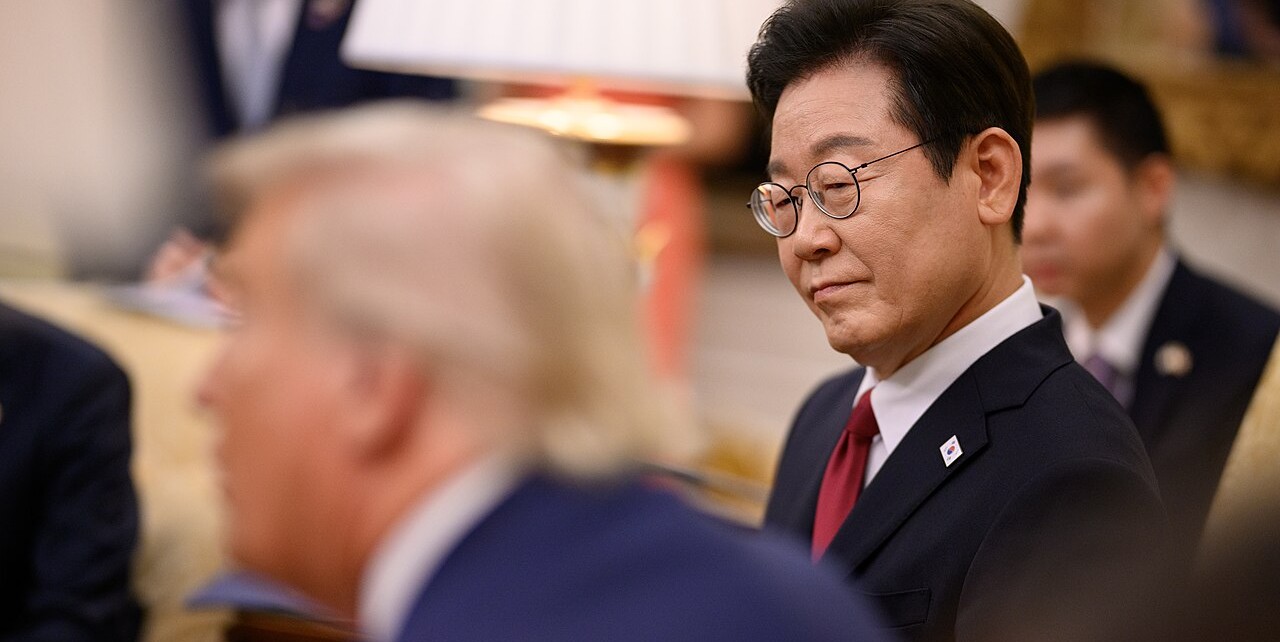
The White House / Wiki Commons
This article was first published by Hankyoreh on 23 March 2026 and is republished with permission.
Stoking groundless anxiety about the Korean Peninsula becoming the next target of a US military operation helps no one.
After a joint American and Israeli bombing campaign against Iran eliminated Ayatollah Ali Khamenei, the country’s supreme leader, certain media outlets in the West have been running sensational stories speculating that US President Donald Trump’s next target, after devastating Iran, may be North Korean leader Kim Jong-un.
Jang Dong-hyuk, the leader of South Korea’s opposition People Power Party, even blustered that the war against Iran is “a preview of the future awaiting Kim Jong-un in North Korea.” Such remarks suggest the Korean Peninsula might be the next battlefield.
Such rumourmongering elicited a direct rebuke from South Korean President Lee Jae Myung. “Some people out there are apparently saying some weird stuff about ‘North Korea being next.’ What would we have to gain from undermining peace and stability on the Korean Peninsula?”
Lee’s position is worth taking seriously for four reasons.
First, North Korea is not Iran. Pyongyang has nukes; Tehran does not.
North Korea has between 50 and 100 nuclear warheads, as well as ballistic missiles capable of striking South Korea, Japan, Guam and even the US mainland.
But Iran has neither nuclear warheads nor the intercontinental ballistic missiles (ICBMs) that could deliver them to the continental US.
That means North Korea and Iran are in different leagues in terms of their nuclear counterstrike capability. No wonder the US treads more carefully with the North.
North Korea and Iran also exhibit marked differences in their domestic politics. The US and Israel’s military action against Iran is driven by the belief that pounding Iran’s leadership through military strikes could lead to regime change through a mass uprising of the Iranian people.
But as the most recent congress of the Workers’ Party of Korea shows, Kim has a firm grip on North Korea, which has a high level of internal cohesion. If anything, American-style blustering and pressure campaigns would only reinforce the Kim regime.
Second is the absence of a country ready to step into Israel’s shoes.
Some say that Israel and its leader, Prime Minister Benjamin Netanyahu, are the prime movers behind the war against Iran. When Joe Kent recently stepped down as director of the US National Counterterrorism Center, he said the entire reason the US had gone ahead with the war when Iran did not pose an immediate threat was because of enticement and pressure from the Israeli government and the pro-Israel lobby in the US.
That claim was backed up by US Secretary of State Marco Rubio’s remarks about the US military acting preemptively, given its knowledge of Israel’s plans to attack.
But when it comes to North Korea, there’s no country available to play Israel’s role of ‘bad cop’, nor is there a powerful lobby inside the US pushing for regime change in the North.
Significantly, Lee Jae Myung—who calls for peace on the Korean Peninsula—would oppose unilateral American military action against North Korea even more vigorously than President Kim Young-sam did when former US President Bill Clinton considered strikes against North Korea in May 1994. And one struggles to imagine a military operation against North Korea without cooperation from the South Korean military.
The third reason is differences in the geopolitical environment.
Iran is in a grave geopolitical bind. The Sunni Arab states, under the leadership of Saudi Arabia, are part of an anti-Iranian coalition, and only one regional power (Turkey) even maintains neutrality. Both China and Russia are friendly with Iran, but they cannot actively aid Iran given concerns about how the US might respond.
North Korea is in quite a different position. For one thing, neither South Korea nor Japan want war with North Korea.
Russia and China would also respond differently to American action against North Korea than they have in Iran. Russia has had a de facto military alliance with North Korea since the two countries signed a new treaty in June 2024, and North Korea still has its friendship treaty with China.
So if the US were to attack North Korea, China and Russia—both of which are opposed to changing the status quo on the Korean Peninsula by overthrowing the North Korean regime—would almost certainly intervene militarily. That’s sure to give the US pause.
The final reason is that the US likely lacks the ability to prosecute two major wars, either simultaneously or sequentially, in the Persian Gulf and on the Korean Peninsula. For a variety of reasons, including defence costs, military capacity and public support, Trump is unlikely to select North Korea as his ‘next target’.
It’s estimated that the US is spending US$890 million each day on its war against Iran. The Pentagon has reportedly asked for its budget to be raised by US$200 billion, but that’s unlikely to happen.
Less than 30% of Americans support the US and Israel’s war against Iran. So under the current circumstances, it wouldn’t be easy to begin yet another war with North Korea.
There’s another factor: Trump has a high degree of distrust for the Iranian leadership, and the US has taken the radical step of launching military strikes in the midst of negotiations with Iran, not once but twice.
At the same time, Trump has worked to maintain a personal relationship with Kim over the years and has repeatedly emphasized his willingness to reopen negotiations without preconditions. That leaves room for dialogue and diplomacy.
Given all these factors, there seems little chance of North Korea becoming the next Iran. As Lee suggested, be careful of what you wish for—it’s unhelpful to stoke groundless anxiety about the Korean Peninsula.
The variable here is North Korea. It’s essential for Pyongyang to actively engage in dialogue with the US while refraining from words and actions that might give American hard-liners an excuse for military action.
Related articles:
Tehran, Caracas… Why Not Pyongyang? (3-minute read)
Iran War Unravels U.S. Strategy and Strengthens Russia China Axis (3-minute read)
The US: Good at Starting but Bad at Ending Wars (3-minute read)
The Author

Related Articles
March 28, 2026
Tehran, Caracas… Why Not Pyongyang?
Policy Brief No. 425John Delury
View more
March 28, 2026
Iran War Unravels U.S. Strategy and Strengthens Russia–China Axis
Policy Brief No. 431Jordan Ryan
View more
March 28, 2026
The US: Good at Starting but Bad at Ending Wars
Policy Brief No. 429John Delury
View more