Takaichi and the New Sino-Japanese Cold: When History Becomes the Amplifier
Ria Shibata
April 15, 2026
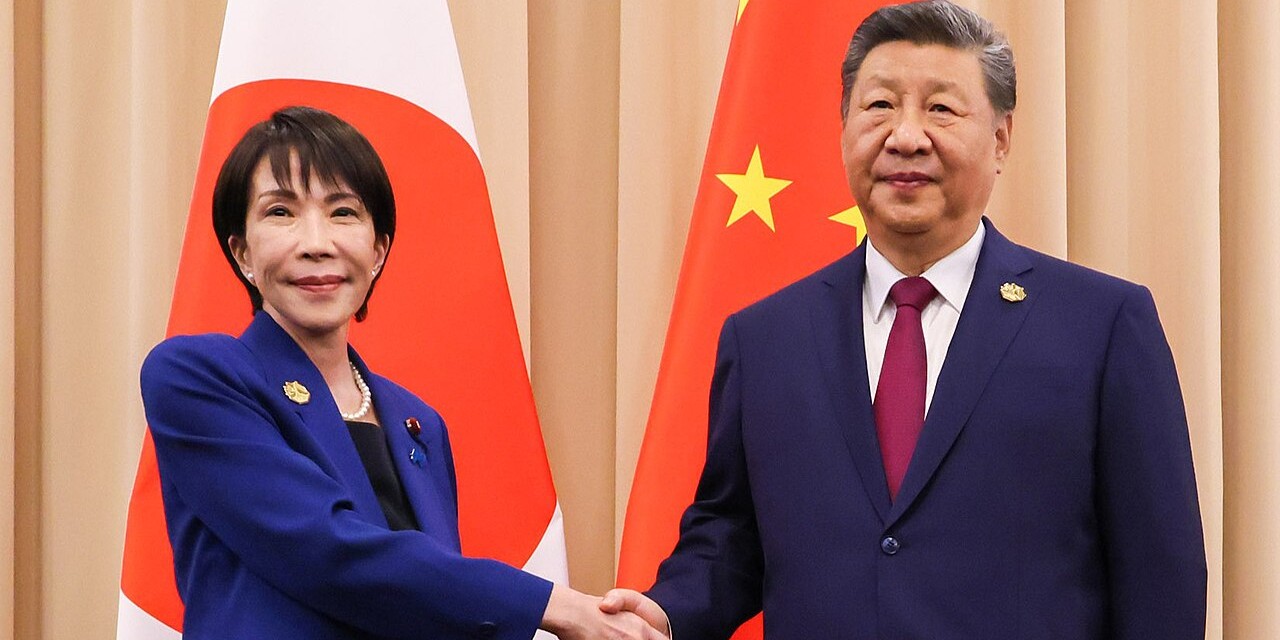
Image: Prime Minister's Office of Japan - Wiki Commons
Japan’s landslide election of Prime Minister Sanae Takaichi has not created a new crisis with China—it has revealed that the old one never healed. History, ignored for decades, is back at the centre of Asia’s most consequential rivalry. And a generation raised on social media is making it more combustible.
When Takaichi declared in November 2025 that Chinese naval action against Taiwan could constitute a “survival-threatening situation” for Japan—implying possible Self-Defense Force intervention—she did not cause a diplomatic crisis. She named one already underway. What followed was a portrait of structural breakdown: Beijing reimposed its ban on Japanese seafood imports, urged citizens to avoid Japan, and halted performances by Japanese entertainers. In December 2025, Chinese military aircraft twice directed fire-control radar at Japan Air Self-Defense Force jets over international waters near Okinawa. Then came February 2026’s election, delivering Takaichi’s Liberal Democratic Party a supermajority in the lower house for the first time in Japan’s postwar history. The Japanese public, in effect, endorsed the confrontation.
Analysts have characterised what is emerging as a ‘managed rivalry’—trade and diplomatic channels persist, but the underlying logic has shifted from coexistence to competition. Japan and China are too economically intertwined to sever ties cleanly; Japanese investment remains significant for a Chinese economy showing signs of structural fatigue. But beneath continued bilateral trade lies cold strategic calculation, periodic economic coercion, and military incidents designed to test each other’s resolve. This is not a freeze; it is a new baseline.
To understand why this is not simply another cyclical row over the Senkaku/Diaoyu islands, one must reckon with history. Japan’s occupation of much of Asia between 1941 and 1945 was brutal in ways that have never been mutually processed. The problem is not merely that China remembers and Japan prefers to move on. It is that Takaichi represents a strand of Japanese conservatism that does not fully accept the premise that there is something to move on from. Her documented desire to visit Yasukuni Shrine—which enshrines Class A war criminals alongside Japan’s war dead—is not an eccentricity. It is a statement of identity. So too are her intentions to revise Japan’s pacifist constitution and reconsider the three non-nuclear principles.
This agenda to normalise Japan as a state reinforces Beijing’s argument that Japan never truly reckoned with its imperial past, and that its postwar pacifism was an American imposition rather than a genuine moral transformation. The LDP’s supermajority reads in Beijing not as a democratic mandate for security realism, but as confirmation that Japanese militarism was dormant, not dead. History here is not merely a rhetorical resource. It is constitutive of how both societies understand their national interests and each other. When Chinese aircraft direct radar at Japanese jets, they communicate, within a domestic context saturated with historical grievance, that China will not be intimidated by a country it regards as unrepentant. The historical wound is not background noise. It is the amplifier through which every signal passes.
What makes the current moment distinctively volatile is the role of the generation that delivered Takaichi her supermajority. Japan’s younger voters did not form their threat perceptions of China through diplomatic communiqués. They formed them through social media: viral footage of Chinese coast guard vessels harassing Japanese fishing boats near the Senkakus, looping clips of PLA naval exercises, algorithmically curated feeds that have made Chinese military assertiveness a fixture of daily digital life. Stripped of diplomatic context and consumed by audiences with limited exposure to Sino-Japanese interdependence, these images function less as information and more as identity formation. China becomes not a rival with whom Japan has complicated but manageable relations, but an existential adversary —visually immediate and perpetually threatening.
The danger is not that young Japanese are wrong to perceive China as a strategic challenge— the radar incidents, the seafood bans, and the harassment of vessels all justify serious concern. The danger is that an ‘us versus them’ identity conflict, hardened through algorithmically reinforced threat imagery, leaves little room for the graduated de-escalation that managing a rivalry with a nuclear-armed neighbour requires. When national identity is at stake, compromise looks like capitulation and restraint looks like weakness. Two generations absorbing strategically selected images of each other’s military power and historical sins, with decreasing exposure to the economic and human ties that give both sides reason for restraint: this is a recipe not for managed rivalry, but for popular pressure that forces governments into corners from which they cannot exit gracefully. The asymmetry matters: Japanese users face commercially driven algorithms that reward outrage, while their Chinese counterparts encounter state-curated feeds where political gatekeeping and algorithmic amplification combine.
The United States has managed to be simultaneously indispensable and unreliable. Trump’s softening toward Beijing—motivated by a prospective trade deal and planned state visit— has created space for China to apply harder pressure on Japan. Reports that Trump privately urged Takaichi to avoid further escalation will not have escaped notice in Beijing.
Takaichi faces a genuine dilemma. She has a historic mandate and the political capital to pursue constitutional revision and deeper security integration. But the path she is on— security assertiveness unaccompanied by credible historical engagement—risks proving China’s narrative right. Every step toward remilitarisation not paired with genuine reckoning with the past gives Beijing more ammunition for its claim that Japan’s transformation was always a fiction.
There is an urgent task that falls not only to governments but to societies: to cultivate in younger generations a threat perception that is measured and conflict sensitive—one that does not foreclose the diplomatic and economic interdependencies that have defined fifty-three years of post-normalisation coexistence, and that has been oriented toward tension reduction rather than confrontation. Social media will not do this work; its incentive structures run in precisely the opposite direction. The managed rivalry that analysts describe as the optimal achievable outcome depends, in the end, on both sides retaining the will to manage it.
Related articles:
China–Japan Relations in a New Normal: Insights from China (3-minute read)
Strategic Stability without Illusions: Rethinking Taiwan in an Era of Coercion and Constraint (3-minute read)
Japan Stumbles: The Taiwan Fiasco (3-minute read)
