Regime Change – Sometimes It Works, Often It Doesn’t
Herbert Wulf
April 1, 2026
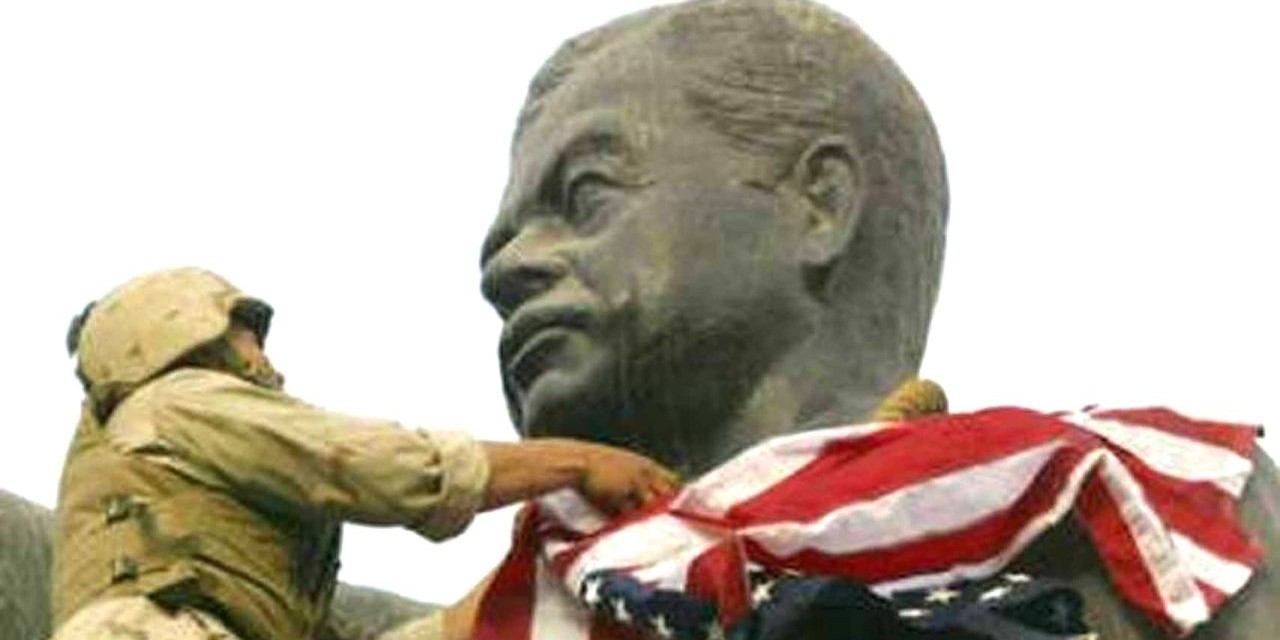
Image: US Department of Defense / Wiki Commons
Donald Trump ran on a platform of ending wars. After his success in Venezuela, he is intoxicated by his military achievements and is banking on regime change in several countries.
In a swift and decisive move, US forces abducted Venezuelan leader Nicolás Maduro and his wife to the United States. The current government in Caracas has little choice but to largely submit to Washington’s dictates. Trump’s motives for the war against Iran remain unclear, partly because the US president has cited various reasons: to finally destroy the Iranian nuclear program, to end the Iranian threat to the Middle East, to support the Iranian people, and to overthrow the terrible regime in Tehran. He remains vague about his reasoning and seems to make off the cuff suggestions for regime change. Trump had a lofty idea at how he envisions the end of this war. He has suggested “unconditional surrender,” followed by his personal involvement in the selection of a successor: I must be involved in picking Iran’s next leader.
The swift victory against Iran failed to materialize, an end to the war is not in sight, and a new leader has been chosen without Trump’s involvement. The structures of the mullah regime appear so entrenched that the anticipated regime change following the rapid decapitation of the leadership did not occur. Yet Donald Trump had proclaimed: “What we did in Venezuela is, in my opinion, the perfect, the perfect scenario.” The Atlantic calls this attitude a “hostile corporate takeover of an entire country”. Now the US government expects Cuba to surrender. “I think I could do anything I want” with Cuba, Trump declared, now that the island is virtually cut off from energy supplies and its economy is in ruins. He is demanding the removal of Cuban President Diaz-Canel.
In the business world hostile corporate takeovers sometimes work, sometimes they fail. Similarly with Trump’s idea of swift government surrenders. In the case of Iran, he was misguided by the Wall Street playbook. Irresponsibly, he called on Iranians to overthrow the government before the bombing campaign started. Regime change in Iran has now been forgotten and Trump is agnostic about democracy. He is interested to get the oil price down and the stock market up.
Lessons from the past
The concept of regime change—replacing the top of the government to install one more agreeable to the US—is not new to US foreign policy. Proponents of regime change usually point to Japan and Germany as positive examples of successful democratization. Often, however, the goal is not, or at least not primarily, democratization, but rather the installation of a government that is ideologically close to the US or amenable to them. But the “Trump Corollary”, as explicitly stated in the National Security Strategy to enforce the Monroe Doctrine, is not new either. In reality, it was already the Kennedy, Nixon, Reagan, and Bush doctrine.
Both Trump’s idea of regime change and his rigorously pursued territorial ambitions (Canada, Greenland, the Panama Canal) are reminiscent of the Monroe Doctrine of 1823, particularly the version of this doctrine expanded by President Roosevelt in 1904. This doctrine legitimized American interventions in Latin America. At the beginning of the 20th century, the US intervened in numerous Latin American countries in ‘its backyard’, using military and intelligence means: in Colombia, to support Panamanian separatists in controlling the Panama Canal; repeatedly in the Dominican Republic; they occupied Cuba from 1906 to 1909 and intervened there repeatedly afterward; in Nicaragua during the so-called ‘Banana War’, to protect the interests of the US company United Fruit; in Mexico, as well as in Haiti and Honduras.
The New York Times recently suggested that Trump’s current enthusiasm for regime change is most comparable to that of Dwight D. Eisenhower. During his two terms in office from 1953 to 1961, the once coldly calculating general allowed himself to be seduced into a downward spiral from one coup to the next. In 1953, the US succeeded in overthrowing the elected Iranian Prime Minister Mohammad Mossadegh with Operation Ajax. Mossadegh wanted to nationalize the British-owned oil industry. The coup succeeded with CIA support. The US installed the Shah as its puppet. He ruled with absolute power until the so-called Iranian Revolution and the dictatorship of Ayatollah Khomeini in 1979. After the successful overthrow of the government in Iran, Eisenhower decided to intervene in Guatemala. The elected president, Jacobo Árbenz Guzmán, who initiated far-reaching land reform laws, was overthrown in a coup d’état in 1954 and replaced by the pro-American colonel, Castillo Armas.
During this period, the US government also formulated the so-called domino theory, which aimed to prevent governments, particularly in Asia, from aligning themselves with the Soviet Union. The assumption was that if one domino fell, others would follow. It was during this time that the costly war in Korea ended in an armistice. Therefore, countries like Vietnam, Laos, Burma, Indonesia, and others were on Eisenhower’s domino list. However, the destabilization campaigns carried out by the CIA sometimes had the opposite effect. Governments in Indonesia and Syria emerged strengthened from the interventions. Eisenhower left Kennedy with the loss of American influence in Cuba. The failed Bay of Pigs invasion in April 1961, intended to overthrow Fidel Castro, was the starting point for the decades-long blockade of Cuba, which Trump is determined to end now through regime change.
The most dramatic example of failed regime change in recent history is undoubtedly the Iraq War, which began in 2003 under President George W. Bush. The stated goal was to remove Saddam Hussein from power and destroy his weapons of mass destruction. The war led to the overthrow of the regime. The United Nations and US teams found no weapons of mass destruction despite intensive on-site investigations. Attempts to establish an orderly state in Iraq failed. These experiences, and especially the disastrous outcome of two decades of military intervention in Afghanistan, discredited the concept of regime change.
What are the implications?
The most important lesson taught by efforts to affect externally forced regime change is that interventions often lead to crises that were ostensibly meant to be prevented or solved. The temptation was too great for Trump to miss the opportunity to depose the despised Maduro government.
Scholarly studies of the numerous attempted regime changes and democratization efforts reveal three key findings. First, simply removing the government from power (whether through assassination, as in the case of Saddam Hussein in Iraq or now in Iran, or through kidnapping as in Venezuela) is insufficient, as such actions often lead to chaos, state collapse, or even civil war. Thus, it will be interesting to watch further developments in Venezuela, Cuba, and Iran.
A second lesson from empirical studies of regime change is that democratization is more likely to succeed if democratic experience already existed in the country. However, this is often not the case.
Finally, if the real goal is democratization (and not just to secure spheres of influence or oil supplies etc.), it is far more promising not only to hold elections (as in Afghanistan, for example), but to renounce violence and initiate a long-term program with development aid and support for civil society.
Whether the US government will be impressed by these findings, or even acknowledge them, is doubtful. Currently, the American president is euphoric, despite the strong reaction from the Iranian government which he, surprisingly, did not expect. His promises to end the senseless wars and not start any new ones, however, seem to have been forgotten.
Related articles:
The US: Good at Starting but Bad at Ending Wars (3-minute read)
Failure of US–Iran Talks Was All Too Predictable — But Turning to Military Strikes Creates Dangerous Unknowns (3-minute read)
The ‘Donroe Doctrine’ (3-minute read)
The Return of the Ugly American (3-minute read)