Greenwashing European Weapons Production
Herbert Wulf
May 15, 2026

Image: Dreamer Light / shutterstock.com
Stocks in the European arms industry are soaring. Arms manufacturers—once publicly shunned as the ‘pariahs’ of the industrial sector—have become investors’ favourite industry in the wake of Russia’s aggression against Ukraine. Even ESG (environmental, social, and governance) investments are now geared towards armaments.
When SIPRI announced in late April that global military spending had risen to USD 2,887 billion in 2025—the highest figure ever recorded—the media reported worldwide on the news. Military spending has increased in every single one of the last 11 years. A noteworthy fact: the largest increases (14 per cent) were recorded in Europe last year.
The full-scale Russian invasion of Ukraine in February 2022 has led to an unprecedented surge in rearmament—not only in Russia and Ukraine, but all over Europe.
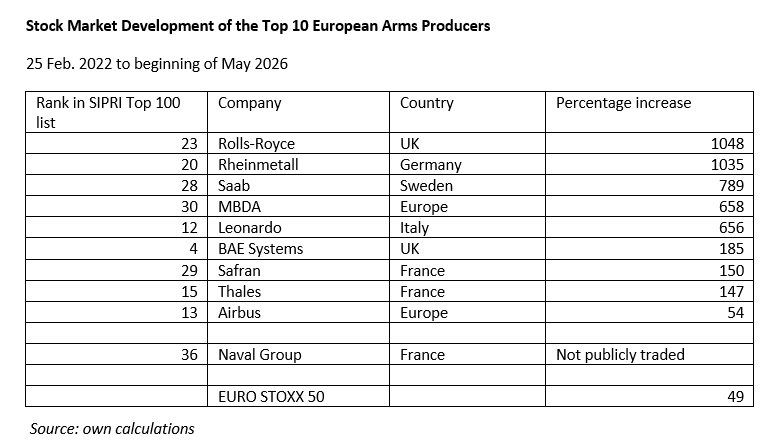
Meanwhile, the order books of the defence industry are full. The share prices of publicly listed arms companies have soared to unprecedented heights. Finance-focused media speak of significantly rising stock prices and label the major arms producing firms as ‘top performers’. The stock market price performance of the ten largest European defence companies—nine of which are publicly traded—confirms this assessment. Although prices have recently dipped slightly following the outbreak of the war in Iran, Rolls-Royce (UK) and Rheinmetall (Germany) lead the pack with share price gains exceeding 1,000 percent since 2022. Eight of these companies have outperformed the general market trend (the EURO STOXX 50, the leading stock index for the Eurozone) by a wide margin.
Greenwashing
So-called sustainable investments in the arms industry have increased significantly in recent years. In a study by Voxeurop, the authors Giorgio Michalopoulos and Stefano Valentino estimate that the €50 billion mark will be surpassed in 2025. The term ‘sustainable’—which is also applied to financial products—takes into account not only financial indicators but also aspects aimed at environmental responsibility, social justice, and good corporate governance. Consequently, investments classified as sustainable—for instance, in weapons or coal—were previously excluded.
These criteria for investment are now being watered down for the European arms industry. Three key actors are instrumental in this process: the defence industry and its associations, the EU Commission, and the financial sector.
The arms industry had already criticized ESG criteria prior to the Russian invasion. In a statement issued in October 2021, the Aerospace, Security and Defence Industries Association of Europe emphasized the unique sustainability of its products: “There exists an inseparable link between sustainability and defense: defense is a crucial component of security, and security constitutes the prerequisite for peace, prosperity, international cooperation, as well as economic and social development.” The association cites Goal 16—”Peace, Justice, and Strong Institutions”—of the United Nations’ SDGs as its reference.
Arms producers recognized long ago that they must cultivate an image as a clean, environmentally, socially, and ethically responsible industry. Germany’s largest arms firm, Rheinmetall, states on its website that “a focus on sustainability is an integral part of Rheinmetall’s strategy” and the company aims to achieve carbon neutrality by 2035. MBDA, Europe’s largest manufacturer of missiles and drones says: “By doing business responsibly, we support our people and the planet. Part of our mission is to always abide by the highest ethical and professional standards.” MBDA even established an ESG committee. Rolls-Royce announced: “In early 2021, we launched our pathway to Net Zero, setting out our near-term actions to achieve net zero by 2050 at the latest.”
The second key protagonist driving the trend toward opening up the defence industry to green and sustainable investments is the European Commission. In October 2023, it published in the Official Journal of the EU, that the Commission considers it necessary to ensure access to finance and investment—including from the private sector—for all strategic sectors, and particularly for the defence industry, which contributes to the security of European citizens.
The financial sector itself is also showing significant interest, as the defence industry promises profitable investments. In 2024, the German Investment and Asset Management Association (BVI) amended its regulatory framework for sustainable financial products. The reason—according to Manager Magazin—was the shifting geopolitical landscape. “Until that time, investments in companies deriving more than 10 percent of their revenue from the manufacture or sale of defense goods had been prohibited. Since December 2024, however—according to the BVI—only investments in manufacturers of weapons outlawed under international law remain forbidden.” In other words: producers of anti-personnel mines, cluster munitions, chemical and biological weapons are not targeted. All other armaments—nuclear weapons and artillery, warships and combat aircraft, drones and missiles, tanks and rifles—are thereby declared sustainable. Now, even savings of small European investors can be directed into the arms industry with a green conscience.
As research by Voxeurop reveals, the bulk of green capital destined for the arms industry flows to the largest corporations, over four billion euros each in 2025 for Safran, Rolls-Royce, Rheinmetall, and Airbus. Investments in the defence sector appear to be so profitable that it flows not only to established firms, but also to startups. Even non-defence established industrial sectors, for instance, automotive manufacturers, unsettled by recent market turbulence, move into arms manufacturing. While VW is still pondering whether to produce the Israeli Iron Dome defence system at its plant in Osnabrück, Germany, the French automobil company Renault has started to produce military drones.
In contrast to the past, jobs for employees in the defence industry are now highly sought after. Salaries are excellent, job security appears assured, and trade unions and works councils—which once advocated for a shift to civilian production and even submitted their own conversion plans—are today betting entirely on arms manufacturing. The defence industry is now suddenly deemed ecologically, socially, and ethically unproblematic. This greenwashing needs to be exposed.
Other articles from this author:
Islamabad in the Spotlight, New Delhi Sidelined, Beijing in the Background (3-minute read)
Regime Change – Sometimes It Works, Often It Doesn’t (3-minute read)
NATO is Falling Apart; the EU is Faltering – Good! (3-minute read)
Department of War: George Orwell Would Feel Validated (3-minute read)