The US: Good at Starting but Bad at Ending Wars
John Delury
March 17, 2026
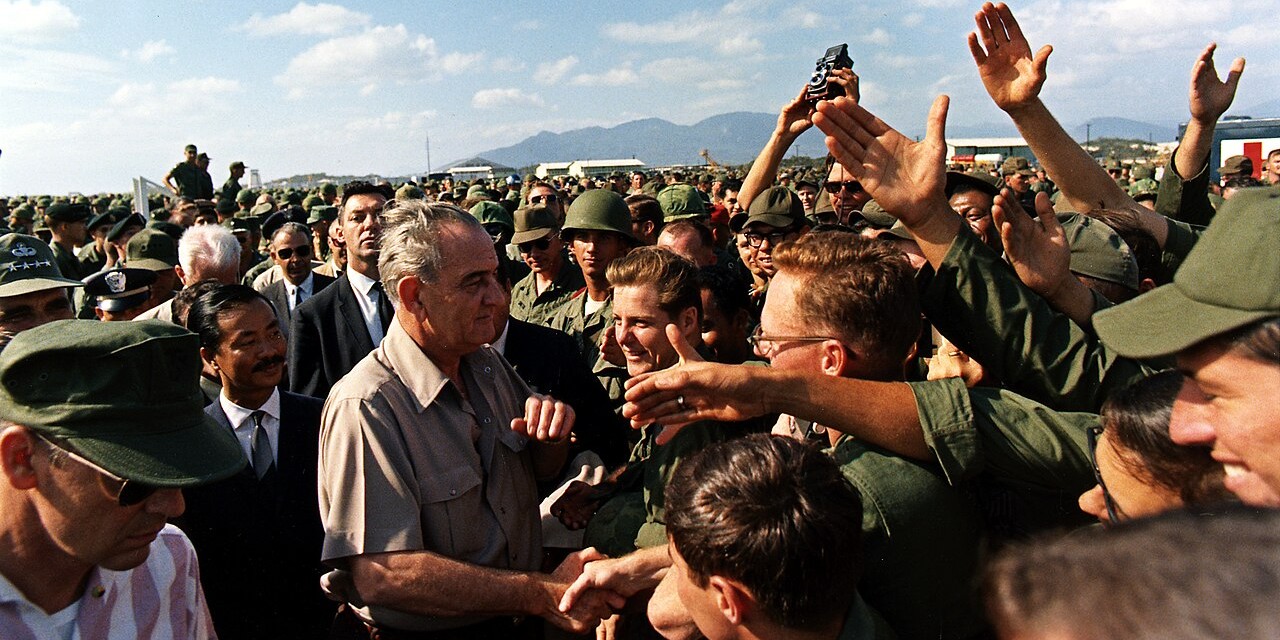
Image: President Lyndon B. Johnson meets troops in Vietnam, 1967 Source: Wiki Commons
As the geopolitical centre of gravity swings violently back to the Middle East, the Asia Pacific seems to have slipped back into the shadows of global media attention. But observers here are anxiously trying to figure out what the Iran War means for the region. If history is any guide, we are just at the beginning of Donald Trump’s ‘little excursion’, and US allies and adversaries should be preparing for a long haul. Removing weapons from Korea, deploying troops from Japan, and delaying a summit in China are just the tip of the iceberg.
———–
The first big headline pertaining to Korea in two weeks of US war with Iran was a report in The Washington Post mentioning that the US military was removing the THAAD [Terminal High Altitude Area Defense] missile defense system from its home in the little town of Seongju—presumably to defend US assets or allies from Iranian missile attacks.
But it was hard to know if this was a one-off or the canary in the coalmine in the absence of clear messaging from US authorities, giving rise to THAAD Watch here in South Korea. Keep in mind there’s been considerable local opposition to the deployment, so footage of launchers leaving Seongju was a cause of celebration in some quarters. President Lee Jae-myung went on record saying he opposed removal—ironic since his liberal party has been unenthusiastic about THAAD due to the damage it did to South Korea’s relations with China. More recent THAAD Watch footage suggested one launcher returned to the golf course. Then satellite sleuth Jeffrey Lewis surmised three of the six launchers were there. Ah, the fog of war.
Japan made headlines next with a more definitive development— a confirmed report that the US was moving the 31st Marine Expeditionary Unit from its base in Okinawa to the Middle East for an unspecified role supporting the war in Iran. As with Seongju, there is considerable local opposition to the huge military presence in Okinawa—indeed, a US–Japan agreement calls for the US to lighten its footprint on the island by relocating about half of the 18,000 Marines stationed there. But the sudden announcement sent small shockwaves.
Finally, after the bombardment of Kharg Island, Trump encouraged East Asia’s big three—China, South Korea and Japan (along with France, the UK, and ‘others’)—to send War Ships to the Strait of Hormuz. It was a strange request, putting Beijing, Seoul and Tokyo in the same boat and asking them to join US-led gunboat diplomacy. Trump then threatened to delay his upcoming state visit to Beijing if China did not comply. He subsequently confirmed he would delay by a month or so, dropping the threat. “Because of the war, I want to be here,” Trump told reporters.
Taken together, these developments are enough to raise the question: Are we witnessing the end of the Pivot to Asia? Should US allies feel yet more urgency to accelerate contingency plans for ‘strategic autonomy’? Will US adversaries feel emboldened in taking advantage of gaps, cracks, and vacuums as Washington retreats from the Indo Pacific?
Or are these just temporary, tactical adjustments as Trump tries to do it all: fight a full-scale war in the Middle East, bomb targets in Africa, remove a leader in Venezuela (Cuba next?) and blow up ships in Latin America and the Caribbean… all while bolstering defense across the Indo-Pacific to contain China’s rise, starting with protecting Taiwan [it’s unclear where supporting Ukraine in its war against Russia falls on this list].
Trump’s request for a 50 per cent increase in defense spending next year to 1.5 trillion dollars indicates his plan is indeed to do it all—imperium sine fine. But will Congress go along with Trump’s proposal for the largest increase in the Pentagon budget since the Korean War? What if his party loses control of Congress in the November elections, and unpopularity of the Iran War contributes to that defeat. Can the United States really afford to maintain this level of what looks like “imperial overstretch,” in the phrase of Paul Kennedy?
———–
As with every war, much depends on when and how it ends. A dizzying array of political and military conditions in and around Iran could satisfy Trump’s fluid definition of victory. If he declares “mission accomplished” relatively soon, maybe the surge ends and assets flow back, like blood returning to its natural flow after an inflammation is resolved.
But does Trump really control when the conflict ends?
The lessons of history here do not bode well for the United States. Trump would hardly be the first president to find himself stuck in a war that either he or the American public or both wanted over a long time ago.
Harry Truman made the pivotal decision to go all-in to defend South Korea against the North Korean invasion in June 1950… but Truman wanted out by the following summer, when negotiations with the Chinese and North Koreans began, to no avail. Dwight Eisenhower won the election in November 1952 in part by promising (vaguely) to end the unpopular war in Korea, but it took him six painful months, he got an armistice not a peace treaty, and the US was stuck with a huge military and financial commitment to South Korea. Korea was the original ‘forever war’—and still hasn’t ended, as Kim Jong Un likes to remind us.
Next was Lyndon Johnson, who wanted out of the conflict in Southeast Asia he inherited from Ike and JFK but found himself sinking deeper into the quagmire. Last week was the 61st anniversary of LBJ’s decision to send the 9th Expeditionary Marine Brigade to land in Danang. To mark the occasion, the Council of Foreign Relations reminded members that diplomatic historians voted this the second worst decision in the history of US foreign policy.
The Vietnam War destroyed Johnson’s presidency but did not end with it. The war continued as the albatross around the neck of President Nixon, who, like Eisenhower with Korea, was elected in part to end the war (“peace with honor”). But it took Nixon and Kissinger four years to get a peace deal, and two years later North Vietnam swallowed up the South and united the country under a communist government.
No two words would haunt the George W. Bush presidency like the banner declaring victory in Iraq, “mission accomplished.” Barack Obama won the presidency in part to end the deeply unpopular war in Iraq. Donald Trump won the first time around in part by tapping into deep discontent that the ‘forever wars’ were still ongoing. When Joe Biden at long last withdrew US troops from Afghanistan, he was pilloried for the way it happened, and after twenty years, the Taliban were back in power.
It might be fair to say as a rule of thumb the United States is good at starting wars but bad at ending them.
———–
History suggests when the Iran War ends will not be up to Trump—not as much as he thinks, anyway. The longer it continues, the more that second order effects will be felt here in East Asia. In the short run, Japanese Prime Minister Takaichi heads to Washington soon and presumably will try to stem the bleeding and revive confidence in the US–Japan alliance. But Trump’s desire to delay his China trip sends a clear message to the region that Washington has a serious bandwidth problem. In the long run, it will be hard for US allies and adversaries to believe that a protracted war with Iran does not mean a diminished American presence in the Asia Pacific.
Related articles:
Tehran, Caracas… Why Not Pyongyang? (3-minute read)
North Korea Searches for a Path Out of International Isolation (3-minute read)
When Destruction Becomes Policy: What the Munich Security Report Reveals About the Future of Global Governance (3-minute read)
International Law Meets an Age of Impunity (3-minute read)
Venezuela and the UN’s Proxy War Moment (3-minutre read)