Iran War Unravels U.S. Strategy and Strengthens Russia–China Axis
Jordan Ryan
March 24, 2026
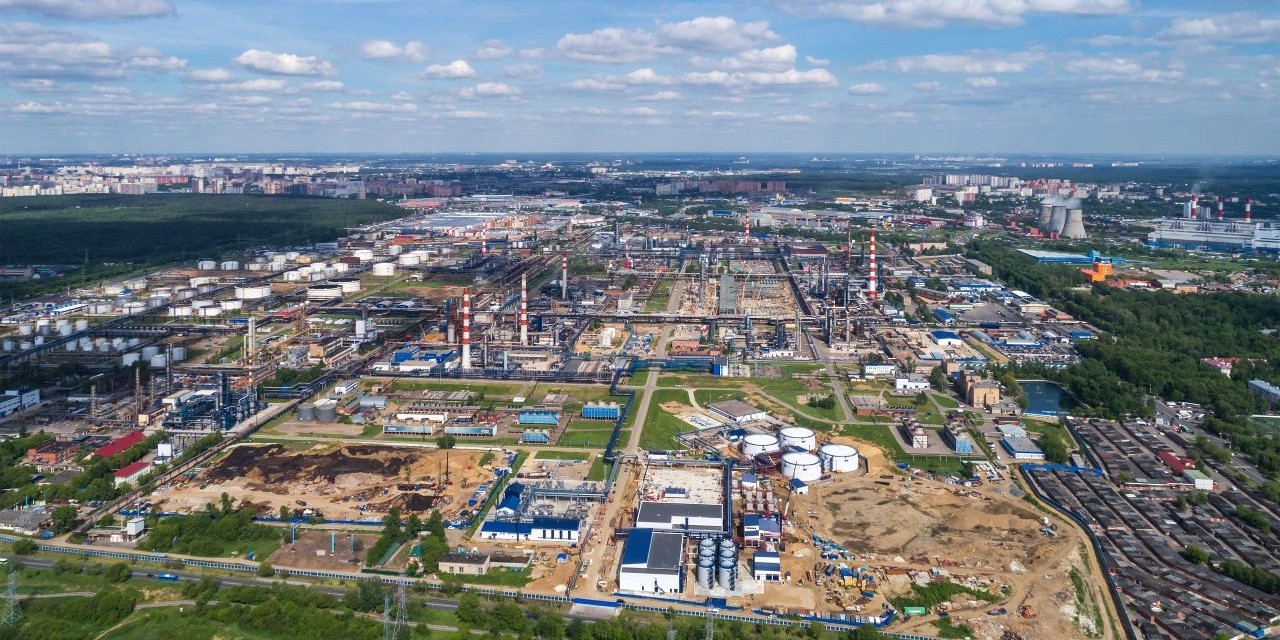
Image: Oil refinery in Kapotnya, Moscow – A.Savin, Wiki Commons
The Iran war is not a discrete military event. It is a systemic rupture that accelerates regional destabilisation, undermines United States strategic coherence, and deepens global fragmentation. The more consequential effect is strategic. The war is accelerating the consolidation of the Russia–China partnership, reversing a half-century of American grand strategy.
‘Unravelling’ here does not mean the absence of power, but the erosion of a strategic principle that once structured its use. From Nixon and Kissinger’s opening to China through Reagan’s management of late Cold War dynamics, a consistent principle held: the United States would seek to prevent a durable alignment between Moscow and Beijing. That principle shaped decades of strategic thinking. As recently as 2017, the United States National Security Strategy explicitly recognised China and Russia as distinct revisionist powers requiring management within a framework of great power competition.
Today, that architecture is under severe strain. This is not merely a loss of tactical advantage. It reflects the erosion of alliance structures and the loss of a coherent framework to prevent Sino-Russian alignment. The December 2025 US National Security Strategy treats China and Russia in isolation, offering no strategy to keep them divided.
The most visible beneficiary of the Iran conflict is Russia. The Russian economy, battered by Western sanctions and the immense costs of the war in Ukraine, was facing a precarious 2026. Russia built its federal budget on oil price assumptions of roughly $60 a barrel. Instead, the eruption of war in the Gulf sent Brent crude surging toward $120 a barrel. This windfall has rescued the Russian war budget, providing the Kremlin with the capital it needs to sustain its military operations in Europe.
Iran’s response to United States strikes follows a predictable logic: unable to match American firepower directly, Tehran escalates through proxy networks and maritime disruption in the Strait of Hormuz and Red Sea. This creates an immediate energy market shock and inflationary spillovers that disproportionately harm fragile economies in the Global South. For China, the world’s largest energy importer, this instability exposes a profound strategic vulnerability to maritime supply disruptions. In response, Beijing is accelerating its pivot toward secure, overland energy supplies from Russia.
What was once a relationship of cautious coordination is hardening into structured alignment, reinforced by energy interdependence, expanding defence cooperation, and increasingly coordinated diplomatic positions. Russia, possessing the world’s largest resource base, trades its hydrocarbons for Chinese capital, technology, and diplomatic cover. China’s 2026–2030 development blueprint, submitted to the National People’s Congress in March, reflects renewed momentum for projects such as the Power of Siberia 2 pipeline, underscoring Beijing’s desire to insulate its economy from Middle Eastern volatility.
The conflict is also serving as a demonstration of this emerging alignment. US officials say that Russia is providing Iran with satellite imagery and other intelligence on the locations of American warships and aircraft in the region. Iran’s Foreign Minister Abbas Araghchi did not deny this, stating in a televised interview that military cooperation with Russia and China still continues. Concurrently, while direct Chinese military involvement in the current fighting is not confirmed by Western intelligence, Beijing’s reported provision of advanced radar systems to Tehran underscores a deepening technological partnership. Russia is demonstrating that it can impose costs on the United States far beyond the borders of Ukraine. Beijing, meanwhile, is observing how United States carrier strike groups operate under fire, refining its own doctrines for potential conflicts in the Indo-Pacific.
By deepening confrontation with Iran while simultaneously relieving economic pressure on Russia, the United States is actively accelerating the alignment it has historically sought to prevent. The longer it remains engaged in the Middle East, the more time and space Moscow and Beijing have to consolidate their partnership. They frame their cooperation not as a marriage of convenience, but as a new model of major-power relations aimed at establishing a multipolar order. This narrative resonates deeply in the Global South, where perceptions of double standards accelerate the erosion of American legitimacy.
The United States must urgently reassess its strategic priorities. The current trajectory is fusing Russian resources with Chinese technological and industrial capacity. To reverse this, policymakers must pursue a negotiated exit from the conflict in the Middle East to stabilise global energy markets, apply targeted economic pressure to exploit the specific nodes where Russian and Chinese interests diverge, and clarify a strategic posture designed explicitly to prevent the consolidation of a Sino-Russian bloc.
The question is no longer whether this alignment is emerging, but how far it will go, and whether it can still be constrained before it becomes permanent.
Related articles:
Trump Comes Calling on Xi: Summit of the Strongmen? (3-minute read)
The US: Good at Starting but Bad at Ending Wars (3-minute read)
Trump’s China Trip: Aiming for Deliverables (3-minute read)
Failure of US–Iran Talks Was All Too Predictable — But Turning to Military Strikes Creates Dangerous Unknowns (3-minute read)
The Author

Related Articles
March 24, 2026
Trump Comes Calling on Xi: Summit of the Strongmen?
Policy Brief No. 430Andrew Scobell
View more
March 24, 2026
The US: Good at Starting but Bad at Ending Wars
Policy Brief No. 429John Delury
View more
March 24, 2026
Trump’s China Trip: Aiming for Deliverables
Policy Brief No. 427Zhiqun Zhu
View more